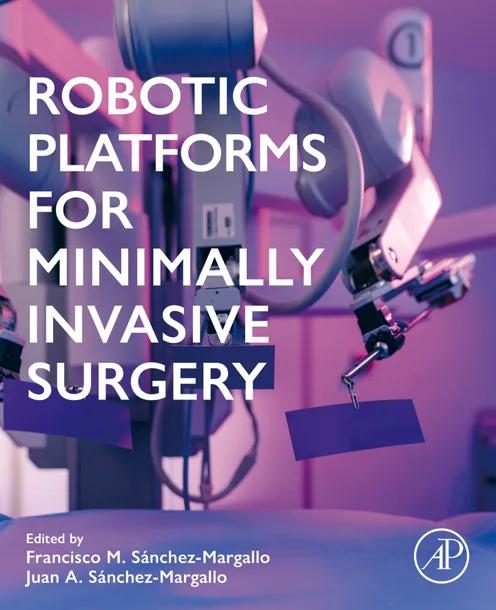
Robotic Platforms for Minimally Invasive Surgery
by Francisco M. Sánchez-Margallo, Juan Sánchez-Margallo
1st Edition
Publisher: Academic Press
Book Details
| Print ISBN | 9780443217333 |
| eText ISBN | 9780443217326 |
| Publisher | Academic Press |
| Publishing Year | 2026 |
| Edition | 1st Edition |
| Language | English |
| Pages | 660 |
Robotic Platforms for Minimally Invasive Surgery, 1st Edition, provides a concise reference detailing primary robotic systems used in minimally invasive surgical practice. The book offers practical guidance for surgeons, researchers, and healthcare professionals who are beginning to engage with robot-assisted procedures. It outlines core operational principles and technological frameworks across contemporary surgical settings.
The text examines established robotic platforms operating across laparoscopic, endoscopic, and microsurgical approaches. Specific surgical systems evaluated include the da Vinci SP, Versius from CMR, and the Hugo RAS platform. These evaluations examine system design features alongside practical clinical utility in operating environments.
Beyond hardware design, the volume outlines competency-based frameworks and technological integration in robotic surgery education. This focus provides targeted reference support for early-career professionals entering the field of robotic surgery.
Table of Contents
Chapter 1: Past, present and future of minimally invasive and robotic surgery
Chapter 2: Technical aspects of robotic platforms
Chapter 3: Multi-Arm Robotics
Chapter 4: Autonomy in cooperative robotic systems for MIS
Chapter 5: Autonomy in the operating room
Chapter 6: Ergonomic recommendations and challenges in robotic surgery
Chapter 7: The Role of Scientific Societies in Advancing and Standardizing Robotic Approaches: Insights from Thoracic Surgery
Chapter 8: The future of sustainable robotics for use in minimally invasive surgery
Chapter 9: Transforming Robotic Surgery Education: Competency-Based Frameworks and Technological Integration
Chapter 10: Impact and implementation of robotic surgery in a training surgery program using pathological obesity surgery as model
Chapter 11: Validation of the Marion portable virtual reality robotic surgical training platform
Chapter 12: The DaVinci SP Robotic System: Urologic applications
Chapter 13: Versius from CMR – the next generation robotic surgical system
Chapter 14: Enhancing Surgical Precision: The Role of the Versius Robot in Minimally Invasive Abdominal Surgery
Chapter 15: The Versius Robotic Platform: Design, Clinical Applications in Cholecystectomy and Future Directions
Chapter 16: Robotic surgery for rectal cancer using Versius robotic platform
Chapter 17: Avatera Robotic System. An interesting alternative
Chapter 18: The Hugo™ Robotic-Assisted Surgery Platform in Urology: Technical Characteristics and Early Clinical Outcomes
Chapter 19: Technical Performance and Clinical Implementation of the Hugo™ RAS System in Urologic Robotic Surgery
Chapter 20: Renal and Adrenal Surgery with the Hugo™ RAS System: Technical Execution and Early Outcomes
Chapter 21: Robotic Radical Cystectomy and Neobladder Reconstruction Using the Hugo™ RAS System
Chapter 22: Hugo RAS system in radical prostatectomy
Chapter 23: Emerging Innovations in Robotic Platforms for Laparoscopic Surgery: Telesurgery and Artificial Intelligence
Chapter 24: Robotic Platforms for Endoluminal Surgery
Chapter 25: Endorobots for Interventional Endoscopy: Design Challenges and Available Technology
Chapter 26: Current and emerging Robotic Platforms in Urology
Chapter 27: Single-Port Robotic Surgery in Urology: Present Applications and Future Perspectives
Chapter 28: From da Vinci to Versius: Transition Dynamics, Learning Curves and Implementation Strategies in Robotic Urologic Surgery
Chapter 29: Advances in Robotic-Assisted Urologic Surgery: Techniques, Outcomes and Future Directions
Chapter 30: Uniportal Robotic-Assisted Thoracic Surgery: Evolution, Current Practices and Future Innovations
Chapter 31: Robotic-Assisted Surgery for Anatomical Lung Resections: Techniques, Outcomes and Complex Cases
Chapter 32: Totally robotic lung transplant: a novel approach
Chapter 33: Robotic-Assisted Surgery for Benign and Malignant Esophageal Conditions: Techniques, Outcomes and Future Directions
Chapter 34: Robotic platforms for colorectal surgery
Chapter 35: Robot-Assisted Colposacropexy Using the Da Vinci® Surgical System
Chapter 36: Uterus transplantation - current and future developments by robotics
Chapter 37: Transoral Robotic Thyroidectomy (TORT): Techniques, Outcomes and Future Directions
Chapter 38: Robotics in Microsurgery and Supermicrosurgery
Chapter 39: The MicroSure MUSA Robot: Development, Clinical Validation and Future of Robotic Microsurgery
Chapter 40: Robotic Microsurgery with the Symani Surgical System: From Preclinical Insights to Clinical Applications
Chapter 41: Robotics in microsurgery: Preclinical studies
Customer Reviews
0.0
0 reviews
No reviews yet. Be the first to review this book!
Write a Review
Reviewed by GradeFocus Editorial Team
▶Research Sources (17)
- The future of sustainable robotics for use in minimally ...
- The MicroSure MUSA robot: Development, clinical ...
- Endorobots for interventional endoscopy: Design ...
- Robotic Platforms for Minimally Invasive Surgery
- https://lernerbooks.com/products/search_results?se...
- Study Aids Collection | Search
- Sign In - MyLibrary | Hal Leonard Online
- Robotic Platforms for Minimally Invasive Surgery - 1st Edition
- Sourcebooks, LLC.
- Searching the Catalog
- Robotic Platforms for Minimally Invasive Surgery - ScienceDirect.com
- Emerging robotic platforms for minimally invasive surgery - PubMed
- Robotic Platforms for Minimally Invasive Surgery - Backstory
- Robotic Platforms for Minimally Invasive Surgery - TGJones
- Emerging Robotic Platforms for Minimally Invasive Surgery
- Robotic Platforms for Minimally Invasive Surgery by - Paper Plus
- Robotic and Minimally Invasive Surgery | Department of Urology
Related Books
Biomechanics of the Human Spine
Fabio Galbusera

Emerging Diagnostic Glucose Sensing Approaches
Abhishek Kandwal

Engineering Nanoparticles for Biomedical Applications
Sulalit Bandyopadhyay
Soft Electronics for Diagnosis, Therapy, and Integrated Systems
Xinge Yu

Green Carbon Dots for Theranostic Applications
Hamed Barabadi
Human-Machine interfaces in Medical Robotics
Yanpei Huang