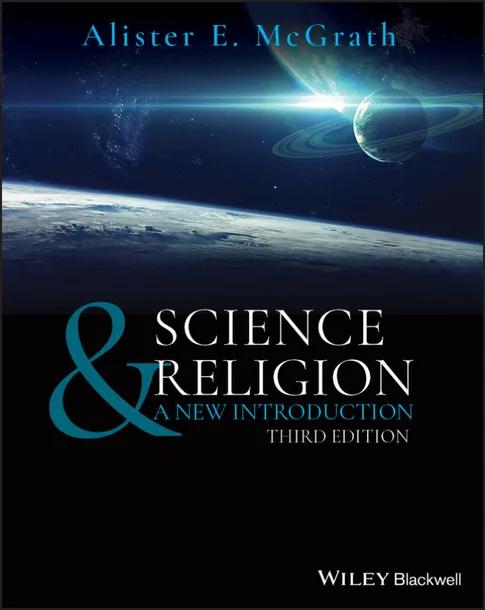
Science & Religion
A New Introduction
by Alister E. McGrath
3rd Edition
Publisher: Wiley-Blackwell
Book Details
| Print ISBN | 9781119599876 |
| eText ISBN | 9781119599869 |
| Publisher | Wiley-Blackwell |
| Publishing Year | 2020 |
| Edition | 3rd Edition |
| Language | English |
| Pages | 272 |
Science & Religion: A New Introduction, 3rd Edition, is an introductory textbook examining the relationship between scientific inquiry and religious thought. Drawing upon history, philosophy, the natural sciences, and theology, the volume explains how both disciplines address central questions across the centuries.
The text outlines foundational frameworks for relating the two fields, including Ian Barbour's models of conflict, independence, dialogue, and integration. It also traces key historical turning points, from the astronomical work of Copernicus and Galileo to Newtonian physics, Darwinian evolution, and modern Big Bang cosmology.
Designed for readers with minimal prior background in science or theology, this textbook supports undergraduate, graduate, seminary, church, and community courses, as well as independent general readers.
Table of Contents
Chapter Preface to the Third Edition: Preface to the Third Edition
Chapter 1: Science and Religion: Exploring a Relationship
- • Why Study Science and Religion?
- • The Chessboard: The Diversity of Science and Religion
- • Ian Barbour’s Four Models of the Relation of Science and Religion
- • Conflict
- • Independence
- • Dialogue
- • Integration
- • Four Ways of Imagining the Relation of Science and Religion
- • Science and Religion Offer Distinct Perspectives on Reality
- • Science and Religion Engage Distinct Levels of Reality
- • Science and Religion Offer Distinct Maps of Reality
- • The Two Books: Two Complementary Approaches to Reality
Chapter 2: Getting Started: Some Historical Landmarks
- • Why Study History?
- • Inventing the ‘Warfare’ of Science and Religion
- • The ‘Essentialist Fallacy’ about Science and Religion
- • Dispelling Myths about Science and Religion
- • The Importance of Biblical Interpretation
- • The Emergence of the Medieval Synthesis
- • Copernicus, Galileo, and the Solar System
- • Newton, the Mechanical Universe, and Deism
- • Darwin and the Biological Origins of Humanity
- • The ‘Big Bang’: New Insights into the Origins of the Universe
Chapter 3: Religion and the Philosophy of Science
- • Fact and Fiction: Realism and Instrumentalism
- • Realism
- • Idealism
- • Instrumentalism
- • Theology and Debates about Realism
- • Explanation, Ontology, and Epistemology: Research Methods and the Investigation of Reality
- • A Case Study in Explanation: Nancey Murphy on ‘Non‐Reductive Physicalism’
- • What Does it Mean to Explain Something?
- • Ontic and Epistemic Approaches to Explanation
- • Religion and Explanation
- • Philip Clayton on Explanation in Religion
- • How Do We Decide What is the Best Explanation?
- • ‘Logic of Discovery’ and ‘Logic of Justification’
- • Inference to the Best Explanation
- • A Case Study: Darwin and Natural Selection
- • Theory Choice and Religion
- • Verification: Logical Positivism
- • Falsification: Karl Popper
- • Theory Change in Science: Thomas S. Kuhn
Chapter 4: Science and the Philosophy of Religion
- • Science, Religion, and Proofs for God’s Existence
- • Traditional Philosophical Arguments for the Existence of God
- • Thomas Aquinas’s Five Ways
- • The Kalam Argument
- • A Case Study: William Paley’s Biological Argument from Design
- • The Ambiguity of ‘Proof ’: Justification in Science and Theology
- • God’s Action in the World
- • Deism: God Acts Through the Laws of Nature
- • Thomism: God Acts Through Secondary Causes
- • Process Theology: God Acts Through Persuasion
- • Quantum Theory: God Acts Through Indeterminacy
- • Miracles and the Laws of Nature
- • David Hume’s Critique of Miracles
- • Keith Ward on Miracles
- • Wolfhart Pannenberg on Miracles
- • Natural Atheology? Evolutionary Debunking Arguments against God
- • Natural Theology: Is God the ‘Best Explanation’ of our Universe?
- • A Metaquestion: Creation and the Uniformity of Nature
Chapter 5: Models and Analogies in Science and Religion
- • The Use of Models in the Natural Sciences
- • The Kinetic Model of Gases
- • Complementarity: Light as Wave and Particle
- • Analogical Reasoning: Galileo and the Mountains of the Moon
- • Using Scientific Models Critically: Darwin’s Principle of Natural Selection
- • The Use of Models and Metaphors in Christian Theology
- • Thomas Aquinas on the _Analogia Entis_ (‘Analogy of Being’)
- • Ian T. Ramsey on the Model of the Divine Economy
- • Arthur Peacocke on the Theological Application of Models and Analogies
- • Sallie McFague on Metaphors in Theology
- • Using Religious Models Critically: Creation
- • Using Religious Models Critically: Theories of the Atonement
- • Models and Mystery: The Limits of Representation of Reality
- • Ian Barbour on Models in Science and Religion
Chapter 6: Science and Religion: Some Major Contemporary Debates
- • Moral Philosophy: Can the Natural Sciences establish Moral Values?
- • Evolution and Ethics: The Debate about Darwinism and Morality
- • Neuroscience and Ethics: Sam Harris on the Moral Landscape
- • Philosophy of Science: Is Reality Limited to What the Sciences Can Disclose?
- • Philosophy of Religion: Theodicy in a Darwinian World
- • Theology: Transhumanism, the ‘Image of God’, and Human Identity
- • Mathematics: Science and the Language of God
- • Physics: Does the ‘Anthropic Principle’ have Religious Significance?
- • Evolutionary Biology: Can we speak of ‘Design’ in Nature?
- • The Psychology of Religion: What is Religion All About?
- • The Cognitive Science of Religion: Is Religion ‘Natural’?
Chapter Conclusion: Conclusion
Chapter Sources of Citations: Sources of Citations
Customer Reviews
0.0
0 reviews
No reviews yet. Be the first to review this book!
Write a Review
Reviewed by GradeFocus Editorial Team