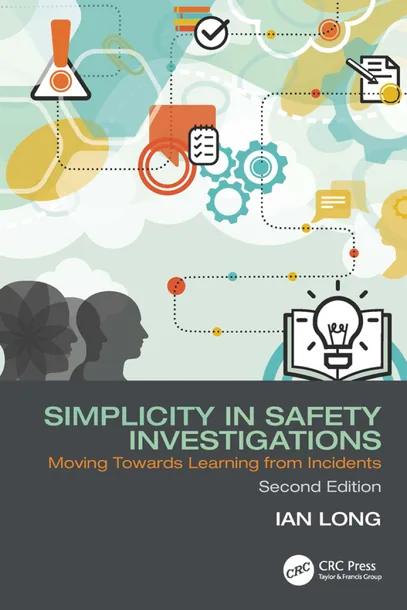
Simplicity in Safety Investigations
Moving Towards Learning from Incidents
by Ian Long
2nd Edition
Publisher: CRC Press
Book Details
| Print ISBN | 9781032870656 |
| eText ISBN | 9781040384503 |
| Publisher | CRC Press |
| Publishing Year | 2026 |
| Edition | 2nd Edition |
| Language | English |
| Pages | 202 |
In Simplicity in Safety Investigations, 2nd Edition, Ian Long provides occupational health and safety practitioners with a systematic operational guide to evaluating workplace incidents. The text focuses on enabling safety professionals to move beyond basic incident reporting, helping organizations implement concrete safety changes that help prevent future workforce fatalities.
Grounded in theoretical research from safety science pioneers Sidney Dekker and James Reason, the volume examines core human performance factors. It analyzes organizational drift, the Efficiency-Thoroughness Trade-Off, and mindset patterns such as What-You-See-Is-All-There-Is. Readers gain practical methods for timeline mapping that contrast Work-As-Done against Work-As-Normal and Work-As-Written.
This second edition features two additional chapters, updated insights on investigation lessons, and expanded coverage of workplace fatalities. Formatted for supervisors, managers, and business leaders across diverse industries, the book delivers structured facilitation and coaching techniques to translate safety reviews into embedded, long-term workplace behaviors.
Table of Contents
Chapter 1: Learning, mindset, and approach
- • What is learning?
- • Mindset
- • Approach
- • Chapter essentials
Chapter 2: Before you start
- • Key decisions: study level, scope, team formation, and roles
- • Learning Study level
- • Scope and team formation
- • A simple study
- • A detailed study
- • Roles
- • The art of facilitation and using a coaching style in facilitation
- • Your conversations and questions (before and after an event)
- • Chapter essentials
Chapter 3: Getting to ‘lessons to be learnt’ – the process
- • Step 0: Immediate response (Pre-Learning Study work)
- • Step 1: A decision to undertake a Learning Study is made
- • Step 2: Preliminary information gathering is completed
- • A side note on post-incident conversations/ interviewing (as compared to taking statements)
- • Generous listening
- • The interview conversation
- • Step 3: A Learning Study team is formed
- • Step 4: The team goes through the draft Work-As-Done timeline
- • Step 5: More comprehensive information gathering is undertaken by the team, including a PEEPO
- • How to run an effective and efficient PEEPO
- • Step 6: The timeline is completed, and ‘Elements of Interest’ are identified (determining Work-As-Done, Work- As-Normal, and Work-As-Written)
- • A side note on the differences between WAD, WAN, and WAW
- • Step 7: The contributors are listed for each Element of Interest
- • Hazards and risks
- • Understanding hazards, risk, and controlling of risk
- • Systems of work and their interrelationships
- • Shared space as it relates to safe workspaces
- • The limitations and use of situational awareness
- • Attitude and mindset
- • Understanding their ‘why’
- • The importance of attitude, internal decisions, and sense-making
- • The adoption of a growth mindset, including a learning mindset
- • Competency
- • Core ‘competency training’ and ‘awareness induction’
- • Experience
- • Process, tools, and equipment
- • Understanding of process and equipment
- • Equipment, tools, and plant design
- • Planning and task assignment
- • Task planning, assignment, acceptance, and monitoring, including communication
- • Understanding their own and others’ expectations
- • Answering a different question – that is, when the action doesn’t match the request
- • What-You-See-Is-All-There-Is and plan continuation
- • Efficiency-Thoroughness Trade-Off
- • Drift
- • Leadership
- • Accountability and authority mismatch
- • The level of understanding and curiosity about how work is actually done
- • Step 8: For each sentence, word, or statement created within the contributors, the team explores what we can learn
- • Step 9: Actions from Learning Study
- • Actions with SMARTS
- • Step 10: Write the report
- • Learning from Normal Work
- • Chapter essentials
Chapter 4: Converting lessons to be learnt into lessons learnt
- • Sharing versus learning
- • The process
- • How can we maximise the likelihood of learning remaining embedded in behaviour?
- • Chapter essentials
Chapter 5: Lessons we need to learn
- • Bhopal
- • Chernobyl
- • Space Shuttle Challenger
- • Herald of Free Enterprise
- • Piper Alpha oil rig
- • Space Shuttle Columbia
- • Deep Water Horizon
- • Fukushima Daiichi
- • Three Mile Island
- • Toulouse AZF Fertilizer Plant
- • West Fertilizer Company
- • Texas City Explosion
- • Flixborough
- • Longford Esso Plant
- • Gretley Mine
- • Costa Concordia
- • Flight AF 447
- • Sewol Ferry
- • Lac-Megantic Train Explosion
- • Phillips Explosion
- • DuPont Toxic Chemical Release
- • Grovepark Mills Explosion
- • Pike River underground mine explosion
- • LPG Fire at Valero – McKee Refinery
- • Catastrophic rupture of heat exchanger at the Tessoro petroleum refinery in Anacortes, Washington
- • AL Solutions metal dust explosion and fire, New Cumberland, USA
- • Nitrous oxide explosion
- • Ethylene release and fire
- • Imperial Sugar
- • Fatal Liquid Nitrogen Release. Foundation Food Group
- • The top 12 categories and their barriers
- • Learning from previous incidents (and audits)
- • Understanding of process, equipment, experience, and competence
- • Procedures and risk assessments
- • Critical processes
- • Emergency planning and processes
- • Management of Change
- • Leadership
- • Cost and production pressures
- • Shift handover and communications
- • Drift
- • Key performance indices
- • Maintenance and poor equipment
- • Overview
- • All 22 lessons to be learnt
- • Barriers
- • Chapter essentials
Chapter 6: Conclusion
- • Afterword, not after-thought
- • The quality checklist
Customer Reviews
0.0
0 reviews
No reviews yet. Be the first to review this book!
Write a Review
Reviewed by GradeFocus Editorial Team
▶Research Sources (16)
- Simplicity in Safety Investigations - Caterpillar Inc. - OverDrive
- Simplicity in Safety Investigations - E-kirja (9781040384503)
- Simplicity in Safety Investigations - Ian Long (9781040384503 ...
- Simplicity in Safety Investigations - 2nd Edition (eBook Rental) Best ...
- "Simplicity in Safety Investigations" als eBook kaufen - Orell Füssli
- Simplicity in Safety Investigations, eBook by Ian Long - Booktopia
- https://lernerbooks.com/products/search_results?se...
- Please verify you are human - Captcha
- Simplicity in Safety Investigations Moving Towards Learning from ...
- Simplicity in Safety Investigations : Moving Towards Learning from ...
- Simplicity in Safety Investigations: Moving Towards Learning from Inci
- Simplicity in Safety Investigations : Ian Long : 9781032870656 - Blackwell's
- Simplicity in Safety Investigations, 2nd Edition by Ian Long - The Nile
- Simplicity in Safety Investigations | Moving Towards Learning from Inc
- Moving Towards Learning from Incidents, Second Edition
- Simplicity in Safety Investigations von Long Ian - Schulthess Buchhandlung
Related Books
Artificial Intelligence in Safety Science and Engineering
Xinyan Huang

Nanotechnology Safety
Ramazan Asmatulu
Occupational Safety and Health in the Emergency Services
James S. Angle
Integrated Occupational Safety and Health Management
Seppo Väyrynen
The Legal Aspects of Industrial Hygiene and Safety
Kurt W. Dreger