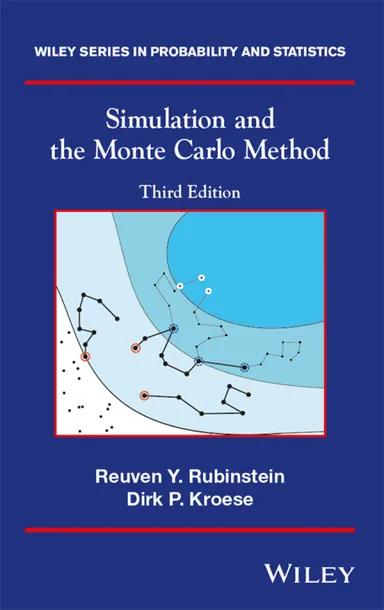
Simulation and the Monte Carlo Method
by Reuven Y. Rubinstein, Dirk P. Kroese
3rd Edition
Publisher: John Wiley & Sons
Book Details
| Print ISBN | 9781118632161 |
| eText ISBN | 9781118632383 |
| Publisher | John Wiley & Sons |
| Publishing Year | 2016 |
| Edition | 3rd Edition |
| Language | English |
| Pages | 432 |
Simulation and the Monte Carlo Method, 3rd Edition, is a textbook designed for upper-undergraduate and beginning graduate courses in stochastic simulation and Monte Carlo techniques. It also serves as a reference for professionals seeking a formal understanding of the subject.
The volume introduces core concepts in probability, Markov processes, and convex optimization before examining discrete-event system simulation and variance reduction. It further addresses Markov Chain Monte Carlo, sensitivity analysis, and cross-entropy methods.
Pedagogical resources include over 100 algorithms presented in modern pseudo code with flow control. In addition, problem sets provide practice through more than 25 new exercises added to this edition.
Table of Contents
Chapter 1: Preliminaries
- • 1.1 Introduction
- • 1.2 Random Experiments
- • 1.3 Conditional Probability and Independence
- • 1.4 Random Variables and Probability Distributions
- • 1.5 Some Important Distributions
- • 1.6 Expectation
- • 1.7 Joint Distributions
- • 1.8 Functions of Random Variables
- • 1.9 Transforms
- • 1.10 Jointly Normal Random Variables
- • 1.11 Limit Theorems
- • 1.12 Poisson Processes
- • 1.13 Markov Processes
- • 1.14 Gaussian Processes
- • 1.15 Information
- • 1.16 Convex Optimization and Duality
- • Problems
- • References
Chapter 2: Random Number, Random Variable, and Stochastic Process Generation
- • 2.1 Introduction
- • 2.2 Random Number Generation
- • 2.3 Random Variable Generation
- • 2.4 Generating from Commonly Used Distributions
- • 2.5 Random Vector Generation
- • 2.6 Generating Poisson Processes
- • 2.7 Generating Markov Chains and Markov Jump Processes
- • 2.8 Generating Gaussian Processes
- • 2.9 Generating Diffusion Processes
- • 2.10 Generating Random Permutations
- • Problems
- • References
Chapter 3: Simulation of Discrete-Event Systems
- • 3.1 Introduction
- • 3.2 Simulation Models
- • 3.3 Simulation Clock and Event List for DEDS
- • 3.4 Discrete-Event Simulation
- • Problems
- • References
Chapter 4: Statistical Analysis of Discrete-Event Systems
- • 4.1 Introduction
- • 4.2 Estimators and Confidence Intervals
- • 4.3 Static Simulation Models
- • 4.4 Dynamic Simulation Models
- • 4.5 Bootstrap Method
- • Problems
- • References
Chapter 5: Controlling the Variance
- • 5.1 Introduction
- • 5.2 Common and Antithetic Random Variables
- • 5.3 Control Variables
- • 5.4 Conditional Monte Carlo
- • 5.5 Stratified Sampling
- • 5.6 Multilevel Monte Carlo
- • 5.7 Importance Sampling
- • 5.8 Sequential Importance Sampling
- • 5.9 Sequential Importance Resampling
- • 5.10 Nonlinear Filtering for Hidden Markov Models
- • 5.11 Transform Likelihood Ratio Method
- • 5.12 Preventing the Degeneracy of Importance Sampling
- • Problems
- • References
Chapter 6: Markov Chain Monte Carlo
- • 6.1 Introduction
- • 6.2 Metropolis–Hastings Algorithm
- • 6.3 Hit-and-Run Sampler
- • 6.4 Gibbs Sampler
- • 6.5 Ising and Potts Models
- • 6.6 Bayesian Statistics
- • 6.7 Other Markov Samplers
- • 6.8 Simulated Annealing
- • 6.9 Perfect Sampling
- • Problems
- • References
Chapter 7: Sensitivity Analysis and Monte Carlo Optimization
- • 7.1 Introduction
- • 7.2 Score Function Method for Sensitivity Analysis of DESS
- • 7.3 Simulation-Based Optimization of DESS
- • 7.4 Sensitivity Analysis of DEDS
- • Problems
- • References
Chapter 8: Cross-Entropy Method
- • 8.1 Introduction
- • 8.2 Estimation of Rare-Event Probabilities
- • 8.3 CE Method for Optimization
- • 8.4 Max-Cut Problem
- • 8.5 Partition Problem
- • 8.6 Traveling Salesman Problem
- • 8.7 Continuous Optimization
- • 8.8 Noisy Optimization
- • 8.9 MinxEnt Method
- • Problems
- • References
Chapter 9: Splitting Method
- • 9.1 Introduction
- • 9.2 Counting Self-Avoiding Walks via Splitting
- • 9.3 Splitting with a Fixed Splitting Factor
- • 9.4 Splitting with a Fixed Effort
- • 9.5 Generalized Splitting
- • 9.6 Adaptive Splitting
- • 9.7 Application of Splitting to Network Reliability
- • 9.8 Applications to Counting
- • 9.9 Case Studies for Counting with Splitting
- • 9.10 Splitting as a Sampling Method
- • 9.11 Splitting for Optimization
- • Problems
- • References
Chapter 10: Stochastic Enumeration Method
- • 10.1 Introduction
- • 10.2 Tree Search and Tree Counting
- • 10.3 Knuth’s Algorithm for Estimating the Cost of a Tree
- • 10.4 Stochastic Enumeration
- • 10.5 Application of SE to Counting
- • 10.6 Application of SE to Network Reliability
- • Problems
- • References
Chapter Appendix: Appendix
- • A.1 Cholesky Square Root Method
- • A.2 Exact Sampling from a Conditional Bernoulli Distribution
- • A.3 Exponential Families
- • A.4 Sensitivity Analysis
- • A.5 A Simple CE Algorithm for Optimizing the Peaks Function
- • A.6 Discrete-Time Kalman Filter
- • A.7 Bernoulli Disruption Problem
- • A.8 Complexity
- • Problems
- • References
Customer Reviews
0.0
0 reviews
No reviews yet. Be the first to review this book!
Write a Review
Reviewed by GradeFocus Editorial Team
Related Books
The Basic Practice of Statistics
David S. Moore
Mathematical Statistics with Applications
Dennis Wackerly
Probability and Statistical Inference
Robert V. Hogg
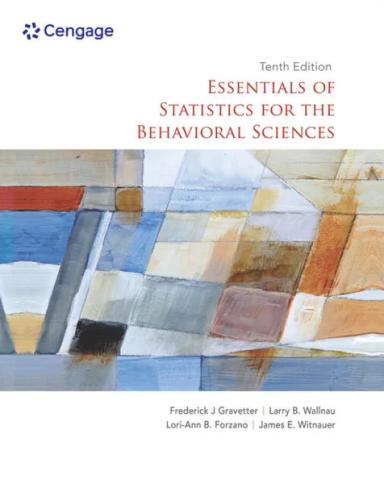
Essentials of Statistics for the Behavioral Sciences
Frederick J Gravetter

The Practice of Statistics for the AP® Course
Daren Starnes
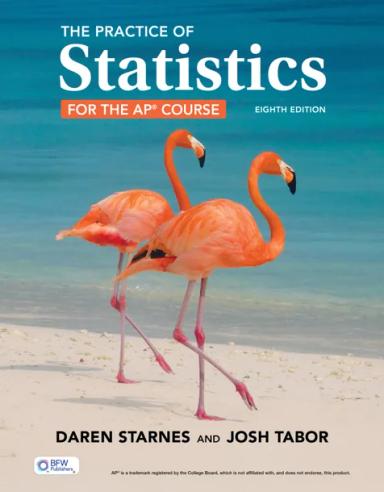
The Practice of Statistics for the AP® Course
Daren Starnes