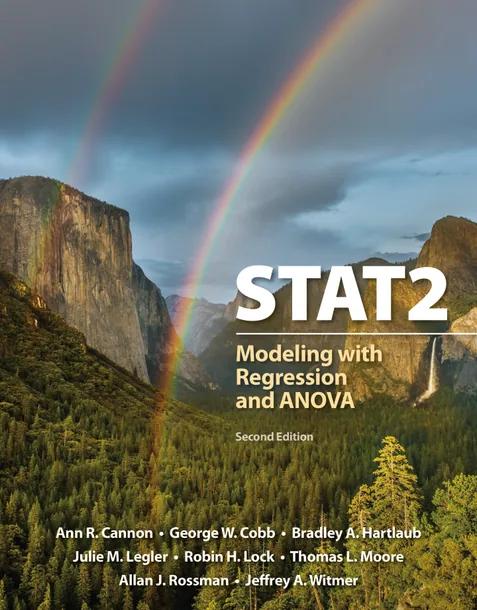
STAT2
Modeling with Regression and ANOVA
by Ann Cannon, George W. Cobb, Bradley A. Hartlaub
2nd Edition
Publisher: W.H. Freeman & Company
Book Details
| Print ISBN | 9781319054076 |
| eText ISBN | 9781319067502 |
| Publisher | W.H. Freeman & Company |
| Publishing Year | 2019 |
| Edition | 2nd Edition |
| Language | English |
STAT2: Modeling with Regression and ANOVA, 2nd Edition, is a textbook designed to introduce statistical modeling beyond introductory college statistics or AP Statistics courses. It helps students expand their analytical capabilities to handle richer datasets with multiple variables.
Organized into thematic units defined by the types of response and predictor variables, the textbook covers linear regression, analysis of variance, logistic regression, and time series analysis. Throughout these topics, modeling follows a four-step cycle: choosing a model form, fitting the model, assessing model fit, and using the model to address research questions.
Prerequisites are limited to a first statistics course and a working knowledge of exponential and logarithmic functions. Authentic multivariable datasets from diverse disciplines provide practical contexts for analysis.
Table of Contents
Chapter 0: What Is a Statistical Model?
- • 0.1 Model Basics
- • 0.2 A Four-Step Process
Chapter 1: Simple Linear Regression
- • 1.1 The Simple Linear Regression Model
- • 1.2 Conditions for a Simple Linear Model
- • 1.3 Assessing Conditions
- • 1.4 Transformations/Reexpressions
- • 1.5 Outliers and Influential Points
Chapter 2: Inference for Simple Linear Regression
- • 2.1 Inference for Regression Slope
- • 2.2 Partitioning Variability—ANOVA
- • 2.3 Regression and Correlation
- • 2.4 Intervals for Predictions
- • 2.5 Case Study: Butterfly Wings
Chapter 3: Multiple Regression
- • 3.1 Multiple Linear Regression Model
- • 3.2 Assessing a Multiple Regression Model
- • 3.3 Comparing Two Regression Lines
- • 3.4 New Predictors from Old
- • 3.5 Correlated Predictors
- • 3.6 Testing Subsets of Predictors
- • 3.7 Case Study: Predicting in Retail Clothing
Chapter 4: Additional Topics in Regression
- • 4.1 Topic: Added Variable Plots
- • 4.2 Topic: Techniques for Choosing Predictors
- • 4.3 Cross-validation
- • 4.4 Topic: Identifying Unusual Points in Regression
- • 4.5 Topic: Coding Categorical Predictors
- • 4.6 Topic: Randomization Test for a Relationship
- • 4.7 Topic: Bootstrap for Regression
Chapter 5: One-way ANOVA and Randomized Experiments
- • 5.1 Overview of ANOVA
- • 5.2 The One-way Randomized Experiment and Its Observational Sibling
- • 5.3 Fitting the Model
- • 5.4 Formal Inference: Assessing and Using the Model
- • 5.5 How Big Is the Effect?: Confidence Intervals and Effect Sizes
- • 5.6 Using Plots to Help Choose a Scale for the Response
- • 5.7 Multiple Comparisons and Fisher’s Least Significant Difference
- • 5.8 Case Study: Words with Friends
Chapter 6: Blocking and Two-way ANOVA
- • 6.1 Choose: RCB Design and Its Observational Relatives
- • 6.2 Exploring Data from Block Designs
- • 6.3 Fitting the Model for a Block Design
- • 6.4 Assessing the Model for a Block Design
- • 6.5 Using the Model for a Block Design
Chapter 7: ANOVA with Interaction and Factorial Designs
- • 7.1 Interaction
- • 7.2 Design: The Two-way Factorial Experiment
- • 7.3 Exploring Two-way Data
- • 7.4 Fitting a Two-way Balanced ANOVA Model
- • 7.5 Assessing Fit: Do We Need a Transformation?
- • 7.6 USING a Two-way ANOVA Model
Chapter 8: Additional Topics in Analysis of Variance
- • 8.1 Topic: Levene’s Test for Homogeneity of Variances
- • 8.2 Topic: Multiple Tests
- • 8.3 Topic: Comparisons and Contrasts
- • 8.4 Topic: Nonparametric Statistics
- • 8.5 Topic: Randomization F-Test
- • 8.6 Topic: Repeated Measures Designs and Data Sets
- • 8.7 Topic: ANOVA and Regression with Indicators
- • 8.8 Topic: Analysis of Covariance
Chapter 9: Logistic Regression
- • 9.1 Choosing a Logistic Regression Model
- • 9.2 Logistic Regression and Odds Ratios
- • 9.3 Assessing the Logistic Regression Model
- • 9.4 Formal Inference: Tests and Intervals
Chapter 10: Multiple Logistic Regression
- • 10.1 Overview
- • 10.2 Choosing, Fitting, and Interpreting Models
- • 10.3 Checking Conditions
- • 10.4 Formal Inference: Tests and Intervals
- • 10.5 Case study: Attractiveness and Fidelity
Chapter 11: Additional Topics in Logistic Regression
- • 11.1 Topic: Fitting the Logistic Regression Model
- • 11.2 Topic: Assessing Logistic Regression Models
- • 11.3 Randomization Tests for Logistic Regression
- • 11.4 Analyzing Two-Way Tables with Logistic Regression
- • 11.5 Simpson’s Paradox
Chapter 12: Time Series Analysis
- • 12.1 Functions of Time
- • 12.2 Measuring Dependence on Past Values: Autocorrelation
- • 12.3 ARIMA models
- • 12.4 Case Study: Residual Oil
Customer Reviews
0.0
0 reviews
No reviews yet. Be the first to review this book!
Write a Review
Reviewed by GradeFocus Editorial Team
▶Research Sources (4)
Related Books
The Basic Practice of Statistics
David S. Moore
Mathematical Statistics with Applications
Dennis Wackerly
Probability and Statistical Inference
Robert V. Hogg
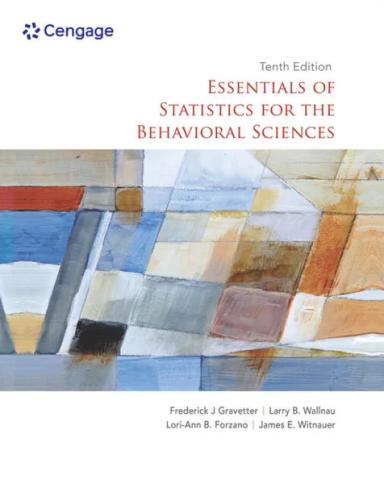
Essentials of Statistics for the Behavioral Sciences
Frederick J Gravetter
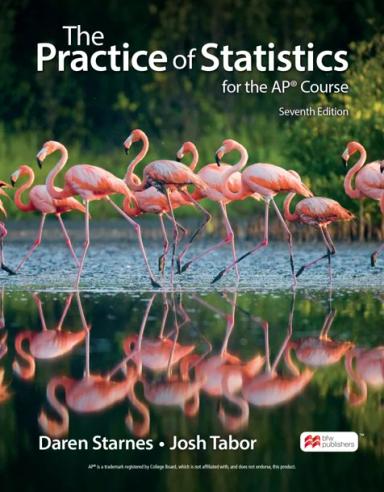
The Practice of Statistics for the AP® Course
Daren Starnes
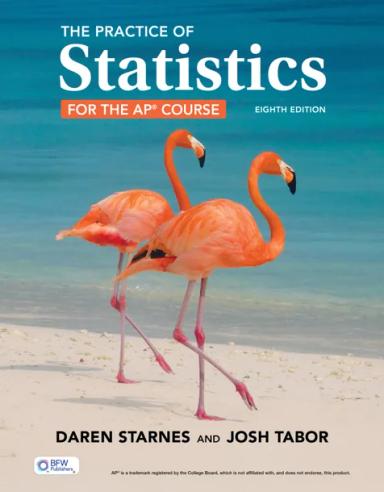
The Practice of Statistics for the AP® Course
Daren Starnes