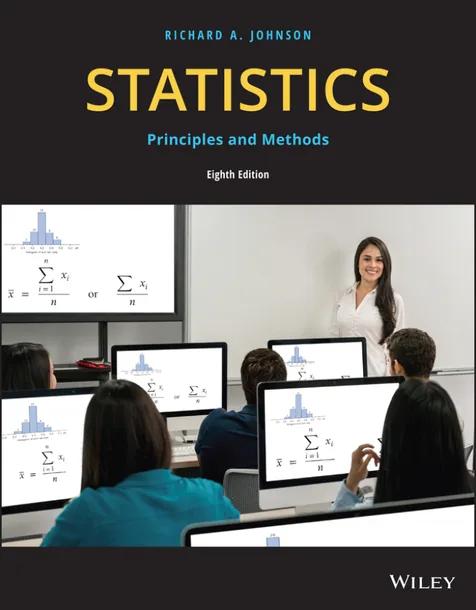
Statistics: Principles and Methods
by Richard A. Johnson, Gouri K. Bhattacharyya
8th Edition
Publisher: Wiley
Book Details
| Print ISBN | 9781119497110 |
| eText ISBN | 9781119497059 |
| Publisher | Wiley |
| Publishing Year | 2019 |
| Edition | 8th Edition |
| Language | English |
| Pages | 576 |
Statistics: Principles and Methods, 8th Edition, is a textbook that introduces students and business professionals to foundational statistical concepts, terminology, and applied methods. It concentrates on statistical measurement, analytical reasoning, and practical data analysis.
The text examines descriptive methods for univariate and bivariate data, probability distributions, sampling variation, and inferential procedures. Coverage also explores regression models, analysis of variance, and categorical data evaluation.
Requiring no specific mathematical background, the book omits derivations in favor of logic, reasoning, and statistics software. Topics are introduced in real-life settings with real-world data and then expanded to address underlying mechanisms, limitations, and practical applications.
Table of Contents
Chapter 1: INTRODUCTION TO STATISTICS
- • 1 The Subject and Scope of Statistics
- • 2 Statistics in Aid of Scientific Inquiry
- • 3 Two Basic Concepts—Population and Sample
- • 4 The Purposeful Collection of Data
- • Case Study: Statistics in Context
- • 5 Objectives of Statistics
Chapter 2: ORGANIZATION AND DESCRIPTION OF DATA
- • 1 Main Types of Data
- • 2 Describing Data by Tables and Graphs
- • 3 Measures of Center
- • 4 Measures of Variation
- • 5 Checking the Stability of the Observations over Time
- • 6 More on Graphics
- • Case Study: Statistics in Context
Chapter 3: DESCRIPTIVE STUDY OF BIVARIATE DATA
- • 1 Summarization of Bivariate Categorical Data
- • 2 A Designed Experiment for Making a Comparison
- • 3 Scatter Diagram of Bivariate Measurement Data
- • 4 The Correlation Coefficient—A Measure of Linear Relation
- • 5 Prediction of One Variable from another (Linear Regression)
Chapter 4: PROBABILITY
- • 1 Probability of an Event
- • 2 Methods of Assigning Probability
- • 3 Event Operations and Two Laws of Probability
- • 4 Conditional Probability and Independence
- • 5 Bayes’ Theorem
- • 6 Random Sampling from a Finite Population
- • Case Study: Statistics in Context
Chapter 5: PROBABILITY DISTRIBUTIONS
- • 1 Random Variables
- • 2 Probability Distribution of a Discrete Random Variable
- • 3 Mean (Expected Value) and Standard Deviation of a Probability Distribution
- • 4 Successes and Failures—Bernoulli Trials
- • 5 The Binomial Distribution
- • 6 The Poisson Distribution and Rare Events
Chapter 6: THE NORMAL DISTRIBUTION
- • 1 Probability Model for a Continuous Random Variable
- • 2 The Normal Distribution—Its General Features
- • 3 The Standard Normal Distribution
- • 4 Probability Calculations with Normal Distributions
- • 5 The Normal Approximation to the Binomial
- • 6 Checking the Plausibility of a Normal Model
- • 7 Transforming Observations to Attain Near Normality
Chapter 7: VARIATION IN REPEATED SAMPLES—SAMPLING DISTRIBUTIONS
- • 1 The Sampling Distribution of a Statistic
- • 2 Distribution of the Sample Mean and the Central Limit Theorem
- • Case Study: Statistics in Context
Chapter 8: DRAWING INFERENCES FROM LARGE SAMPLES
- • 1 Two Types of Statistical Inference: Estimation and Testing
- • 2 Point Estimation of a Population Mean
- • 3 Confidence Interval Estimation of a Population Mean
- • 4 Testing Hypotheses about a Population Mean
- • 5 Inferences about a Population Proportion
Chapter 9: SMALL SAMPLE INFERENCES FOR NORMAL POPULATIONS
- • 1 Student’s t Distribution
- • 2 Inferences about —Small Sample Size
- • 3 Relationship between Tests and Confidence Intervals
- • 4 Inferences about the Standard Deviation (The Chi-Square Distribution)
- • 5 Robustness of Inference Procedures
Chapter 10: COMPARING TWO TREATMENTS
- • 1 Two Designs: Independent Samples and Matched Pairs Sample
- • 2 Inferences about the Difference of Means—Independent Large Samples
- • 3 Inferences about the Difference of Means—Independent Small Samples from Normal Populations
- • 4 Randomization and Its Role in Inference
- • 5 Matched Pairs Comparisons
- • 6 Choosing Between Independent Samples and a Matched Pairs Sample
- • 7 Comparing Two Population Proportions
Chapter 11: REGRESSION ANALYSIS I Simple Linear Regression
- • 1 Regression with a Single Predictor
- • 2 A Straight Line Regression Model
- • 3 The Method of Least Squares
- • 4 The Sampling Variability of the Least Squares Estimators—Tools for Inference
- • 5 Important Inference Problems
- • 6 The Strength of a Linear Relation
- • 7 Remarks about the Straight Line Model Assumptions
Chapter 12: REGRESSION ANALYSIS II Multiple Linear Regression and Other Topics
- • 1 Nonlinear Relations and Linearizing Transformations
- • 2 Multiple Linear Regression
- • 3 Residual Plots to Check the Adequacy of a Statistical Model
Chapter 13: ANALYSIS OF CATEGORICAL DATA
- • 1 Formulating Testing Problems Concerning Categorical Data
- • 2 Pearson’s χ2 Test for Goodness of Fit
- • 3 Contingency Table with One Margin Fixed (Test of Homogeneity)
- • 4 Contingency Table with Neither Margin Fixed (Test of Independence)
Chapter 14: ANALYSIS OF VARIANCE (ANOVA)
- • 1 Comparison of Several Treatments—One-Way Analysis of Variance
- • 2 Population Model and Inferences for a One-Way Analysis of Variance
- • 3 Simultaneous Confidence Intervals
- • 4 Graphical Diagnostics and Displays to Supplement ANOVA
- • 5 Randomized Block Experiments for Comparing k Treatments
Chapter 15: NONPARAMETRIC INFERENCE
- • 1 The Wilcoxon Rank-Sum Test for Comparing Two Treatments
- • 2 Matched Pairs Comparisons
- • 3 Measure of Correlation Based on Ranks
- • 4 Concluding Remarks
Chapter APPENDIX A1: SUMMATION NOTATION
Chapter APPENDIX A2: RULES FOR COUNTING
Chapter APPENDIX A3: EXPECTATION AND STANDARD DEVIATION—PROPERTIES
Chapter APPENDIX A4: THE EXPECTED VALUE AND STANDARD DEVIATION OF X
Chapter APPENDIX B: TABLES
- • Table 1 Random Digits
- • Table 2 Cumulative Binomial Probabilities
- • Table 3 Cumulative Poisson Probabilities
- • Table 4 Standard Normal Probabilities
- • Table 5 Percentage Points _t_ of _t_ Distributions
- • Table 6 Percentage Points χ2 of χ2 Distributions
- • Table 7 Percentage Points of _F_( v1, v2 ) Distributions
- • Table 8 Selected Tail Probabilities for the Null Distribution of Wilcoxon’s Rank-Sum Statistic
- • Table 9 Selected Tail Probabilities for the Null Distribution of Wilcoxon’s Signed-Rank Statistic
- • Table F1 General Formulas for Inferences about a Mean (), Difference of Two Means ( 1 − 2 )
- • Table F2 Inference about Proportions
- • Summary of Formulas Useful for Exams
Chapter DATA BANK: DATA BANK
Chapter ANSWERS TO SELECTED ODD-NUMBERED EXERCISES: ANSWERS TO SELECTED ODD-NUMBERED EXERCISES
Customer Reviews
0.0
0 reviews
No reviews yet. Be the first to review this book!
Write a Review
Reviewed by GradeFocus Editorial Team
Related Books
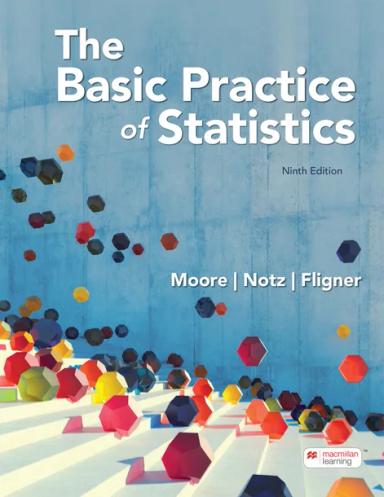
The Basic Practice of Statistics
David S. Moore
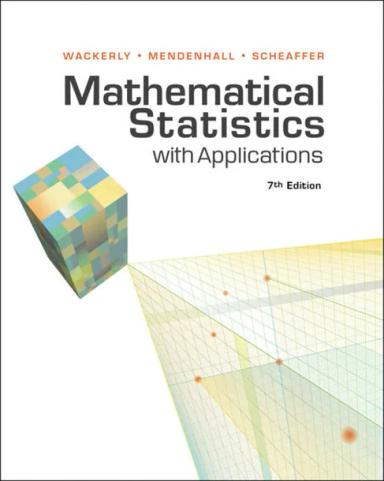
Mathematical Statistics with Applications
Dennis Wackerly
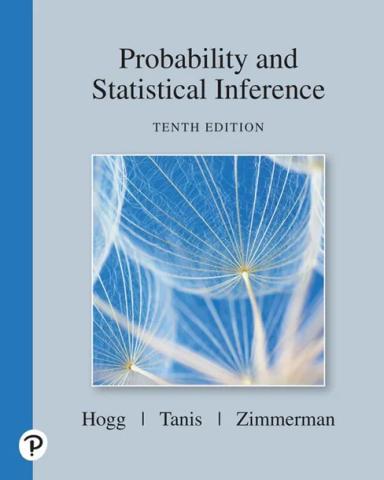
Probability and Statistical Inference
Robert V. Hogg
Essentials of Statistics for the Behavioral Sciences
Frederick J Gravetter

The Practice of Statistics for the AP® Course
Daren Starnes
The Practice of Statistics for the AP® Course
Daren Starnes