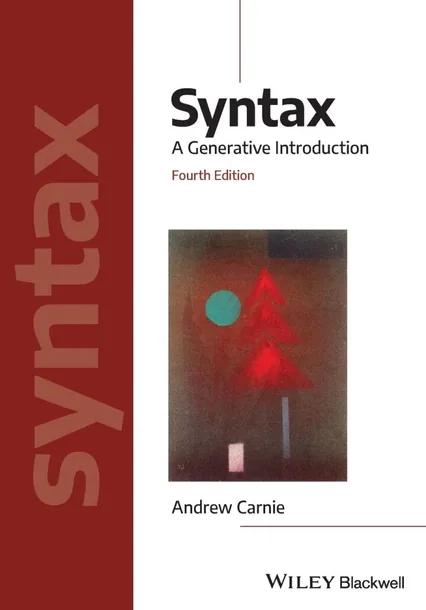
Syntax
A Generative Introduction
by Andrew Carnie
4th Edition
Publisher: Wiley-Blackwell
Book Details
| Print ISBN | 9781119569237 |
| eText ISBN | 9781119569312 |
| Publisher | Wiley-Blackwell |
| Publishing Year | 2021 |
| Edition | 4th Edition |
| Language | English |
| Pages | 544 |
Syntax: A Generative Introduction, 4th Edition, by Andrew Carnie, is an introductory textbook exploring the rules, principles, and processes that determine sentence structure. Written for beginning syntacticians, the volume supports undergraduate and graduate coursework in linguistics, grammar, language, and second language teaching.
The volume balances foundational concepts with theoretical syntax, addressing generative grammar, constituency, structural relations, and binding theory. It guides readers through basic, intermediate, and advanced topics while implicitly tracing the historical evolution of generative theory, as highlighted in a review from LINGUIST List.
Pedagogical tools throughout the volume include learning objectives, discussion questions, and exercises of varying difficulty levels. The 2021 fourth edition also incorporates additional problem sets in every chapter to support student practice.
Table of Contents
Chapter 1: Generative Grammar
- • 0. Preliminaries
- • 1. Syntax as Science – the Scientific Method
- • 2. Syntax as a Cognitive Science
- • 3. Models of Syntax
- • 4. Competence vs. Performance
- • 5. A Clarification on the Word “Language”
- • 6. Where Do the Rules Come From?
- • 7. Choosing among Theories about Syntax
- • 8. The Scientific Method and the Structure of this Textbook
- • 9. Conclusion
- • Ideas, Rules, and Constraints Introduced in this Chapter
- • General Problem Sets
- • Challenge Problem Sets
Chapter 2: Parts of Speech
- • 0. Words and Why They Matter to Syntax
- • 1. Determining Part of Speech
- • 2. The Major Parts of Speech: N, V, Adj, and Adv
- • 3. Open vs. Closed; Lexical vs. Functional
- • 4. Subcategories and Features
- • 5. Conclusion
- • Ideas, Rules, and Constraints Introduced in this Chapter
- • General Problem Sets
- • Challenge Problem Sets
Chapter 3: Constituency, Trees, and Rules
- • 0. Introduction
- • 1. Rules and Trees
- • 2. How to Draw a Tree
- • 3. Modification and Ambiguity
- • 4. Constituency Tests
- • 5. Constituency in Other Languages
- • 6. Conclusion
- • Ideas, Rules, and Constraints Introduced in this Chapter
- • General Problem Sets
- • Challenge Problem Sets
Chapter 4: Structural Relations
- • 0. Introduction
- • 1. The Parts of a Tree
- • 2. Dominance
- • 3. Precedence
- • 4. C-command
- • 5. Grammatical Relations
- • 6. Conclusions
- • Ideas, Rules, and Constraints Introduced in this Chapter
- • General Problem Sets
- • Challenge Problem Sets
Chapter 5: Binding Theory
- • 0. Introduction
- • 1. The Notions _Coindex_ and _Antecedent_
- • 2. Binding
- • 3. Locality Conditions on the Binding of Anaphors
- • 4. The Distribution of Pronouns
- • 5. The Distribution of R-expressions
- • 6. Why Does Binding Theory Matter to Syntacticians
- • 6. Conclusion
- • Ideas, Rules, and Constraints Introduced in this Chapter
- • General Problem Sets
- • Challenge Problem Sets
Chapter 6: X-bar Theory
- • 0. Introduction
- • 1. Bar-level Projections
- • 2. Generalizing the Rules: The X-bar Schema
- • 3. Complements, Adjuncts, and Specifiers
- • 4. Some Definitional Housekeeping
- • 5. Parameters of Word Order
- • 6. Drawing Trees in X-bar Notation
- • 7. Conclusion
- • Ideas, Rules, and Constraints Introduced in this Chapter
- • General Problem Sets
- • Challenge Problem Sets
Chapter 7: Extending X-bar Theory to Functional Categories
- • 0. Introduction
- • 1. Determiner Phrases (DPs)
- • 2. A Descriptive Tangent into Clause Types
- • 3. Complementizer Phrases (CPs)
- • 4. Tense, Perfect, Progressive and Voice Phrases
- • Ideas, Rules, and Constraints Introduced in this Chapter
- • General Problem Sets
- • Challenge Problem Sets
Chapter 8: Constraining X-bar: Theta Theory
- • 0. Introduction
- • 1. Some Basic Terminology
- • 2. Thematic Relations and Theta Roles
- • 3. The Lexicon
- • 4. Expletives and the Extended Projection Principle
- • 5. Conclusion
- • Ideas, Rules, and Constraints Introduced in this Chapter
- • General Problem Sets
- • Challenge Problem Sets
Chapter 9: Theta Grids and Functional Categories
- • 0. Introduction
- • 1. Complementizers
- • 2. Determiners
- • 3. Using Theta Grids for English Auxiliaries
- • 4. Main verbs vs. Auxiliaries
- • 5. Conclusion
- • Ideas, Rules, and Constraints Introduced in this Chapter
- • General Problem Sets
- • Challenge Problem Sets
Chapter 10: Head-to-Head Movement
- • 0. Introduction
- • 1. Verb Movement (V → T)
- • 2. T Movement (T → C)
- • 3. Do-support
- • Appendix: Determining if a Language has V → T Movement
- • Ideas, Rules, and Constraints Introduced in this Chapter
- • General Problem Sets
- • Challenge Problem Sets
Chapter 11: DP Movement
- • 0. Introduction
- • 1. A Puzzle for the Theory of Theta Roles
- • 2. Passives
- • 3. Case
- • 4. Raising: Reprise
- • 5. Passives: Reprise
- • 6. Inherently Passive Verbs: Unaccusatives
- • 7. DP Movement in SVO vs. VSO Languages
- • 8. Conclusion
- • Ideas, Rules, and Constraints Introduced in this Chapter
- • General Problem Sets
- • Challenge Problem Sets
Chapter 12: _Wh_\-movement and Locality Constraints
- • 0. Introduction
- • 1. Movement in _Wh_\-questions
- • 2. Relative Clauses
- • 3. Islands
- • 4. The Minimal Link Condition
- • 5. Echo Questions (_Wh_\-in-situ) in English
- • 6. Conclusion
- • Ideas, Rules, and Constraints Introduced in this Chapter
- • General Problem Sets
- • Challenge Problem Sets
Chapter 13: A Unified Theory of Movement
- • 0. Introduction
- • 1. Move
- • 2. Explaining Cross-linguistic Differences
- • 3. Scope, Covert Movement, and the MLC
- • 4. Conclusion
- • Ideas, Rules, and Constraints Introduced in this Chapter
- • General Problem Sets
- • Challenge Problem Sets
Chapter 14: Ditransitives
- • 0. Introduction
- • 1. The Problem of Ditransitive Verbs
- • 2. The Active Voice Head
- • 3. Object Shift
- • 4. Ditransitives: Reprise
- • Ideas, Rules, and Constraints Introduced in this Chapter
- • General Problem Sets
- • Challenge Problem Sets
Chapter 15: Raising, Control, and Empty Categories
- • 0. Introduction
- • 1. Raising vs. Control
- • 2. Two Kinds of Raising, Two Kinds of Control
- • 3. Control Theory
- • 4. Another Kind of Null Subject: “Little” pro
- • 5. Conclusion
- • Ideas, Rules, and Constraints Introduced in this Chapter
- • General Problem Sets
- • Challenge Problem Sets
Chapter 16: Ellipsis
- • 0. Ellipsis
- • 1. LF-copying or PF-deletion
- • 2. Antecedent-Contained Deletion and Pseudogapping
- • 3. Conclusion
- • Ideas, Rules, and Constraints Introduced in this Chapter
- • General Problem Sets
- • Challenge Problem Sets
Chapter 17: Advanced Topics in Binding Theory
- • 0. Introduction
- • 1. Levels of Representation
- • 2. The Definition of Binding Domain
- • Ideas, Rules, and Constraints Introduced in this Chapter
- • General Problem Sets
- • Challenge Problem Sets
Chapter 18: Polysynthesis, Incorporation, and Non-configurationality
- • 0. Introduction
- • 1. Polysynthesis
- • 2. Incorporation
- • 3. Scrambling and Non-configurationality
- • 4. Conclusion
- • Ideas, Rules, and Constraints Introduced in this Chapter
- • General Problem Sets
- • Challenge Problem Sets
Chapter 19: Merge
- • 0. Introduction
- • 1. External Merge
- • 2. Internal Merge
- • 3. Conclusion
- • Ideas, Rules, and Constraints Introduced in this Chapter
- • General Problem Sets
- • Challenge Problem Sets
Customer Reviews
0.0
0 reviews
No reviews yet. Be the first to review this book!
Write a Review
Reviewed by GradeFocus Editorial Team