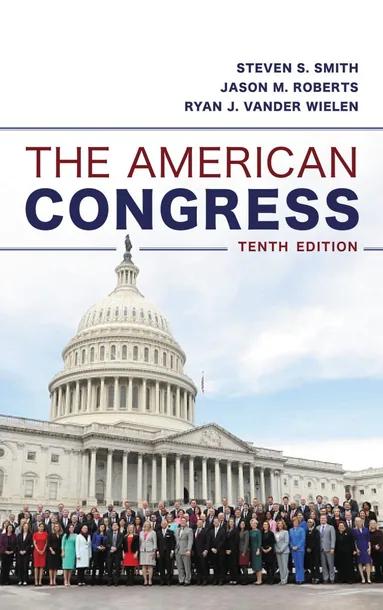
The American Congress
by Steven S. Smith, Jason M. Roberts, Ryan J. Vander Wielen
10th Edition
Publisher: Bloomsbury Publishing
Book Details
| Print ISBN | 9781538125823 |
| eText ISBN | 9781538125847 |
| Publisher | Bloomsbury Publishing |
| Publishing Year | 2019 |
| Edition | 10th Edition |
| Language | English |
| Pages | 416 |
The American Congress, 10th Edition, provides an introductory examination of congressional politics and the national lawmaking process. Drawing on the authors' scholarship and Capitol Hill experience, the work portrays legislators both as individual politicians and as participants in a complex governing institution.
The textbook explores representation, the constitutional and statutory rules structuring elections, and the organization of parties, leaders, and committees. It also examines floor procedures, the federal budget process, and congressional interactions with the presidency, the courts, and interest groups.
Widely adopted in colleges and universities across the country, this edition includes chapter learning aids such as key terms lists, discussion questions, and suggested further reading.
Table of Contents
Chapter 1: The Troubled Congress
- • Studying Congress
- • A Partisan, Centralized Congress
- • Will Polarized Parties, Centralized Decision Making, and Procedural Warfare Last Forever?
- • An Unpopular Congress
- • Other Trends in Congressional Politics
- • The Changing Congress
- • Key Terms
- • Suggested Reading
- • Discussion Questions
Chapter 2: Representation and Lawmaking in Congress
- • Models of Representation
- • Models of Lawmaking
- • Rules for Representation and Lawmaking in the Constitution
- • Beyond the Constitution: The Development of Parties and Committees
- • Conclusion
- • Key Terms
- • Suggested Reading
- • Discussion Questions
Chapter 3: Congressional Elections
- • The Rules Governing Congressional Elections
- • The Constitution: Eligibility, Voting Rights, and Chamber Size
- • Federal Law: Apportionment and Campaign Finance
- • State Law: Redistricting and Primaries
- • Election Practice Reform
- • Variations in the Incumbency Advantage
- • Biased Campaign Funding
- • Nationalization of Congressional Elections
- • Midterm Elections
- • Conclusion
- • Key Terms
- • Suggested Reading
- • Discussion Questions
Chapter 4: Members, Goals, Resources, and Strategies
- • Members’ Goals
- • Members’ Resources
- • Influences on Members
- • Choosing Strategies
- • Legislative Styles
- • Conclusion
- • Key Terms
- • Suggested Reading
- • Discussion Questions
Chapter 5: Parties and Leaders
- • The Nature of Congressional Parties.
- • Factions Within Congressional Parties
- • Party Organizations
- • Party Leaders
- • House Party Leaders
- • Senate Party Leaders
- • Party Leaders’ Resources
- • Term Limits for Party Leaders
- • Congressional Leaders and Presidential Succession
- • A New Party Era
- • Conclusion
- • Key Terms
- • Suggested Reading
- • Discussion Questions
Chapter 6: The Committee System
- • Types of Committees
- • The Nature of Congressional Committees
- • The Power of Modern Committees
- • Declining Committee Autonomy
- • Committee Membership
- • Committee Leaders
- • Conclusion
- • Key Terms
- • Suggested Reading
- • Discussion Questions
Chapter 7: The Rules of the Legislative Game
- • Legislative Rules in Perspective
- • Beyond the Constitution: House and Senate Rules
- • The Standard Legislative Process
- • Introduction of Legislation
- • Referral to Committee
- • Committee Action
- • Circumventing Committees
- • Floor Scheduling
- • Floor Consideration
- • Resolving Differences Between Chambers
- • House and Senate Rules Compared
- • Authorizing and Appropriating
- • Evolution of the Legislative Process
- • Conclusion
- • Key Terms
- • Suggested Reading
- • Discussion Questions
Chapter 8: The Rules of the Game: The Budget Process
- • Overview of the Federal Budget
- • Creating a Congressional Budget Process: 1974
- • The Pliable Budget Process
- • The Multiple Legislative Personalities of Tax Legislation
- • The Multiple Legislative Personalities of Spending Bills
- • Battle over Earmarks
- • Conclusion
- • Key Terms
- • Suggested Reading
- • Discussion Questions
Chapter 9: The Floor and Voting
- • Voting Procedure
- • Analyzing Votes
- • Conclusion
- • Key Terms
- • Discussion Questions
- • Suggested Reading
Chapter 10: Congress and the President
- • The President as a Legislative Player
- • Presidents’ Strategies
- • Presidential Resources
- • Congressional Resources and Strategies
- • Ideological Outlook
- • The Divided-Government Debate
- • Conclusion
- • Key Terms
- • Suggested Reading
- • Discussion Questions
Chapter 11: Congress and the Courts
- • Courts as Umpires
- • Judges as Policy Makers
- • Congressional Resources and Strategies
- • Conclusion
- • Key Terms
- • Suggested Reading
- • Discussion Questions
Chapter 12: Congress, Lobbyists, and Interest Groups
- • The Expanding Community of Lobbyists and Interest Groups
- • Developments in Interest Group Strategies
- • Inside Lobbying
- • Regulating Lobbying
- • Members’ Groups and Legislative Service Organizations
- • The Influence of Lobbyists and Interest Groups
- • Conclusion
- • Key Terms
- • Suggested Reading
- • Discussion Questions
Customer Reviews
0.0
0 reviews
No reviews yet. Be the first to review this book!
Write a Review
Reviewed by GradeFocus Editorial Team