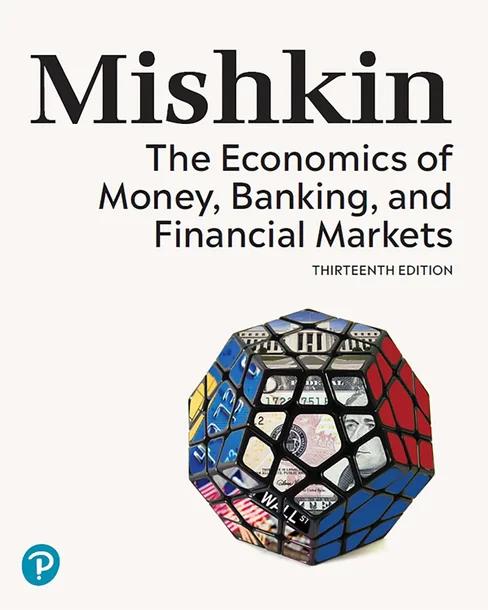
The Economics of Money, Banking, and Financial Markets
by Frederic Mishkin
13th Edition
Publisher: Pearson
Book Details
| Print ISBN | 9780136894353 |
| eText ISBN | 9780136893882 |
| Publisher | Pearson |
| Publishing Year | 2022 |
| Edition | 13th Edition |
| Language | English |
The Economics of Money, Banking, and Financial Markets, 13th Edition, is a textbook by Frederic Mishkin that introduces the principles of financial systems and economic policy. Published by Pearson, the text explores the connections between monetary policymaking, institutional finance, and modern economies.
Broad thematic areas include the architecture of financial markets, the operational management and regulation of banking institutions, and central bank strategy. The text also evaluates international finance and macroeconomic monetary theory.
Drawing on the author's background as a Governor of the Federal Reserve, the volume incorporates real-world examples designed to help students connect analytical models and equations to everyday personal and professional choices.
Table of Contents
PART 1: INTRODUCTION
Chapter 1: Why Study Money, Banking, and Financial Markets?
Chapter 2: An Overview of the Financial System
Chapter 3: What Is Money?
PART 2: FINANCIAL MARKETS
Chapter 4: The Meaning of Interest Rates
Chapter 5: The Behavior of Interest Rates
Chapter 6: The Risk and Term Structure of Interest Rates
Chapter 7: The Stock Market, the Theory of Rational Expectations, and the Efficient Market Hypothesis
PART 3: FINANCIAL INSTITUTIONS
Chapter 8: An Economic Analysis of Financial Structure
Chapter 9: Banking and the Management of Financial Institutions
Chapter 10: Economic Analysis of Financial Regulation
Chapter 11: Banking Industry: Structure and Competition
Chapter 12: Financial Crises
PART 4: CENTRAL BANKING AND THE CONDUCT OF MONETARY POLICY
Chapter 13: Central Banks and the Federal Reserve System
Chapter 14: The Money Supply Process
Chapter 15: Tools of Monetary Policy
Chapter 16: The Conduct of Monetary Policy: Strategy and Tactics
PART 5: INTERNATIONAL FINANCE AND MONETARY POLICY
Chapter 17: The Foreign Exchange Market
Chapter 18: The International Financial System
PART 6: MONETARY THEORY
Chapter 19: Quantity Theory, Inflation, and the Demand for Money
Chapter 20: The IS Curve
Chapter 21: The Monetary Policy and Aggregate Demand Curves
Chapter 22: Aggregate Demand and Supply Analysis
Chapter 23: Monetary Policy Theory
Chapter 24: The Role of Expectations in Monetary Policy
Chapter 25: Transmission Mechanisms of Monetary Policy
Customer Reviews
0.0
0 reviews
No reviews yet. Be the first to review this book!
Write a Review
Reviewed by GradeFocus Editorial Team