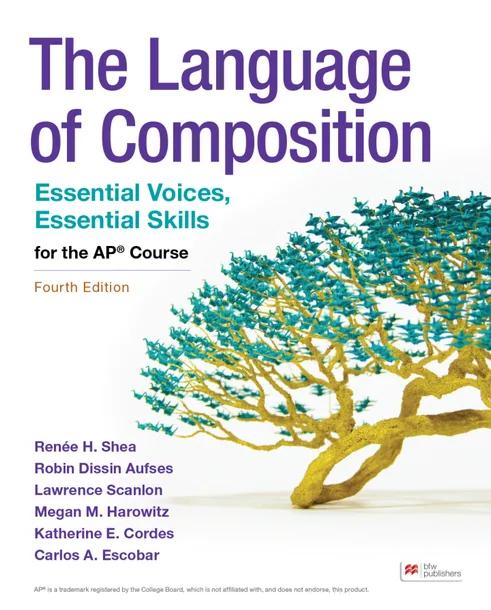
The Language of Composition
Essential Voices, Essential Skills for the AP® Course
by Renee H. Shea, Lawrence Scanlon, Robin Dissin Aufses
4th Edition
Publisher: Bedford/St. Martin's
Book Details
| Print ISBN | 9781319409258 |
| eText ISBN | 9781319469177 |
| Publisher | Bedford/St. Martin's |
| Publishing Year | 2023 |
| Edition | 4th Edition |
| Language | English |
| Pages | 1216 |
The Language of Composition, 4th Edition provides high school students with writing instruction, reading analysis, and practical exercises aligned with the AP English Language and Composition Exam. Written by Renee H. Shea, Lawrence Scanlon, Robin Dissin Aufses, Megan M. Harowitz, Katherine E. Cordes, and Carlos A. Escobar, this textbook supports AP English Language students seeking targeted preparation in rhetoric and writing.
Instruction focuses on fundamental composition skills organized through individual chapters on rhetorical analysis, argument, and synthesis. These core chapters supply exercises and methodological guidance designed to build student competency in analyzing written texts and drafting well-supported academic essays.
The volume also incorporates thematic reading sections that cover distinct topic areas: identity, environment, money, community, justice, and culture. Together, the skill-building units and thematic readings provide structured support for students working toward mastery in AP English Language coursework.
Table of Contents
Chapter 1: Rhetorical Analysis
- • Section 1
- • The Rhetorical Situation
- • Rhetorical Appeals
- • Analyzing Rhetoric and Style
- • Culminating Activity / Section 1: Analyzing Rhetoric: Defending a Claim with Evidence
- • Section 2
- • From Reading to Writing: Crafting an AP® Rhetorical Analysis Essay
- • Culminating Activity / Section 2: Crafting an AP® Rhetorical Analysis Essay
- • Section 3
- • Developing Sophistication in an AP® Rhetorical Analysis Essay
- • Culminating Activity / Section 3: Developing Sophistication in an AP® Rhetorical Analysis Essay
Chapter 2: Argument
- • Section 1
- • What Is Argument?
- • Understanding Claims
- • Understanding and Analyzing Evidence
- • Logical Reasoning and Organization: Shaping an Argument
- • Culminating Activity / Section 1: Analyzing Argument: Defending a Claim with Evidence
- • Section 2
- • From Reading to Writing: Crafting an AP® Argument Essay
- • Culminating Activity / Section 2: Crafting an AP® Argument Essay
- • Section 3
- • Developing Sophistication in an AP® Argument Essay
- • Culminating Activity / Section 3: Developing Sophistication in an AP® Argument Essay
Chapter 3: Synthesis
- • Section 1
- • Approaching Sources in Arguments
- • Examining Sources in Arguments
- • Synthesizing Sources
- • Using Sources to Inform an Argument
- • Using Sources to Appeal to an Audience
- • Culminating Activity / Section 1: Synthesizing Sources
- • Section 2
- • From Reading to Writing: Crafting an AP® Synthesis Essay
- • Culminating Activity / Section 2: Crafting an AP® Synthesis Essay
- • How Free Is Free Speech?
- • Section 3
- • Developing Sophistication in an AP® Synthesis Essay
- • Culminating Activity / Section 3: Developing Sophistication in an AP® Synthesis Essay
Chapter 4: Identity
- • Chapter Introduction / AP® Unit 4
- • Central Essay / Amy Tan, Mother Tongue
- • Classic Essay / Zora Neale Hurston, How It Feels to Be Colored Me
- • Other Voices
- • Visual Text
- • Conversation / Defining Masculinity
- • AP® Multiple-Choice Practice
- • Suggestions for Writing / Identity
Chapter 5: Environment
- • Chapter Introduction / AP® Unit 5
- • Central Essay / Bill McKibben, 2050: How Earth Survived
- • Classic Essay / Rachel Carson, from Silent Spring
- • Other Voices
- • Visual Text
- • Conversation / Animal Conservation
- • AP® Multiple-Choice Practice
- • Suggestions for Writing / Environment
Chapter 6: Money
- • Chapter Introduction / AP® Unit 6
- • Central Essay / Barbara Ehrenreich, from Serving in Florida
- • Classic Essay / Jonathan Swift, A Modest Proposal
- • Other Voices
- • Visual Texts
- • Conversation / Paying for College
- • AP® Multiple-Choice Practice
- • Suggestions for Writing / Money
Chapter 7: Community
- • Chapter Introduction / AP® Unit 7
- • Central Essay / Rebecca Solnit, from A Paradise Built in Hell
- • Classic Essay / Martin Luther King Jr., Letter from Birmingham Jail
- • Other Voices
- • Visual Text
- • Conversation / Reparations
- • AP® Multiple-Choice Practice
- • Suggestions for Writing / Community
Chapter 8: Justice
- • Chapter Introduction / AP® Unit 8
- • Central Essay / Ta-Nehisi Coates, from Between the World and Me
- • Classic Essay / Henry David Thoreau, On the Duty of Civil Disobedience
- • Other Voices
- • Visual Texts
- • Conversation / The Second Amendment
- • AP® Multiple-Choice Practice
- • Suggestions for Writing / Justice
Chapter 9: Culture
- • Chapter Introduction / AP® Unit 9
- • Central Essay / Toni Morrison, Nobel Prize Lecture
- • Classic Essay / Joan Didion, On Self-Respect
- • Other Voices
- • Visual Texts
- • Conversation / Cultural Appropriation
- • AP® Multiple-Choice Practice
- • Suggestions for Writing / Culture
Customer Reviews
0.0
0 reviews
No reviews yet. Be the first to review this book!
Write a Review
Reviewed by GradeFocus Editorial Team
▶Research Sources (11)
- The Language of Composition by: Renee Shea
- The Language of Composition, 4th Edition
- Purposeful Design Publications Language Arts Series
- The Language of Composition
- Books | Thoughtful Learning K-12
- Open-Access Textbooks
- The language of composition : reading, writing, rhetoric
- The Language of Composition: Essentia...Show more
- The Language of Composition - 4th Edition - Solutions and Answers
- The Language of Composition 4th Edition | Renee Shea
- The Language of Composition 4th Edition PDF