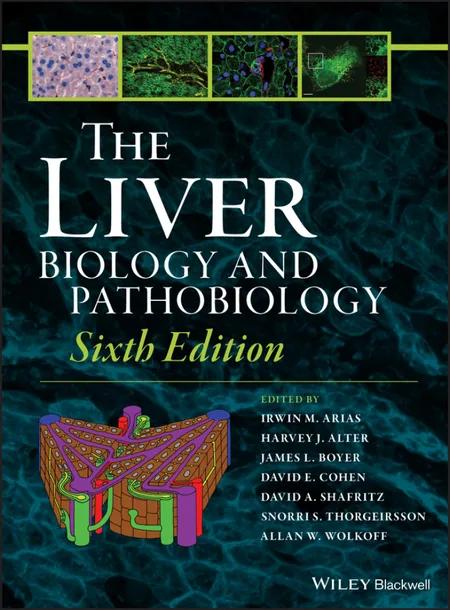
The Liver
Biology and Pathobiology
by Irwin M. Arias, Harvey J. Alter, James L. Boyer
6th Edition
Publisher: Wiley-Blackwell
Book Details
| Print ISBN | 9781119436829 |
| eText ISBN | 9781119436836 |
| Publisher | Wiley-Blackwell |
| Publishing Year | 2020 |
| Edition | 6th Edition |
| Language | English |
| Pages | 1152 |
The Liver: Biology and Pathobiology, 6th Edition, connects hepatic molecular physiology to disease pathology and practical clinical applications. It establishes a direct link between fundamental laboratory science and clinical hepatology.
The volume addresses core liver functions, cellular biology, growth, and regeneration. Key subject areas include liver RNA structure and function, gene editing, single-cell and single-molecule genomic analyses, hepatitis molecular biology, and therapeutic mechanisms.
The 2020 edition includes sixteen Horizons chapters exploring emerging science and technology, supported by full-color illustrations. It serves as a resource for hepatologists, gastroenterologists, transplant surgeons, and biomedical researchers in cell biology, virology, and drug metabolism.
Table of Contents
Chapter 1: Organizational Principles of the Liver
Chapter 2: Embryonic Development of the Liver
Chapter 3: Cytoskeletal Motors: Structure and Function in Hepatocytes
Chapter 4: Hepatocyte Surface Polarity
Chapter 5: Primary Cilia
Chapter 6: Endocytosis in Liver Function and Pathology
Chapter 7: The Hepatocellular Secretory Pathway
Chapter 8: Mitochondrial Function, Dynamics, and Quality Control
Chapter 9: Nuclear Pore Complex
Chapter 10: Protein Maturation and Processing at the Endoplasmic Reticulum
Chapter 11: Protein Degradation and the Lysosomal System
Chapter 12: Peroxisome Assembly, Degradation, and Disease
Chapter 13: Organelle–Organelle Contacts: Origins and Functions
Chapter 14: Gap and Tight Junctions in Liver: Structure, Function, and Pathology
Chapter 15: Ribosome Biogenesis and its Role in Cell Growth and Proliferation in the Liver
Chapter 16: miRNAs and Hepatocellular Carcinoma
Chapter 17: Hepatocyte Apoptosis: Mechanisms and Relevance in Liver Diseases
Chapter 18: Copper Metabolism and the Liver
Chapter 19: The Central Role of the Liver in Iron Storage and Regulation of Systemic Iron Homeostasis
Chapter 20: Disorders of Bilirubin Metabolism
Chapter 21: Hepatic Lipid Droplets in Liver Function and Disease
Chapter 22: Lipoprotein Metabolism and Cholesterol Balance
Chapter 23: Bile Acid Metabolism in Health and Disease: An Update
Chapter 24: TGR5 (GPBAR1) in the Liver
Chapter 25: Bile Acids as Signaling Molecules
Chapter 26: Hepatic Adenosine Triphosphate ]Binding Cassette Transport Proteins and Their Role in Physiology
Chapter 27: Basolateral Plasma Membrane Organic Anion Transporters
Chapter 28: Hepatic Nuclear Receptors
Chapter 29: Molecular Cholestasis
Chapter 30: Pathophysiologic Basis for Alternative Therapies for Cholestasis
Chapter 31: Adaptive Regulation of Hepatocyte Transporters in Cholestasis
Chapter 32: Cholangiocyte Biology and Pathobiology
Chapter 33: Polycystic Liver Diseases: Genetics, Mechanisms, and Therapies
Chapter 34: The Liver Sinusoidal Endothelial Cell: Basic Biology and Pathobiology
Chapter 35: Fenestrations in the Liver Sinusoidal Endothelial Cell
Chapter 36: Stellate Cells and Fibrosis
Chapter 37: Non ]alcoholic Fatty Liver Disease and Insulin Resistance
Chapter 38: AMPK: Central Regulator of Glucose and Lipid Metabolism and Target of Type 2 Diabetes Therapeutics
Chapter 39: Insulin ]Mediated PI3K and AKT Signaling
Chapter 40: Ca2+ Signaling in the Liver
Chapter 41: Clinical Genomics of NAFLD
Chapter 42: Stem Cell ]Fueled Maturational Lineages in Hepatic and Pancreatic Organogenesis
Chapter 43: Developmental Morphogens and Adult Liver Repair
Chapter 44: Liver Repopulation by Cell Transplantation and the Role of Stem Cells in Liver Biology
Chapter 45: Liver Regeneration
Chapter 46: β ]Catenin Signaling
Chapter 47: Polyploidy in Liver Function, Mitochondrial Metabolism, and Cancer
Chapter 48: Hepatic Encephalopathy
Chapter 49: The Kidney in Liver Disease
Chapter 50: α1 ]Antitrypsin Deficiency
Chapter 51: Pathophysiology of Portal Hypertension
Chapter 52: Non ]alcoholic Fatty Liver Disease: Mechanisms and Treatment
Chapter 53: Alcoholic Liver Disease
Chapter 54: Drug ]Induced Liver Injury
Chapter 55: Oxidative Stress and Inflammation in the Liver
Chapter 56: The Role of Bile Acid ]Mediated Inflammation in Cholestatic Liver Injury
Chapter 57: Toll ]like Receptors in Liver Disease
Chapter 58: Experimental Models of Liver Cancer: Genomic Assessment of Experimental Models
Chapter 59: Epidemiology of Hepatocellular Carcinoma
Chapter 60: Mutations and Genomic Alterations in Liver Cancer
Chapter 61: Treatment of Liver Cancer
Chapter 62: Molecular Biology of Hepatitis Viruses
Chapter 63: Immune Mechanisms of Viral Clearance and Disease Pathogenesis During Viral Hepatitis
Chapter 64: Clinical Implications of the Molecular Biology of Hepatitis B Virus
Chapter 65: Viral Escape Mechanisms in Hepatitis C and the Clinical Consequences of Persistent Infection
Chapter 66: Tracking Hepatitis C Virus Interactions with the Hepatic Lipid Metabolism : A Hitchhiker’s Guide to Solve Remaining Translational Research Challenges in Hepatitis C
Chapter 67: Nucleoside Antiviral Agents for HCV: What’s Left to Do?
Chapter 68: Hepatitis E Virus: An Emerging Zoonotic Virus Causing Acute and Chronic Liver Disease
Chapter 69: Biological Principles and Clinical Issues Underlying Liver Transplantation for Viral ]Induced End ]Stage Liver Disease in the Era of Highly Effective Direct ]Acting Antiviral Agents
Chapter 70: Time for the Elimination of Hepatitis C Virus as a Global Health Threat
Chapter 71: Genome Editing by Targeted Nucleases and the CRISPR/Cas Revolution
Chapter 72: Imaging Cellular Proteins and Structures: Smaller, Brighter, and Faster
Chapter 73: Liver ]Directed Gene Therapy
Chapter 74: Telomeres and Telomerase in Liver Generation and Cirrhosis
Chapter 75: Toxins and Biliary Atresia
Chapter 76: The Dual Role of ABC Transporters in Drug Metabolism and Resistance to Chemotherapy
Chapter 77: Stem Cell ]Derived Liver Cells: From Model System to Therapy
Chapter 78: Extracellular Vesicles and Exosomes: Biology and Pathobiology
Chapter 79: Integrated Technologies for Liver Tissue Engineering
Chapter 80: Pluripotent Stem Cells and Reprogramming: Promise for Therapy
Chapter 81: Chromatin Regulation and Transcription Factor Cooperation in Liver Cells
Chapter 82: Drug Interactions in the Liver
Chapter 83: Metabolic Regulation of Hepatic Growth
Chapter 84: The Gut Microbiome and Liver Disease
Chapter 85: Lineage Tracing: Efficient Tools to Determine the Fate of Hepatic Cells in Health and Disease
Chapter 86: The Hepatocyte as a Household for Plasmodium Parasites
Customer Reviews
0.0
0 reviews
No reviews yet. Be the first to review this book!
Write a Review
Reviewed by GradeFocus Editorial Team