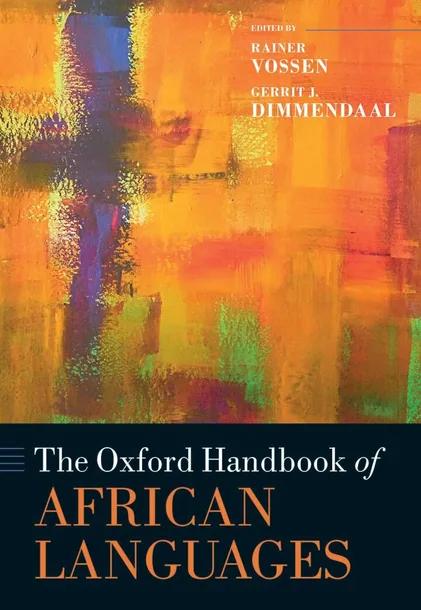
The Oxford Handbook of African Languages
by Rainer Vossen, Gerrit J. Dimmendaal
1st Edition
Publisher: Oxford University Press
Book Details
| Print ISBN | 9780199609895 |
| eText ISBN | 9780191007385 |
| Publisher | Oxford University Press |
| Publishing Year | 2020 |
| Edition | 1st Edition |
| Language | English |
| Pages | 1056 |
The Oxford Handbook of African Languages, 1st Edition, edited by Rainer Vossen and Gerrit J. Dimmendaal, provides an extensive reference on the linguistic systems of Africa. It synthesizes scholarship across descriptive linguistics, anthropology, and linguistic typology.
The volume explores Africa's linguistic landscape, covering languages commonly grouped into the Niger-Congo, Afro-Asiatic, Nilo-Saharan, and Khoisan phyla. Chapters examine foundational grammatical domains, language comparison, and classification history.
In addition to broader familial surveys, the handbook features grammatical sketches of eighteen representative languages and examines cultural topics such as colour terminology and language endangerment.
Table of Contents
Chapter 1: Introduction
Chapter 2: Phonology and phonetics
Chapter 3: Tone
Chapter 4: Morphology
Chapter 5: Syntax
Chapter 6: African language types
Chapter 7: Dialectology and linguistic geography
Chapter 8: Reflections on the history of African language classification
Chapter 9: Niger-Congo, with a special focus on Benue-Congo
Chapter 10: Atlantic
Chapter 11: Mande
Chapter 12: Kwa
Chapter 13: Gur
Chapter 14: Bantu and Bantoid
Chapter 15: Adamawa
Chapter 16: Ubangi
Chapter 17: Kordofanian
Chapter 18: Afro-Asiatic overview
Chapter 19: Egyptian
Chapter 20: Berber
Chapter 21: East Cushitic
Chapter 22: North Cushitic
Chapter 23: Central Cushitic
Chapter 24: South Cushitic
Chapter 25: Omotic
Chapter 26: Chadic
Chapter 27: Ethio-Semitic
Chapter 28: Nilo-Saharan and its limits
Chapter 29: Saharan
Chapter 30: Eastern Sudanic
Chapter 31: Central Sudanic
Chapter 32: Khoisan
Chapter 33: Linguistic isolates
Chapter 34: Bom-Kim
Chapter 35: Dan
Chapter 36: Biali
Chapter 37: Yukuben
Chapter 38: Bende
Chapter 39: Waja
Chapter 40: Zande
Chapter 41: Zenaga
Chapter 42: Sidaama
Chapter 43: Kolisi
Chapter 44: Iraqw
Chapter 45: Wandala
Chapter 46: Kumam
Chapter 47: Baale
Chapter 48: Songhay languages
Chapter 49: Cara
Chapter 50: ǁ?X'egwi
Chapter 51: Sandawe
Chapter 52: Ideophones
Chapter 53: Colour term systems: Genetic vs areal distribution in Sub-Saharan Africa
Chapter 54: Experiencer constructions
Chapter 55: Language and ethnobotany
Chapter 56: Distinctive languages
Chapter 57: Conversation analysis
Chapter 58: Cognition and language
Chapter 59: Indigenous African scripts
Chapter 60: Language policy and politics
Chapter 61: Language and education
Chapter 62: Language endangerment, documentation, and revitalization
Chapter 63: Language birth: youth/town language
Chapter 64: Language contact
Chapter 65: Mixed languages: The case of Ma'a/Mbugu
Chapter 66: African languages in the Diaspora
Chapter 67: Pidgin and creole languages
Chapter 68: Sign languages
Chapter 69: Arabic in Africa
Chapter 70: Orthography standardization
Chapter 71: Pragmatics and communication
Chapter 72: African languages in information and communication technology
Chapter 73: Words, things, and meaning: Linguistics as a tool for historical reconstruction
Chapter 74: Language and archaeology
Chapter 75: Narratives
Chapter 76: Proverbs
Chapter 77: Poetry
Customer Reviews
0.0
0 reviews
No reviews yet. Be the first to review this book!
Write a Review
Reviewed by GradeFocus Editorial Team