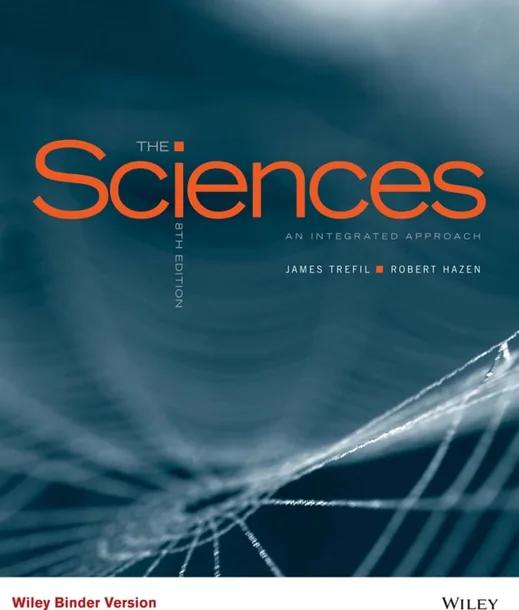
The Sciences: An Integrated Approach
by James Trefil, Robert M. Hazen
8th Edition
Publisher: Wiley
Book Details
| Print ISBN | 9781119049685 |
| eText ISBN | 9781119234333 |
| Publisher | Wiley |
| Publishing Year | 2016 |
| Edition | 8th Edition |
| Language | English |
| Pages | 640 |
The Sciences: An Integrated Approach, 8th Edition, is a textbook designed to help students achieve scientific literacy. The text approaches science as a seamless web of knowledge about the universe, emphasizing general principles and their application to real-world situations.
Coverage brings together physics, chemistry, astronomy, earth sciences, and biology. The volume explores concepts across these fields, introducing topics such as thermodynamics, electromagnetic radiation, planetary systems, ecology, cellular biology, and genetics.
Written at a detail level appropriate for non-science majors, the textbook uses Great Ideas statements to set up a unifying framework. These statements help learners connect everyday observations to broad scientific principles across disciplines.
Table of Contents
Chapter 1: Science: A Way of Knowing
- • How do you know what you know?
- • The Role of Science
- • The Scientific Method
- • Other Ways of Knowing
- • The Organization of Science
Chapter 2: The Ordered Universe
- • Why do planets appear to wander slowly across the sky?
- • The Night Sky
- • The Birth of Mechanics
- • Isaac Newton and the Universal Laws of Motion
- • Momentum
- • The Universal Force of Gravity
Chapter 3: Energy
- • Why must animals eat to stay alive?
- • The Great Chain of Energy
- • Forms of Energy
- • The Interchangeability of Energy
- • The First Law of Thermodynamics: Energy is Conserved
- • The United States and Its Energy Future
Chapter 4: Heat and the Second Law of Thermodynamics
- • Why is it easier to make an omelet from an egg than to make an egg from an omelet?
- • Nature’s Direction
- • Coming to Terms with Heat
- • Heat Transfer
- • The Second Law of Thermodynamics
- • Consequences of the Second Law
Chapter 5: Electricity and Magnetism
- • What is lightning?
- • Nature’s Other Forces
- • Static Electricity
- • Magnetism
- • Batteries and Electric Circuits
- • Connections Between Electricity and Magnetism
- • Electrical Effects from Magnetism
Chapter 6: Waves and Electromagnetic Radiation
- • What is color?
- • The Nature of Waves
- • The Electromagnetic Wave
- • The Electromagnetic Spectrum
Chapter 7: Albert Einstein and the Theory of Relativity
- • Can a human ever travel faster than the speed of light, at “warp speed”?
- • Frames of Reference
- • Special Relativity
- • General Relativity
Chapter 8: The Atom
- • Why are there so many different materials in the world?
- • The Smallest Pieces
- • The Structure of the Atom
- • When Matter Meets Light
- • Spectroscopy
Chapter 9: Quantum Mechanics
- • How can the electron behave like both a particle and a wave?
- • The World of the Very Small
- • Probabilities
- • Wave-Particle Duality
- • Wave-Particle Duality and the Bohr Atom
- • Quantum Entanglement
Chapter 10: Atoms in Combination: The Chemical Bond
- • How does blood clot?
- • Our Material World
- • Electron Shells and Chemical Bonds
- • Types of Chemical Bonds
- • Chemical Reactions and the Formation of Chemical Bonds
- • Common Chemical Reactions
- • Building Molecules: The Hydrocarbons
Chapter 11: Materials and Their Properties
- • How have computers gotten so much faster?
- • Materials and the Modern World
- • The Strengths of Materials
- • Magnetic Properties of Materials
- • Microchips and the Information Revolution
- • Information
Chapter 12: The Nucleus of the Atom
- • How do scientists determine the age of the oldest human fossils?
- • Empty Space, Explosive Energy
- • The Organization of the Nucleus
- • Radioactivity
- • Energy from the Nucleus
Chapter 13: The Ultimate Structure of Matter
- • How can antimatter be used to probe the human brain?
- • Of What is the Universe Made?
- • Discovering Elementary Particles
- • The Elementary Particle Zoo
- • The Four Fundamental Forces
- • Quantum Gravity, Strings, and Theories of Everything
Chapter 14: The Stars
- • How much longer can the Sun sustain life on Earth?
- • The Nature of Stars
- • The Anatomy of Stars
- • The Variety of Stars
- • The Life Cycles of Stars
Chapter 15: Cosmology
- • Will the universe end?
- • Edwin Hubble and the Discovery of Galaxies
- • The Redshift and Hubble’s Law
- • The Large-Scale Structure of the Universe
- • The Evolution of the Universe
- • Of What is the Universe Made?
Chapter 16: Earth and Other Planets
- • Is Earth the only planet with life?
- • The Formation of the Solar System
- • The Nebular Hypothesis
- • Exploring the Solar System
- • Extrasolar Planets
Chapter 17: Plate Tectonics
- • Can we predict destructive earthquakes?
- • Dynamic Earth
- • Plate Tectonics: A Unifying View of Earth
- • Another Look at Volcanoes and Earthquakes
Chapter 18: Earth’s Many Cycles
- • Will we ever run out of fresh water?
- • Cycles Small and Large
- • The Hydrologic Cycle
- • The Atmospheric Cycle
- • The Rock Cycle
Chapter 19: Ecology, Ecosystems, and the Environment
- • Are human activities affecting the global environment?
- • Ecology and Ecosystems
- • The Law of Unintended Consequences
- • Threats to the Global Ecosystem and Environment
- • Debates about Global Climate Change
Chapter 20: Strategies of Life
- • The Organization of Living Things
- • What is Life?
- • Classifying Living Things
- • Survival: A New Look at the Life Around You
Chapter 21: The Living Cell
- • What is the smallest living thing?
- • The Nature and Variety of Cells
- • The Cell Theory
- • How Does a Cell Work?
- • Metabolism: Energy and Life
- • Cell Division
Chapter 22: Molecules of Life
- • What constitutes a healthy diet?
- • Organic Molecules
- • Proteins: The Workhorses of Life
- • Proteins as Enzymes
- • Carbohydrates
- • Lipids
- • Minerals and Vitamins
Chapter 23: Classical and Modern Genetics
- • Why do offspring resemble their parents?
- • Classical Genetics
- • DNA and the Birth of Molecular Genetics
- • The Genetic Code
- • Viruses
- • The Human Genome
Chapter 24: The New Science of Life
- • Can we cure cancer?
- • Genetic Engineering
- • DNA Fingerprinting
- • Stem Cells, Cloning, and Regenerative Medicine
- • Cancer—A Different Kind of Genetic Disease
- • Gene Therapy
- • DNA Repair in the Cell
- • Birth of Genomic Science
- • Unraveling the Past: Mitochondrial DNA
Chapter 25: Evolution
- • How did life emerge on the ancient Earth?
- • The Fact of Evolution
- • Chemical Evolution
- • The Window of Opportunity
- • Natural Selection and the Development of Complex Life
- • The Story of Life
- • The Evolution of Human Beings
Customer Reviews
0.0
0 reviews
No reviews yet. Be the first to review this book!
Write a Review
Reviewed by GradeFocus Editorial Team