Book Details
| Print ISBN | 9780137551200 |
| eText ISBN | 9780137551415 |
| Publisher | Pearson |
| Publishing Year | 2023 |
| Edition | 8th Edition |
| Language | English |
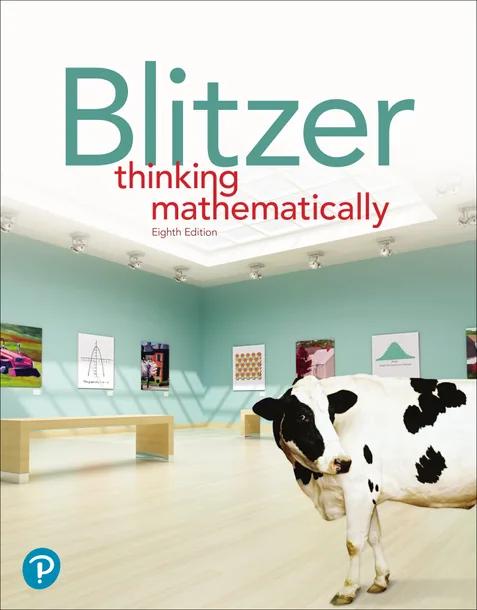
Thinking Mathematically, 8th Edition, by Robert F. Blitzer is a textbook designed to show non-math majors how mathematics applies to everyday life. The text introduces foundational concepts through accessible applications that connect abstract ideas to practical situations.
Coverage spans core mathematical subjects, including critical thinking, set theory, logic, number systems, and algebra. The text also examines quantitative fields such as personal finance, probability, statistics, geometry, voting and apportionment methods, and graph theory.
The 2023 edition updates exercises and examples with new data, including topics such as modeling coronavirus cases and the value of online classes. Each chapter concludes with a summary, review exercises, and a test to provide structured practice.
Table of Contents
Chapter 1: Problem Solving and Critical Thinking
- • 1.1 Inductive and Deductive Reasoning
- • 1.2 Estimation, Graphs, and Mathematical Models
- • 1.3 Problem Solving
Chapter 2: Set Theory
- • 2.1 Basic Set Concepts
- • 2.2 Subsets
- • 2.3 Venn Diagrams and Set Operations
- • 2.4 Set Operations and Venn Diagrams with Three Sets
- • 2.5 Survey Problems
Chapter 3: Logic
- • 3.1 Statements, Negations, and Quantified Statements
- • 3.2 Compound Statements and Connectives
- • 3.3 Truth Tables for Negation, Conjunction, and Disjunction
- • 3.4 Truth Tables for the Conditional and the Biconditional
- • 3.5 Equivalent Statements and Variations of Conditional Statements
- • 3.6 Negations of Conditional Statements and De Morgan's Laws
- • 3.7 Arguments and Truth Tables
- • 3.8 Arguments and Euler Diagrams
Chapter 4: Number Representation and Calculation
- • 4.1 Our Hindu-Arabic System and Early Positional Systems
- • 4.2 Number Bases in Positional Systems
- • 4.3 Computation in Positional Systems
- • 4.4 Looking Back at Early Numeration Systems
Chapter 5: Number Theory and the Real Number System
- • 5.1 Number Theory: Prime and Composite Numbers
- • 5.2 The Integers; Order of Operations
- • 5.3 The Rational Numbers
- • 5.4 The Irrational Numbers
- • 5.5 Real Numbers and Their Properties; Clock Addition
- • 5.6 Exponents and Scientific Notation
- • 5.7 Arithmetic and Geometric Sequences
Chapter 6: Algebra: Equations and Inequalities
- • 6.1 Algebraic Expressions and Formulas
- • 6.2 Linear Equations in One Variable and Proportions
- • 6.3 Applications of Linear Equations
- • 6.4 Linear Inequalities in One Variable
- • 6.5 Quadratic Equations
Chapter 7: Algebra: Graphs, Functions, and Linear Systems
- • 7.1 Graphing and Functions
- • 7.2 Linear Functions and Their Graphs
- • 7.3 Systems of Linear Equations in Two Variables
- • 7.4 Linear Inequalities in Two Variables
- • 7.5 Linear Programming
- • 7.6 Modeling Data: Exponential, Logarithmic, and Quadratic Functions
Chapter 8: Personal Finance
- • 8.1 Percent, Sales Tax, and Discounts
- • 8.2 Income Tax
- • 8.3 Simple Interest
- • 8.4 Compound Interest
- • 8.5 Annuities, Methods of Saving, and Investments
- • 8.6 Cars
- • 8.7 The Cost of Home Ownership
- • 8.8 Credit Cards
Chapter 9: Measurement
- • 9.1 Measuring Length; The Metric System
- • 9.2 Measuring Area and Volume
- • 9.3 Measuring Weight and Temperature
Chapter 10: Geometry
- • 10.1 Points, Lines, Planes, and Angles
- • 10.2 Triangles
- • 10.3 Polygons, Perimeter, and Tessellations
- • 10.4 Area and Circumference
- • 10.5 Volume and Surface Area
- • 10.6 Right Triangle Trigonometry
- • 10.7 Beyond Euclidean Geometry
Chapter 11: Counting Methods and Probability Theory
- • 11.1 The Fundamental Counting Principle
- • 11.2 Permutations
- • 11.3 Combinations
- • 11.4 Fundamentals of Probability
- • 11.5 Probability with the Fundamental Counting Principle, Permutations, and Combinations
- • 11.6 Events Involving *Not* and *Or*; Odds
- • 11.7 Events Involving *And*; Conditional Probability
- • 11.8 Expected Value
Chapter 12: Statistics
- • 12.1 Sampling, Frequency Distributions, and Graphs
- • 12.2 Measures of Central Tendency
- • 12.3 Measures of Dispersion
- • 12.4 The Normal Distribution
- • 12.5 Problem Solving with the Normal Distribution
- • 12.6 Scatter Plots, Correlation, and Regression Lines
Chapter 13: Voting and Apportionment
- • 13.1 Voting Methods
- • 13.2 Flaws of Voting Methods
- • 13.3 Apportionment Methods
- • 13.4 Flaws of Apportionment Method
Chapter 14: Graph Theory
- • 14.1 Graphs, Paths, and Circuits
- • 14.2 Euler Paths and Euler Circuits
- • 14.3 Hamilton Paths and Hamilton Circuits
- • 14.4 Trees
Customer Reviews
0.0
0 reviews
No reviews yet. Be the first to review this book!
Write a Review
Reviewed by GradeFocus Editorial Team