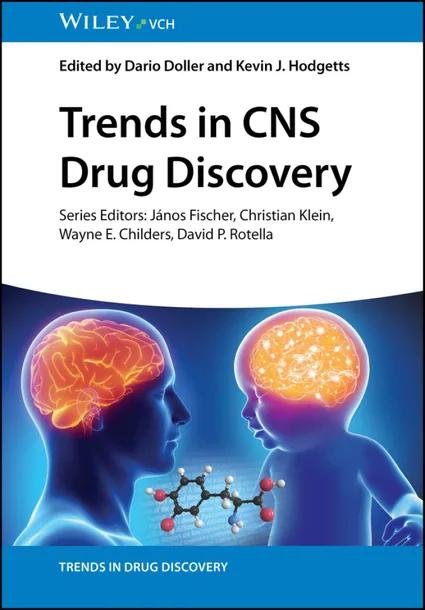
Trends in CNS Drug Discovery
by Dario Doller, Kevin J. Hodgetts, János Fischer
1st Edition
Publisher: Wiley-VCH
Book Details
| Print ISBN | 9783527352807 |
| eText ISBN | 9783527844685 |
| Publisher | Wiley-VCH |
| Publishing Year | 2026 |
| Edition | 1st Edition |
| Language | English |
| Pages | 480 |
Trends in CNS Drug Discovery, 1st Edition, offers a comprehensive reference on emerging therapeutic paradigms and molecular technologies targeting central nervous system disorders. Edited by Dario Doller and Kevin J. Hodgetts, this 480-page volume presents chemical strategies for addressing neurological conditions including Alzheimer's disease, schizophrenia, and epilepsy.
The text examines varied therapeutic modalities, including serotonergic agonists and psychoactive cannabinoids within psychedelics-inspired drug discovery. It details targeted protein degraders, allosteric modulators, combination drugs, and prodrugs designed to optimize clinical outcomes. Methodological coverage integrates biomarkers, animal models, and brain imaging techniques such as PET and MRI.
A primary feature includes nonregulated preclinical neuroscience research, emphasizing experimental design rigor, data reporting standards, and reproducible methods. This publication provides targeted coverage for academic researchers, industry professionals, and graduate students across medicinal chemistry, neurobiology, and pharmaceutical sciences.
Table of Contents
Chapter 1: CNS Drug Discovery in "The Century of Biology"
- • 1.1 Welcome to "The Century of Biology"!
- • 1.2 Understanding Brain Health Around theWorld
- • 1.3 Where Are New CNS Drugs Coming from?
- • 1.4 Psychedelics as Potential Therapeutic Drugs
- • 1.5 CNS Drugs Acting at Novel Biological Targets
- • 1.6 Starting with the End in Mind: Defining a CNS Disease
- • 1.7 Where to Go from Here
Chapter 2: Advances in Disease Modifying Therapies for Parkinson's Disease
- • 2.1 Introduction
- • 2.2 Parkinson's Disease Pathology
- • 2.3 Disease-Modifying Treatments for Parkinson's Disease
- • 2.4 Progress and Challenges
Chapter 3: Psychedelics-Inspired Drug Discovery
- • 3.1 Introduction
- • 3.2 What Are Psychedelics and What Makes a Compound, Psychedelic?
- • 3.3 What Is Known about the Therapeutic Mechanism of Action of Psychedelics?
- • 3.4 Typical Psychedelics
- • 3.5 Non-psychedelic Serotonergic Agonists
- • 3.6 Atypical Psychedelics
- • 3.7 Psychoactive Cannabinoids as Atypical Psychedelics
- • 3.8 Conclusion
Chapter 4: Epilepsy and Related Seizure Disorders
- • 4.1 Introduction
- • 4.2 Models and Mechanisms of Drug-Resistant Epilepsy
- • 4.3 Targets for Drug Development
- • 4.4 Future Challenges in Epilepsy Drug Development
Chapter 5: Strategies for Neuroprotection in Alzheimer's Disease
- • 5.1 Introduction
- • 5.2 Targeting Pathogenic Protein Aggregation
- • 5.3 Oxidative Stress and Mitochondrial Dysfunction
- • 5.4 Neuroinflammation
- • 5.5 Protein Processing Pathways
- • 5.6 Conclusions
Chapter 6: Rigor in Experimental Design in Nonregulated Preclinical Research in Neuroscience Drug Discovery
- • 6.1 Introduction
- • 6.2 What Makes Data Robust?
- • 6.3 Other Types of Validity and Poor Translatability
- • 6.4 Threats to Robust Data
- • 6.5 Reporting Standards
- • 6.6 AnimalWelfare
- • 6.7 Regulated Versus Nonregulated Nonclinical Studies
- • 6.8 Conclusion
Chapter 7: Biomarkers in CNS Drug Discovery, Drug Development, and Clinical Implementation
- • 7.1 Introduction
- • 7.2 Biomarkers in Drug Discovery, Development, and Clinical Implementation
- • 7.3 Biomarkers for Alzheimer's Disease: History and Overview
- • 7.4 Pharmacodynamic and Candidate Surrogate Biomarkers for AD
- • 7.5 Discovering New Biomarkers for AD: An Ongoing Need
- • 7.6 Case Study: Example of Successful Discovery of New Candidate Biomarkers Through Proteomics in the SHINE-A Clinical Cohort
- • 7.7 Advancements in Biomarker Discovery and Development for Neurodegenerative Diseases Beyond AD
- • 7.8 Conclusions and Future Directions
Chapter 8: Positron Emission Tomography (PET) and Magnetic Resonance Imaging (MRI) in CNS Drug Discovery
- • 8.1 Introduction
- • 8.2 PET Imaging in Clinical Drug Development
- • 8.3 PET Radioligand Discovery and Development
- • 8.4 Conclusion
Chapter 9: Bioanalytical Strategies to De-risk CNS Drug Discovery for Novel Chemical Modalities
- • 9.1 Introduction
- • 9.2 Permeation of Molecules into the Brain: Key Compartments and Processes
- • 9.3 Key Considerations for Novel Chemical and Biological Constructs
- • 9.4 A Brief History of the Kp,uu Concept and Its Importance for CNS-Focused Drug Design
- • 9.5 Moving Beyond the Rule-of-5 and Newer Territory for CNS Drugs
- • 9.6 Understanding Analytical Errors and Variability in Brain Penetration Measurements
- • 9.7 Potential Bioanalytical Technologies for Novel Modalities
- • 9.8 Bioanalytical Approaches to Account for Brain Concentration and Brain Vascular Volume
- • 9.9 Measuring Target Engagement
- • 9.10 Summary and Conclusions
Chapter 10: Discovery of ABBV-951 (VYALEVTM/PRODUODOPA®) for Advanced Parkinson's Disease
- • 10.1 Introduction
- • 10.2 Synthesis of Levodopa and Carbidopa Phosphate Prodrugs
- • 10.3 Preclinical Characterization
- • 10.4 Clinical First-in-Human and Phase 1 Studies
- • 10.4.1 First-in-human ABBV-951 Study
- • 10.4.2 First in Patient ABBV-951 Study
- • 10.5 Conclusions
Chapter 11: Inducers of Targeted Protein Degradation as Drug Candidates for Neurodegenerative Disorders
- • 11.1 Introduction
- • 11.2 PROTACs for NDs
- • 11.3 Hydrophobic Tagging for the Treatment of NDs
- • 11.4 Approaches Exploiting Lysosomal Degradation for Treatment of NDs
- • 11.5 Other TPD Strategies for the Treatment of NDs
- • 11.6 Availability of TPD Drugs in the CNS
- • 11.7 Summary and Outlook
Chapter 12: Kinase Inhibitors for the Treatment of Brain Diseases
- • 12.1 Introduction
- • 12.2 Kinase Inhibitors for the Treatment of Brain Tumors
- • 12.3 Kinase Inhibitors for the Treatment of Nononcologic Brain Diseases
- • 12.4 Perspectives
Chapter 13: An Academic Laboratory's Approach for Discovering CNS-Active Drug-Like Small Molecules for the Treatment of SMA
- • 13.1 Introduction
- • 13.2 Design of a Library of Riluzole Analogs
- • 13.3 Conclusions
Chapter 14: Medicinal Chemistry "in the System": A CNS Drug Design Narrative Fit for the Century of Biology
- • 14.1 Introduction: Like Biology, Drug Design Is Getting More Complex
- • 14.2 Allosteric Modulation: Transitioning from a Two-Particle to a Three-Particle System
- • 14.3 Orthosteric Drug or Allosteric Drug?
- • 14.4 Examples of Allosteric Modulators Progressing in the Clinic for CNS Indications
- • 14.5 Can Allosteric Functional Effects Be Predicted? The Five Dimensions of Protein Function
- • 14.6 Allosteric Binding Sites: Examples of Allosteric Function
- • 14.7 Beyond Allosterism: Progress Toward Drug Discovery "in a system"
- • 14.8 Non-small Molecule Therapeutics for CNS Disorders
- • 14.9 Summary and a Look Ahead
Chapter 15: The Role of Venture Capital in Drug Discovery
- • 15.1 Introduction
- • 15.2 Sources of Funding: Focusing on the Best Path for Future Success
- • 15.3 Your Company's Value Proposition
- • 15.4 Identifying Key Stakeholders to Ensure Product Adoption
- • 15.5 The Role of Market Definition in Defining the Discovery Opportunity
- • 15.6 Leverage Points in the Buying Process
- • 15.7 Understanding the Competitive Landscape
- • 15.8 The Benefit Ladder
- • 15.9 Developing and Refining the Business Model
- • 15.10 Building the Team to Take You to the Finish Line
- • 15.11 The Current Investment Landscape in Neurology
- • 15.12 A Bright Future for Neuroscience Investment
Chapter 16: Epilog: CNS Drug Discovery – The Years Ahead
- • Acronyms
- • 16.1 The Dual Frontier: AI and the Human Brain in CNS Drug Discovery
- • 16.2 The Rate of CNS Drug Discovery and Reaction Kinetics Theory
- • 16.3 AI Can Discover Novel Drugs (Under the Right Conditions)
- • 16.4 An Example ofWhat AI Cannot Do: Autoantibody Receptor Encephalitis
- • 16.5 The Limitations of Artificial Intelligence in CNS Drug Discovery
- • 16.6 Conclusion: Toward a Brighter Tomorrow
- • References
Customer Reviews
0.0
0 reviews
No reviews yet. Be the first to review this book!
Write a Review
Reviewed by GradeFocus Editorial Team
▶Research Sources (16)
- Trends in CNS Drug Discovery - Doller, Dario - Hodgetts, Kevin J ...
- Trends in CNS Drug Discovery, eBook by Dario Doller - Booktopia
- Trends in CNS Drug Discovery - - e-bok (9783527844685) | Adlibris ...
- "Trends in CNS Drug Discovery" (eBook) Doller, Dario - buchhaus.ch
- Search - Snapplify Kenya
- Search results - RNIB Bookshare
- Kevin J., Hodgetts - Search - Snapplify Kenya
- Current Trends in Computational Modeling for Drug Discovery - ترب
- Trends in CNS Drug Discovery
- Trends in CNS Drug Discovery (Hardcover) by Dario Doller et al.
- Trends in CNS Drug Discovery
- CNS drug development. Part I: The early period of ...
- Trends in CNS Drug Discovery
- Trends in CNS Drug Discovery
- Download the ebook: 3 Drug Discovery Trends We're ...
- [PDF] Trends in CNS Drug Discovery by Dario Doller