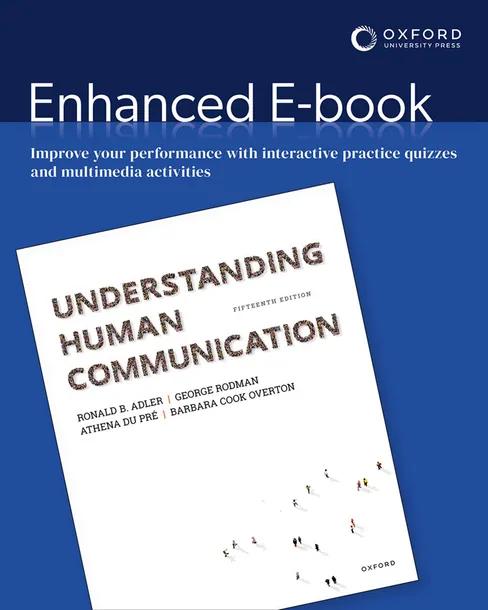
Understanding Human Communication
by Ronald B. Adler, George Rodman, Athena du Pré
15th Edition
Publisher: Oxford University Press
Book Details
| Print ISBN | 9780197615638 |
| eText ISBN | 9780197615676 |
| Publisher | Oxford University Press |
| Publishing Year | 2023 |
| Edition | 15th Edition |
| Language | English |
| Pages | 544 |
Understanding Human Communication, 15th Edition offers college students, educators, and professionals a structured framework for studying human interaction and public speaking. Published by Oxford University Press, this textbook connects foundational theory with practical message design.
The text surveys diverse interaction contexts, beginning with intrapersonal thought processes and dyadic exchanges before expanding into interpersonal relationships. It further details small-group interactions, organizational environments, mass communication systems, and social media channels.
To guide learning across introductory coursework, the 15th edition presents a chapter order designed to construct communication skills in a logical sequence. This layout offers direct support for developing student communication competence.
Table of Contents
Chapter 1: Communication: What and Why
- • 1.1 Characteristics of Communication
- • Defining Communication
- • Transactional Model of Communication
- • 1.2 Types of Communication
- • Intrapersonal Communication
- • Dyadic Communication
- • Interpersonal Communication
- • Small-Group Communication
- • Organizational Communication
- • Public Communication
- • Mass Communication
- • Social Media Communication
- • 1.3 Communication Competence
- • There's No “Ideal” Way to Communicate
- • Competence Is Situational
- • Competence Is Relational
- • Competent Communicators Are Empathic
- • Competence Can Be Learned
- • Competence Requires Effort
- • Competent Communicators Self-Monitor
- • Competent Communicators Are Committed
- • 1.4 Misconceptions About Communication
- • Myth: Communication Requires Complete Understanding
- • Myth: Communication Can Solve All Problems
- • Myth: Communication Is Good
- • Myth: Meanings Are in Words
- • Myth: Communication Is Simple
- • Myth: More Communication Is Always Better
- • MAKING THE GRADE
- • KEY TERMS
- • PUBLIC SPEAKING PRACTICE
- • ACTIVITIES
- • Features
- • Communication Strategies: Maintaining a Healthy Relationship with Social Media
- • Understanding Your Communication: What Type of Communicator Are You?
- • Figures
- • Figure 1.1 Transactional Model of Communication
Chapter 2: Communicating with Social Media
- • 2.1 The Roles of Social and Mass Media
- • Characteristics of Social Media
- • Social Media Uses and Gratifications
- • Masspersonal Communication
- • 2.2 Mediated Versus Face-to-Face Communication
- • Message Richness
- • Synchronicity
- • Permanence
- • 2.3 Benefits and Drawbacks of Social Media
- • Benefits of Social Media
- • Drawbacks of Social Media
- • 2.4 Influences on Mediated Communication
- • Gender
- • Age
- • 2.5 Communicating Competently with Social Media
- • Maintaining Positive Relationships
- • Protecting Yourself
- • MAKING THE GRADE
- • KEY TERMS
- • PUBLIC SPEAKING PRACTICE
- • ACTIVITIES
- • Features
- • Understanding Your Communication: What Type of Social Media Communicator Are You?
- • Communication Strategies: Using LinkedIn for Career Success
- • Communication Strategies: Evaluating (Mis)information
- • Table and Figure
- • Table 2.1 Common Types of Social Media Content
- • Figure 2.1 Overlapping Boundaries Between Different Types of Media
Chapter 3: The Self, Perception, and Communication
- • 3.1 Communication and the Self
- • Self-Concept
- • Self-Esteem
- • Personality
- • Reflected Appraisal
- • Social Comparison
- • Self-Fulfilling Prophecies
- • 3.2 Perceiving Others
- • Selection
- • Organization
- • Interpretation
- • 3.3 Problematic Perceptual Tendencies
- • Categorizing People
- • Clinging to First Impressions
- • Paying More Attention to Negative Impressions than to Positive Ones
- • Judging Yourself More Charitably than You Judge Others
- • Overgeneralizing
- • Gravitating to the Familiar
- • 3.4 Perceptual Skill Builders
- • Emotional Intelligence
- • Perception Checking
- • 3.5 Communication and Identity Management
- • Public and Private Selves
- • Facework
- • Why Manage Identities?
- • Identity Management and Honesty
- • Characteristics of Identity Management
- • MAKING THE GRADE
- • KEY TERMS
- • PUBLIC SPEAKING PRACTICE
- • ACTIVITIES
- • Features
- • Communication Strategies: Keeping It Real on Social Media
- • Communication Strategies: Ways to Reverse Self-Defeating Thinking
- • Communication Strategies: Focus on Individuality Rather than Stereotypes
- • Understanding Your Communication: How Emotionally Intelligent Are You?
- • Communication Strategies: Should You Humblebrag in Job Interviews?
- • Communication Strategies: Work Lessons from Undercover Boss
- • Figure
- • Figure 3.1 The Figure-Ground Principle
Chapter 4: Communication and Culture
- • 4.1 Understanding Cultures and Cocultures
- • Salience
- • In-Group and Out-Group
- • 4.2 How Cultural Values and Norms Shape Communication
- • Individualism and Collectivism
- • High and Low Cultural Context
- • Uncertainty Avoidance
- • Power Distance
- • Talk and Silence
- • 4.3 Cocultures' Influence on Communication
- • Intersectionality Theory
- • Race and Ethnicity
- • Sex and Gender
- • Religion
- • Disability
- • Political Viewpoints
- • Age/Generation
- • 4.4 Becoming an Effective Intercultural Communicator
- • Contact with a Diverse Array of People
- • Tolerance for Ambiguity
- • Open-Mindedness
- • Knowledge and Skill
- • Patience and Perseverance
- • MAKING THE GRADE
- • KEY TERMS
- • PUBLIC SPEAKING PRACTICE
- • ACTIVITIES
- • Features
- • Understanding Your Communication: How Much Do You Know About Other Cultures?
- • Communication Strategies: Talking About Race
- • Communication Strategies: Communicating Respectfully About Gender
- • Communication Strategies: Discussing Politics Responsibly on Social Media
- • Communication Strategies: Coping with Culture Shock
- • Tables
- • Table 4.1 Individualistic Versus Collectivistic Cultures
- • Table 4.2 High- and Low-Context Communication
- • Table 4.3 Differences Between Low and High Uncertainty Avoidance
- • Table 4.4 Differences Between Low and High Power Distance
Chapter 5: Language
- • 5.1 The Nature of Language
- • Language Is Symbolic
- • Words Have Varying Interpretations
- • Meaning Is Negotiated
- • Language Is Governed by Rules
- • 5.2 The Power of Language
- • Gender References
- • Names
- • Accents
- • Assertive and Collaborative Language
- • 5.3 Language and Misunderstandings
- • Abstract Language
- • Equivocal Language
- • Relative Words
- • Slang
- • Jargon
- • Euphemisms
- • 5.4 Troublesome Language
- • Confusion About Facts, Inferences, and Opinions
- • Lies and Evasions
- • Emotive Language
- • Microaggressions
- • MAKING THE GRADE
- • KEY TERMS
- • PUBLIC SPEAKING PRACTICE
- • ACTIVITIES
- • Features
- • Understanding Your Communication: How Do You Use Language?
- • Communication Strategies: Balancing Assertive and Collaborative Language
- • Communication Strategies: Expressing Yourself Clearly
- • Communication Strategies: Distinguishing Between Facts and Opinions
- • Communication Strategies: Engaging in Microresistance
- • Figure
- • Figure 5.1 Triangle of Meaning
Chapter 6: Listening
- • 6.1 The Value of Listening
- • 6.2 Misconceptions About Listening
- • Myth: Listening and Hearing Are the Same Thing
- • Myth: Listening Is a Natural Process
- • Myth: All Listeners Receive the Same Message
- • Myth: People Have One Listening “Style”
- • Myth: Women are More Supportive Listeners Than Men
- • Myth: The Majority of Listening Happens Offline
- • 6.3 Overcoming Challenges to Effective Listening
- • Message Overload
- • Noise
- • Cultural Differences
- • 6.4 Faulty Listening Habits
- • Pretending to Listen
- • Tuning In and Out
- • Missing the Underlying Point
- • Dividing Attention
- • Being Self-Centered
- • Talking More than Listening
- • Avoiding the Issue
- • Being Defensive
- • 6.5 Listening to Connect and Support
- • Allow Enough Time
- • Be Sensitive to Personal and Situational Factors
- • Ask Questions
- • Listen for Unexpressed Thoughts and Feelings
- • Encourage Further Comments
- • Reflect Back the Speaker's Thoughts
- • Consider the Pros and Cons When Analyzing
- • Reserve Judgment, Except in Rare Cases
- • Think Twice Before Offering Advice or Solutions
- • Offer Comfort, If Appropriate
- • 6.6 Listening to Learn, Analyze, and Critique
- • Task-Oriented Listening
- • Analytical Listening
- • Critical Listening
- • MAKING THE GRADE
- • KEY TERMS
- • PUBLIC SPEAKING PRACTICE
- • ACTIVITIES
- • Features
- • Understanding Your Communication: What Are Your Listening Strengths?
- • Communication Strategies: Listening in a Virtual Space
- • Communication Strategies: Active Listening
- • Communication Strategies: When Is a Question Not a Question?
Chapter 7: Nonverbal Communication
- • 7.1 Characteristics of Nonverbal Communication
- • Nonverbal Communication Is Unavoidable
- • Nonverbal Communication Is Ambiguous
- • Nonverbal Cues Convey Emotion
- • Nonverbal Cues Help Manage Identities
- • Nonverbal Cues Affect Relationships
- • 7.2 Functions of Nonverbal Communication
- • Substituting
- • Complementing
- • Accenting
- • Regulating
- • Contradicting
- • Deceiving
- • 7.3 Types of Nonverbal Communication
- • Body Movements
- • Voice
- • Appearance
- • Touch
- • Space
- • Time
- • 7.4 Influences on Nonverbal Communication
- • Culture
- • Gender
- • MAKING THE GRADE
- • KEY TERMS
- • PUBLIC SPEAKING PRACTICE
- • ACTIVITIES
- • Features
- • Communication Strategies: Making the Most of Nonverbal Communication at Work
- • Understanding Your Communication: How Worldly Are Your Nonverbal Communication Skills?
- • Communication Strategies: Deception Detection Hacks
Chapter 8: Understanding Interpersonal Communication
- • 8.1 Characteristics of Interpersonal Communication
- • What Makes Communication Interpersonal?
- • Content and Relational Messages
- • 8.2 Interpersonal Relationship Building
- • How People Choose Relational Partners
- • Metacommunication
- • Self-Disclosure
- • Interpersonal Communication Online
- • 8.3 Communicating with Friends and Family
- • Friendships Have Unique Qualities
- • Friendships Develop with Communication
- • Friendships Can Build Bridges
- • Family Relationships
- • 8.4 Communicating with Romantic Partners
- • Stages of Romantic Relationships
- • Love Languages
- • 8.5 Relational Dialectics
- • Connection Versus Autonomy
- • Openness Versus Privacy
- • Predictability Versus Novelty
- • MAKING THE GRADE
- • KEY TERMS
- • PUBLIC SPEAKING PRACTICE
- • ACTIVITIES
- • Features
- • Communication Strategies: Questions to Ask Yourself Before Self-Disclosing
- • Communication Strategies: How to Be a Good Friend
- • Understanding Your Communication: What Kind of Friendship Do You Have?
- • Communication Strategies: How to Make Friends with a Wide Range of People
- • Communication Strategies: Strengthening Family Ties
- • Communication Strategies: Meeting an Online Date for the First Time
- • Understanding Your Communication: What Is Your Love Language?
- • Communication Strategies: Managing Dialectical Tensions
- • Figures
- • Figure 8.1 Social Penetration Model
- • Figure 8.2 The Johari Window
- • Figure 8.3 Knapp's Stages of Relational Development
Chapter 9: Managing Conflict
- • 9.1 Understanding Interpersonal Conflict
- • Expressed Struggle
- • Interdependence
- • Perceived Incompatible Goals
- • Perceived Scarce Resources
- • 9.2 Communication Climates
- • Confirming and Disconfirming Messages
- • How Communication Climates Develop
- • 9.3 Conflict Communication Styles
- • Nonassertiveness
- • Indirect Communication
- • Passive Aggression
- • Direct Aggression
- • Assertiveness
- • 9.4 Negotiation Strategies
- • Win-Lose
- • Lose-Lose
- • Compromise
- • Win-Win
- • 9. 5 Cultural Approaches to Conflict Communication
- • Individualism and Collectivism
- • High and Low Context
- • Emotional Expressiveness
- • MAKING THE GRADE
- • KEY TERMS
- • PUBLIC SPEAKING PRACTICE
- • ACTIVITIES
- • Features
- • Communication Strategies: Managing Conflict in Online Classes and Teams
- • Communication Strategies: Rules for Fighting Fair
- • Understanding Your Communication: What's the Forecast for Your Communication Climate?
- • Communication Strategies: Dealing with Sexual Harassment
- • Communication Strategies: Protecting Yourself from an Abusive Partner
- • Understanding Your Communication: How Assertive Are You?
- • Communication Strategies: Negotiating with a Bully
- • Tables
- • Table 9.1 Distancing Behavior
- • Table 9.2 Choosing the Most Appropriate Method of Conflict Resolution
Chapter 10: Communicating for Career Success
- • 10.1 Communication Skills Are Essential
- • 10.2 Setting the Stage for Career Success
- • Developing a Good Reputation
- • Managing Your Online Identity
- • Cultivating a Professional Network
- • 10.3 Preparing Job Search Materials
- • Create a Portfolio of Your Work
- • Write a Confidence-Inspiring Cover Letter
- • Construct a High-Quality Resume
- • Follow Application Instructions
- • Keep Organized Records of Your Interactions
- • 10.4 Taking Part in a Job Interview
- • Preparing for an Interview
- • Participating in a Job Interview
- • 10.5 Adapting to a New Work Environment
- • Culture in the Workplace
- • Patterns of Interaction
- • Communication and Workplace Etiquette
- • Working Remotely
- • MAKING THE GRADE
- • KEY TERMS
- • PUBLIC SPEAKING PRACTICE
- • ACTIVITIES
- • Features
- • Communication Strategies: Building a Career-Enhancing Network
- • Communication Strategies: Answering “What Is Your Greatest Weakness?”
- • Communication Strategies: Creating a Job Interview Presentation
- • Communication Strategies: Responding to Common Interview Questions
- • Communication Strategies: Interviewing by Phone or Video
- • Figures
- • Figure 10.1 Sample Cover Letter
- • Figure 10.2 Sample Resume
- • Figure 10.3 Organizational Communication Networks
Chapter 11: Teamwork and Leadership
- • 11.1 Communicating Well as a Follower
- • Be Proactive
- • Seek Feedback
- • Support Others
- • If Something Isn't Right, Speak Up
- • Handle Challenges Calmly
- • 11.2 Communicating in Groups and Teams
- • What Makes a Group a Team?
- • Motivational Factors
- • Rules and Norms in Small Groups
- • Individual Roles
- • 11.3 Making the Most of Group Interaction
- • Recognize Stages of Team Development
- • Enhance Cohesiveness
- • Manage Meetings Well
- • Use Meeting Technology Effectively
- • Use Discussion Formats Strategically
- • 11.4 Group Problem Solving
- • Advantages of Group Problem Solving
- • A Structured Problem-Solving Approach
- • 11.5 Communicating Effectively as a Leader
- • Leadership Can Be Learned
- • Power Comes in Many Forms
- • Leadership Approaches Vary
- • Good Leadership Is Situational
- • Transformational Leadership
- • 11.6 Leaving a Job Graciously
- • MAKING THE GRADE
- • KEY TERMS
- • PUBLIC SPEAKING PRACTICE
- • ACTIVITIES
- • Features
- • Understanding Your Communication: How Good a Follower Are You?
- • Communication Strategies: Working with a Difficult Boss
- • Communication Strategies: Getting Slackers to Do Their Share
- • Communication Strategies: Dealing with Difficult Team Members
- • Communication Strategies: Making the Most of a Brainstorming Session
- • Communication Strategies: Maximizing the Effectiveness of Multicultural Teams
- • Communication Strategies: Ways to Reach a Group Decision
- • Communication Strategies: Demonstrating Your Leadership Potential
- • Understanding Your Communication: What's Your Leadership Style?
- • Figures
- • Figure 11.1 Roles That Team Members Play
- • Figure 11.2 The Managerial Grid
Chapter 12: Preparing and Presenting Your Speech
- • 12.1 Getting Started
- • Choosing Your Topic
- • Defining Your Purpose
- • Writing a Purpose Statement
- • Stating Your Thesis
- • 12.2 Analyzing the Speaking Situation
- • The Listeners
- • The Occasion
- • 12.3 Gathering Information
- • Online Research
- • Library Research
- • Interviewing
- • Survey Research
- • 12.4 Managing Communication Apprehension
- • Facilitative and Debilitative Communication Apprehension
- • Sources of Debilitative Communication Apprehension
- • Overcoming Debilitative Communication Apprehension
- • 12.5 Presenting Your Speech
- • Choosing an Effective Type of Delivery
- • Practicing Your Speech
- • 12.6 Guidelines for Delivery
- • Visual Aspects of Delivery
- • Auditory Aspects of Delivery
- • 12.7 Sample Speech
- • MAKING THE GRADE
- • KEY TERMS
- • PUBLIC SPEAKING PRACTICE
- • ACTIVITIES
- • Features
- • Communication Strategies: Adapting With Integrity
- • Communication Strategies: Evaluating Websites
- • Understanding Your Communication: Speech Anxiety Symptoms
- • Communication Strategies: Practicing Your Presentation
- • Figure
- • Figure 12.1 Attitudes, Beliefs, and Values
Chapter 13: Speech Organization and Support
- • 13.1 Building Your Speech
- • Your Preliminary Notes
- • Your Work
Customer Reviews
0.0
0 reviews
No reviews yet. Be the first to review this book!
Write a Review
Reviewed by GradeFocus Editorial Team
▶Research Sources (14)
- Understanding Human Communication - Paperback
- ISBN 9780197615676 - Understanding Human ...
- Understanding Human Communication - ISBN ...
- Understanding Human Communication by: Ronald B. Adler
- Understanding Human Communication Textbook | 15th Ed.
- Understanding Human Communication 15th Edition
- Understanding Human Communication
- Understanding human communication : Adler, Ronald B. ...
- Understanding Human Communication | Rent
- Understanding Human Communication (15th edition)
- Understanding Human Communication
- Understanding Human Communication 15 ed 15
- Understanding human communication. - UC Library Catalogue
- Understanding Human Communication 13th Edition Pages ...