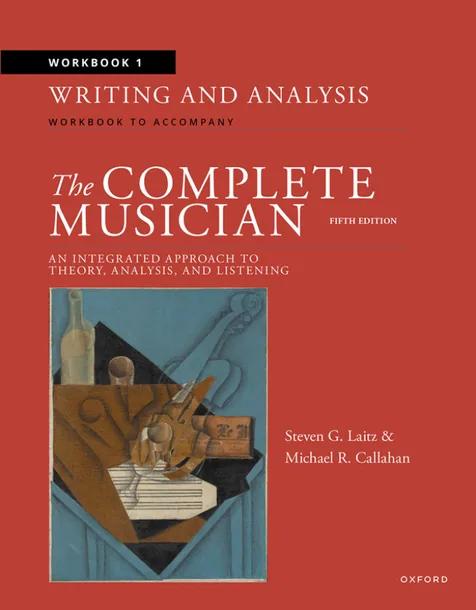
Workbook 1: Writing and Analysis
Workbook to Accompany The Complete Musician
by Steven G. Laitz, Michael R. Callahan
5th Edition
Publisher: Oxford University Press
Book Details
| Print ISBN | 9780190924546 |
| eText ISBN | 9780197637289 |
| Publisher | Oxford University Press |
| Publishing Year | 2023 |
| Edition | 5th Edition |
| Language | English |
Workbook 1: Writing and Analysis, 5th Edition, by Steven G. Laitz and Michael R. Callahan, provides written activities and analytical practice for music theory coursework. Published by Oxford University Press in 2023, this workbook accompanies the main text, The Complete Musician: An Integrated Approach to Theory, Analysis, and Listening, Fifth Edition.
Initial units explore musical space and time by examining pitches, scales, keys, meter, rhythm, and intervals. The assignments then guide student practice through counterpoint, triad structures, texture, embellishing tones, voice leading, and two-level analysis. Subsequent sections address contrapuntal expansions of tonic and dominant harmonies, inversions of dominant and leading-tone seventh chords, pre-dominant functions, phrase models, step-descent bass lines, back-relating dominants, periods, sentences, applied chords, modulation, harmonic sequences, and binary variations.
This volume concentrates exclusively on written assignments and analytical activities rather than performance or ear-training tasks. Its structured exercises provide targeted practice designed to support classroom instruction and assignment reviews within music study.
Table of Contents
Chapter 1A: Musical Space: Pitches, Scales, and Keys
Chapter 1B: Musical Time: Meter and Rhythm
Chapter 1C: Intervals
Chapter 2: Pitch and Meter Combine: Melody and Counterpoint
Chapter 3: Triads, Seventh Chords, and Texture
Chapter 4: The Role of Context: Embellishing Tones and Melodic Shape
Chapter 5: Tonic, Dominant, and Voice Leading
Chapter 6: V7 and Two-Level Analysis
Chapter 7: Expanding Tonic and Dominant with First-Inversion Triads
Chapter 8: Inversions of V7 and Leading-Tone Seventh Chords
Chapter 9: The Pre-Dominant Function and the Phrase Model
Chapter 10: Accented and Chromatic Embellishing Tones
Chapter 11: Six-Four Chords, Revisiting the Subdominant, and Summary of Contrapuntal Expansions
Chapter 12: Pre-Dominant Seventh Chords and Embedded Phrase Models
Chapter 13: The Submediant and Step-Descent Bass
Chapter 14: The Mediant and the Back-Relating Dominant
Chapter 15: The Period
Chapter 16: Sentences, Double Periods, and Asymmetric Periods
Chapter 17: Applied Chords
Chapter 18: Modulation
Chapter 19: Harmonic Sequences
Chapter 20: Binary Form and Variations
Chapter 21: Modal Mixture
Chapter 22: Chromatic Modulation and Text-Music Relations
Chapter 23: Neapolitan Chords
Chapter 24: Augmented Sixth Chords
Chapter 25: Ternary Form
Chapter 26: Rondo Form
Chapter 27: Sonata Form
Chapter 28: Tonal Ambiguity and Symmetrically Constructed Harmonies
Chapter 29: Symmetry Stretches Tonality: Chromatic Sequences and Equal Divisions of the Octave
Chapter 30: Centricity, Extended and Non-Tertian Sonorities, and Collections
Chapter 31: Analysis with Sets
Chapter 32: New Rhythmic and Metric Possibilities, Ordered PC Relations, and Twelve-Tone Techniques
Customer Reviews
0.0
0 reviews
No reviews yet. Be the first to review this book!
Write a Review
Reviewed by GradeFocus Editorial Team
▶Research Sources (14)
- Workbook 1: Writing and Analysis - Paperback - Steven G. Laitz
- Search Results : Laitz
- Captcha - Erie2 BOCES | Erie BOCES
- Workbook 1: Writing and Analysis
- Workbook 1- Writing and Analysis:... | Rent | 9780190924546
- Sign In - MyLibrary | Hal Leonard Online
- All
- Thompson Learn.
- New Receipts
- Workbook 1: Writing and Analysis - Steven G. Laitz
- Workbook to Accompany the Complete Musician
- Workbook to Accompany The Complete Musician
- Workbook 1: Writing and Analysis | Rent | 9780190924546
- Workbook 1 : Steven G. Laitz, : 9780190924546