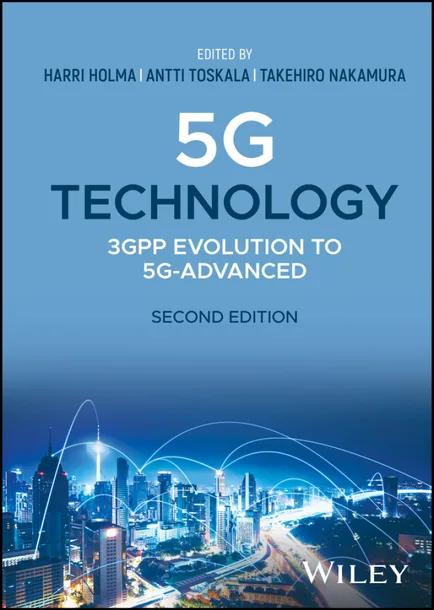
5G Technology
3GPP Evolution to 5G-Advanced
by Harri Holma, Antti Toskala, Takehiro Nakamura
2nd Edition
Publisher: John Wiley & Sons
Book Details
| Print ISBN | 9781119816034 |
| eText ISBN | 9781119816089 |
| Publisher | John Wiley & Sons |
| Publishing Year | 2024 |
| Edition | 2nd Edition |
| Language | English |
| Pages | 656 |
The 2nd Edition of 5G Technology: 3GPP Evolution to 5G-Advanced provides a comprehensive technical overview of modern mobile communication standards for wireless researchers, network planners, and R&D engineers. Authors Harri Holma, Antti Toskala, and Takehiro Nakamura examine architectural frameworks, standardization targets, and technology components that guide current radio network deployments. It establishes clear technical context for understanding standardized mobile systems from initial concepts to advanced field implementations.
The volume synthesizes foundational radio features, detailing physical layer operations, radio protocol structures, transport layer requirements, and overall network architecture configurations. Technical topics cover spectrum utilization strategies, millimeter wave transmission, beamforming mechanisms, and network slicing setups designed to support complex infrastructure requirements.
Key sections trace standards evolution across 3GPP Release 16, 17, and 18, focusing on radio enhancements for 5G-Advanced developments. This volume supports university lecturers, technology analysts, and spectrum regulators who evaluate core system performance metrics, including data rates, coverage parameters, latency specifications, and network measurement procedures.
Table of Contents
Chapter 1: Introduction
- • 1.1 Introduction
- • 1.2 5G Targets
- • 1.3 5G Technology Components
- • 1.4 5G Spectrum
- • 1.5 5G Capabilities
- • 1.6 5G Capacity Boost
- • 1.7 5G Standardization and Schedule
- • 1.8 5G Use Cases
- • 1.9 Evolution Path from LTE to 5G
- • 1.10 5G-Advanced
- • 1.11 Summary
Chapter 2: 5G Targets and Standardization
- • 2.1 Introduction
- • 2.2 Itu
- • 2.3 Ngmn
- • 2.4 3GPP Schedule and Phasing
- • 2.5 Evolution Towards 5G-Advanced and 6G
Chapter 3: Technology Components
- • 3.1 Introduction
- • 3.2 Spectrum Utilization
- • 3.3 Beamforming
- • 3.4 Flexible Physical Layer and Protocols
- • 3.5 Network Slicing
- • 3.6 Dual Connectivity with LTE
- • 3.7 Radio Cloud and Edge Computing
- • 3.8 Summary
Chapter 4: Spectrum
- • 4.1 Introduction
- • 4.2 Millimeter Wave Spectrum Above 20 GHz
- • 4.3 Mid-Band Spectrum at 3.3–5.0 GHz and at 2.6 GHz
- • 4.4 Low-Band Spectrum Below 3 GHz
- • 4.5 Unlicensed Band
- • 4.6 Shared Band
- • 4.7 3GPP Frequency Variants
- • 4.8 Summary
Chapter 5: 5GArchitecture
- • 5.1 Introduction
- • 5.2 5G Architecture Options
- • 5.3 5G Core Network Architecture
- • 5.4 5G RAN Architecture
- • 5.5 Network Slicing
- • 5.6 Summary
Chapter 6: 5G Physical Layer
- • 6.1 Introduction
- • 6.2 5G Multiple Access Principle
- • 6.3 Physical Channels and Signals
- • 6.4 Basic Structures for 5G Frame Structure
- • 6.5 5G Channel Structures and Beamforming Basics
- • 6.6 Random Access
- • 6.7 Downlink User Data Transmission
- • 6.8 Uplink User Data Transmission
- • 6.9 Uplink Signaling Transmission
- • 6.10 Downlink Signaling Transmission
- • 6.11 Physical Layer Procedures
- • 6.12 5G MIMO and Beamforming Operation
- • 6.13 Channel Coding with 5G
- • 6.14 Dual Connectivity
- • 6.15 5G Data Rates
- • 6.16 Physical Layer Measurements
- • 6.17 UE Capability
- • 6.18 Summary
Chapter 7: 5G Radio Protocols
- • 7.1 Introduction
- • 7.2 5G Radio Protocol Layers
- • 7.3 Sdap
- • 7.4 Pdcp
- • 7.5 Rlc
- • 7.6 MAC Layer
- • 7.7 The RRC Protocol
- • 7.8 Radio Protocols in RAN Architecture
- • 7.9 Summary
Chapter 8: Deployment Aspects
- • 8.1 Introduction
- • 8.2 Spectrum Resources
- • 8.3 Network Density
- • 8.4 Mobile Data Traffic Growth
- • 8.5 Base Station Site Solutions
- • 8.6 Electromagnetic Field (EMF) Considerations
- • 8.7 Network Synchronization and Coordination Requirements
- • 8.8 5G Overlay with Another Vendor LTE
- • 8.9 Summary
Chapter 9: Transport
- • 9.1 5G Transport Network
- • 9.2 Capacity and Latency
- • 9.3 Technologies
- • 9.4 Fronthaul and Backhaul Interfaces
- • 9.5 Specific Topics
Chapter 10: 5G Performance
- • 10.1 Introduction
- • 10.2 Peak Data Rates
- • 10.3 Practical Data Rates
- • 10.4 Latency
- • 10.5 Link Budgets
- • 10.6 Coverage for Sub-6-GHz Band
- • 10.7 Massive MIMO and Beamforming Algorithms
- • 10.8 Packet Scheduling Algorithms
- • 10.9 Spectral Efficiency and Capacity
- • 10.10 Network Energy Efficiency
- • 10.11 Traffic and Device Density
- • 10.12 Ultra-Reliability for Mission-Critical Communication
- • 10.13 Mobility and High-Speed Trains
- • 10.14 Summary
Chapter 11: Measurements
- • 11.1 Introduction
- • 11.2 Propagation Measurements Above 6 GHz
- • 11.3 Field Experiments with Sub-6-GHz 5G Radio
- • 11.4 Field Experiments of Millimeter Wave 5G Radio
- • 11.5 Summary
Chapter 12: 5G RF Design Challenges
- • 12.1 Introduction
- • 12.2 Impact of New Physical Layer on RF Performance
- • 12.3 5G Standalone Performance Aspects in Frequency Range 1
- • 12.4 5G Standalone Performance Aspects in mmWave Frequency Range 2
- • 12.5 Dual Uplink Performance Challenges for NSA Operation
- • 12.6 Examples of UE Implementation Challenges
- • 12.7 Summary
Chapter 13: 5G Modem Design Challenges
- • 13.1 Introduction
- • 13.2 High Data Rate, System Flexibility, and Computational Complexity
- • 13.3 Low Latency, Flexible Timing, and Modem Control Flow Complexity
- • 13.4 Multi-RAT Coexistence and Modem Architecture
- • 13.5 Wider Bandwidth Operation and Modem Power Consumption
- • 13.6 Summary
Chapter 14: Internet of Things Optimization
- • 14.1 Introduction
- • 14.2 IoT Optimization in LTE Radio
- • 14.3 Lte-m
- • 14.4 Narrowband-IoT
- • 14.5 IoT Optimization in LTE Core Network
- • 14.6 Coverage
- • 14.7 Delay and Capacity
- • 14.8 Power Saving Features
- • 14.9 NB-IoT Power Consumption Measurements
- • 14.10 IoT Solution Benchmarking
- • 14.11 IoT Optimizations in 5G
- • 14.12 Summary
Chapter 15: LTE-Advanced Evolution
- • 15.1 Introduction
- • 15.2 Overview of LTE Evolution
- • 15.3 LTE-Advanced Pro Technologies
- • 15.4 5G and LTE Benchmarking
- • 15.5 Summary
Chapter 16: 5G-Advanced Overview
- • 16.1 Introduction
- • 16.2 3GPP Schedule
- • 16.3 5G-Advanced Key Areas
- • 16.4 Extended and Augmented Reality
- • 16.5 Superaccurate Positioning
- • 16.6 Radio Performance Boosters
- • 16.7 New Vertical Use Cases
- • 16.8 Resilient Timing
- • 16.9 Network Automation and Energy Efficiency
- • 16.10 RedCap/NR-Light for IoT
- • 16.11 Outlook For 5G Release 19
- • 16.12 Outlook For 6G
- • 16.13 Summary
Chapter 17: Radio Enhancements in Release 16–18
- • 17.1 Introduction
- • 17.2 Coverage Enhancements
- • 17.3 MIMO Enhancements
- • 17.4 Mobility
- • 17.5 UE Power Saving
- • 17.6 AI/ML for Air Interface and NG-RAN
- • 17.7 Integrated Access and Backhaul
- • 17.8 Dual Connectivity and Carrier Aggregation Enhancements
- • 17.9 Small Data Transmission
- • 17.10 Conclusion
Chapter 18: Industrial Internet of Things
- • 18.1 Introduction
- • 18.2 Reduced Capability (RedCap) Devices
- • 18.3 RedCap Device Complexity
- • 18.4 RedCap Device Power Consumption
- • 18.5 RedCap Benchmarking with LTE-Based IoT
- • 18.6 New Spectrum Options
- • 18.7 Ultra-reliable Low Latency Communication
- • 18.8 Low Latency Communication
- • 18.9 Ultra-Reliable Communication
- • 18.10 Time Sensitive Network
- • 18.11 LAN Service
- • 18.12 Positioning Solutions
- • 18.13 Non-Public Networks
- • 18.14 Summary
Chapter 19: Verticals
- • 19.1 Introduction
- • 19.2 Non-Terrestrial Networks (NTN)
- • 19.3 High Altitude Platform Stations (HAPS)
- • 19.4 Drones
- • 19.5 Vehicle Connectivity
- • 19.6 Public Safety
- • 19.7 Dedicated Networks with less than 5 MHz of Spectrum
- • 19.8 Unlicensed
- • 19.9 Summary
Chapter 20: Open RAN and Virtualized RAN
- • 20.1 Introduction
- • 20.2 Radio Network Architecture Trends
- • 20.3 Open RAN Fronthaul
- • 20.4 Uplink Capacity Optimization
- • 20.5 O-RAN Alliance
- • 20.6 O-RAN Fronthaul
- • 20.7 Open Test and Integration Center and PlugFests
- • 20.8 O-RAN Security and Orchestration
- • 20.9 Baseband Virtualization and Cloud Ran
- • 20.10 Baseband Virtualization and Centralization
- • 20.11 Far Edge Availability and Network Topology
- • 20.12 Fiber and Optics Availability
- • 20.13 Baseband Hardware Efficiency
- • 20.14 Virtual RAN Evolution
- • 20.15 RAN Intelligent Controller
- • 20.16 Summary
Chapter 21: Machine Learning for 5G System Optimization
- • 21.1 Introduction
- • 21.2 Motivation
- • 21.3 Model Training and Inference in Wireless Systems
- • 21.4 Machine Learning Categories
- • 21.5 Key Algorithm Tech
Customer Reviews
0.0
0 reviews
No reviews yet. Be the first to review this book!
Write a Review
Reviewed by GradeFocus Editorial Team
▶Research Sources (13)
- 5G Technology | Rent | 9781119816089 - Valore
- 9781119816089: 5G Technology | BookScouter.com
- eBook: 5G Technology von Harri Holma | ISBN 978-1-119-81608-9 ...
- 5G Technology (ebook) | 9781119816089 | Boeken | bol
- 5G Technology : 3GPP Evolution to 5G-Advanced - Holma, Harri ...
- Shift 2 Drive Josh Harper - Bookshop.org
- Please verify you are human - Captcha
- 5G‐Advanced Overview | Wiley Telecom books - IEEE Xplore
- 5G Technology, 2nd Edition [Book]
- 5G Technology: 3GPP Evolution to 5G-Advanced ...
- 5G Technology: 3GPP Evolution to 5G-Advanced
- 3GPP Evolution to 5G-Advanced [2 ed.] 1119816033, ...
- 5G Wireless Technology