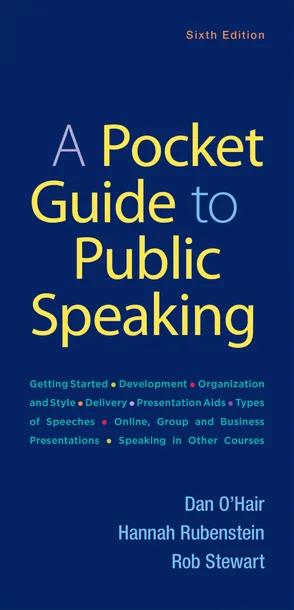
A Pocket Guide to Public Speaking
by Dan O'Hair, Hannah Rubenstein, Rob Stewart
6th Edition
Publisher: Bedford/St. Martin's
Book Details
| Print ISBN | 9781319102784 |
| eText ISBN | 9781319217099 |
| Publisher | Bedford/St. Martin's |
| Publishing Year | 2019 |
| Edition | 6th Edition |
| Language | English |
| Pages | 336 |
A Pocket Guide to Public Speaking, 6th Edition, is a concise textbook designed to guide speakers through the essential stages of speechcraft. The text offers accessible coverage of fundamental principles typically addressed in full-sized speech volumes, from topic selection to final presentation.
Coverage centers on three primary areas: speech development, ethical communication, and delivery techniques. Readers learn how to analyze audience needs, organize key arguments into clear outlines, and manage speech anxiety when presenting before groups.
Widely adopted in colleges and universities across the country, this guide serves students in public speaking courses as well as speakers preparing for presentations in cross-curricular, workplace, and community environments.
Table of Contents
Chapter 1: Becoming a Public Speaker
- • Gain a Vital Life Skill
- • Advance Your Professional Goals
- • Enhance Your Career as a Student
- • Find New Opportunities for Civic Engagement
- • The Classical Roots of Public Speaking
- • Learning to Speak in Public
- • Draw on Conversational Skills
- • Draw on Skills in Composition
- • Develop an Effective Oral Style
- • Demonstrate Respect for Difference
- • Public Speaking as a Form of Communication
- • Public Speaking as an Interactive Communication Process
Chapter 2: From A to Z: Overview of a Speech
- • Analyze the Audience
- • Select a Topic
- • Determine the Speech Purpose
- • Compose a Thesis Statement
- • Develop the Main Points
- • Gather Supporting Materials
- • Arrange the Speech into Its Major Parts
- • Outline the Speech
- • Consider Presentation Aids
- • Practice Delivering the Speech
Chapter 3: Managing Speech Anxiety
- • Identify What Makes You Anxious
- • Lack of Positive Experience
- • Feeling Different
- • Being the Center of Attention
- • Pinpoint the Onset of Anxiety
- • Pre-Preparation Anxiety
- • Preparation Anxiety
- • Pre-Performance Anxiety
- • Performance Anxiety
- • Use Proven Strategies to Build Your Confidence
- • Prepare and Practice
- • Modify Thoughts and Attitudes
- • Visualize Success
- • Activate the Relaxation Response
- • Briefly Meditate
- • Use Stress-Control Breathing
- • Stage One
- • Stage Two
- • Use Movement to Minimize Anxiety
- • Learn from Feedback
Chapter 4: Ethical Public Speaking
- • Demonstrate Competence and Character
- • Respect Your Listeners’ Values
- • Contribute to Positive Public Discourse
- • Use Your Rights of Free Speech Responsibly
- • Observe Ethical Ground Rules
- • Be Trustworthy
- • Demonstrate Respect
- • Make Responsible Speech Choices
- • Demonstrate Fairness
- • Be Civic-Minded
- • Avoid Plagiarism
- • Orally Acknowledge Your Sources
- • Citing Quotations, Paraphrases, and Summaries
- • Fair Use, Copyright, and Ethical Speaking
Chapter 5: Listeners and Speakers
- • Recognize the Centrality of Listening
- • Recognize That We Listen Selectively
- • Anticipate Obstacles to Listening
- • Minimize External and Internal Distractions
- • Refrain from Multitasking
- • Guard against Scriptwriting and Defensive Listening
- • Beware of Laziness and Overconfidence
- • Work to Overcome Cultural Barriers
- • Practice Active Listening
- • Set Listening Goals
- • Listen for Main Ideas
- • Strive for the Open and Respectful Exchange of Ideas
- • Evaluate Evidence and Reasoning
- • Offer Constructive and Compassionate Feedback
Chapter 6: Analyzing the Audience
- • Adapt to Audience Psychology: Who Are Your Listeners?
- • "If the Value Fits, Use It"
- • Gauge Listeners’ Feelings toward the Topic
- • Gauge Listeners’ Feelings toward You as the Speaker
- • Gauge Listeners’ Feelings toward the Occasion
- • Adapt Your Message to Audience Demographics
- • Age
- • Ethnic or Cultural Background
- • Socioeconomic Status
- • Income
- • Occupation
- • Education
- • Religion
- • Political Affiliation
- • Gender and Sexual Orientation
- • Group Affiliations
- • Adapt to Diverse Audiences
- • Adapt to Cross-Cultural Values
- • Focus on Universal Values
- • Tools for Learning About Your Audience
- • Conduct Interviews
- • Survey the Audience
- • Consult Published Sources
- • Analyze the Speech Setting and Context
Chapter 7: Selecting a Topic and Purpose
- • Explore Topics for Your Speech
- • Identify Personal Interests
- • Consider Current Events and Controversial Issues
- • Survey Grassroots Issues: Engage the Community
- • Steer Clear of Overused and Trivial Topics
- • Try Brainstorming to Generate Ideas
- • Use Internet Tools
- • Identify the General Purpose of Your Speech
- • Refine the Topic and Purpose
- • Narrow Your Topic
- • Form a Specific Speech Purpose
- • Compose a Thesis Statement
- • Example 1
- • Example 2
- • From Source to Speech: Narrowing Your Topic to Fit Your Audience
Chapter 8: Developing Supporting Material
- • Offer Examples
- • Share Stories
- • Draw on Testimony
- • Provide Facts and Statistics
- • Use Statistics Accurately
- • Use Frequencies to Indicate Counts
- • Use Percentages to Express Proportion
- • Use Types of Averages Accurately
- • Use Statistics Selectively—and Memorably
- • Present Statistics Ethically
Chapter 9: Finding Credible Sources in Print and Online
- • Assess Your Research Needs
- • Use Library Databases to Access Credible Sources
- • Recognize Propaganda, Misinformation, and Disinformation
- • Investigate a Mix of Primary and Secondary Sources
- • Explore Primary Sources
- • Consider Personal Knowledge and Experience
- • Access Government Information
- • Explore Digital Collections
- • Access Blogs
- • Conduct Interviews
- • Distribute Surveys
- • Explore Secondary Sources
- • Wikipedia—Dos and Don’ts
- • From Source to Speech: Evaluating Web Sources
Chapter 10: Citing Sources in Your Speech
- • Alert Listeners to Key Source Information
- • Establish the Source’s Trustworthiness
- • Qualify the Source
- • Avoid a Mechanical Delivery
- • Vary the Wording
- • Vary the Order
- • Types of Sources and Sample Oral Citations
- • Book
- • Reference Work
- • Article in a Journal, Newspaper, or Magazine
- • Website
- • Blog
- • Television or Radio Program
- • Online Video
- • Testimony (Lay or Expert)
- • Interview and Other Personal Communication
Chapter 11: Organizing the Body of the Speech
- • Use Main Points to Make Your Major Claims
- • Restrict the Number of Main Points
- • Restrict Each Main Point to a Single Idea
- • Use the Purpose and Thesis Statements as Guides
- • Use Supporting Points to Substantiate Your Claims
- • Pay Close Attention to Coordination and Subordination
- • Principles of Coordination and Subordination
- • Strive for a Unified, Coherent, and Balanced Organization
- • Use Transitions to Give Direction to the Speech
- • Use Transitions between Speech Points
- • Use Internal Previews and Summaries as Transitions
- • From Point to Point: Using Transitions to Guide Your Listeners
Chapter 12: Selecting an Organizational Pattern
- • Arranging Speech Points Chronologically
- • Arranging Speech Points Using a Spatial Pattern
- • Arranging Speech Points Using a Causal (Cause-Effect) Pattern
- • Arranging Speech Points Using a Problem-Solution Pattern
- • Arranging Speech Points Topically
- • Arranging Speech Points Using a Narrative Pattern
Chapter 13: Preparing Outlines for the Speech
- • Plan on Creating Two Outlines
- • Use Sentences, Phrases, or Key Words
- • Use a Key-Word Outline for Optimal Eye Contact
- • Create a Working Outline First
- • Sample Working Outline
- • Prepare a Speaking Outline for Delivery
- • Sample Speaking Outline
Chapter 14: Developing the Introduction and Conclusion
- • Preparing the Introduction
- • Gain Audience Attention
- • Use a Quotation
- • Tell a Story
- • Establish Common Ground
- • Offer Unusual Information
- • Pose Questions
- • Use Humor—Perhaps
- • Preview the Topic, Purpose, and Main Points
- • Establish Credibility as a Speaker
- • Motivate the Audience to Accept Your Goals
- • Preparing the Conclusion
- • Signal the End of the Speech and Provide Closure
- • Summarize the Key Points
- • Reiterate the Topic and Speech Purpose
- • Challenge the Audience to Respond
- • Make the Conclusion Memorable
Chapter 15: Using Language
- • Use an Oral Style
- • Strive for Simplicity
- • Make Frequent Use of Repetition
- • Use Personal Pronouns
- • Choose Concrete Language and Vivid Imagery
- • Offer Vivid Imagery
- • Use Figures of Speech
- • Avoid Clichés, Mixed Metaphors, and Faulty Analogies
- • Choose Words That Build Credibility
- • Use Words Appropriately
- • Use Words Accurately
- • Use the Active Voice
- • Use Inclusive, Unbiased Language
- • Choose Words That Create a Lasting Impression
- • Use Repetition to Create Rhythm
- • Use Alliteration for a Poetic Quality
- • Experiment with Parallelism
Chapter 16: Methods of Delivery
- • Keys to Effective Delivery
- • Select a Method of Delivery
- • Speaking from Manuscript
- • Speaking from Memory
- • Speaking Impromptu
- • Speaking Extemporaneously
Chapter 17: Your Voice in Delivery
- • Adjust Your Speaking Volume
- • Vary Your Intonation
- • Adjust Your Speaking Rate
- • Use Strategic Pauses
- • Strive for Vocal Variety
- • Carefully Pronounce and Articulate Words
- • Use Dialect (Language Variation) with Care
Chapter 18: Your Body in Delivery
- • Pay Attention to Body Language
- • Animate Your Facial Expressions
- • Maintain Eye Contact
- • Use Gestures That Feel Natural
- • Create a Feeling of Immediacy
- • Maintain Good Posture
- • Practice the Delivery
- • Focus on the Message
- • Plan Ahead and Practice Often
- • From Weak to Confident Delivery: Enhancing Your Delivery with Body Language
Chapter 19: Speaking with Presentation Aids
- • Select an Appropriate Aid
- • Props and Models
- • Pictures
- • Graphs, Charts, and Tables
- • Audio, Video, and Multimedia
- • Options for Showing Presentation Aids
- • Flip Charts
- • Chalkboards and Whiteboards
Chapter 20: Designing Presentation Aids
- • Keep the Design Simple
- • Use Design Elements Consistently
- • Select Appropriate Type Styles and Fonts
- • Use Color Carefully
- • Consider Subjective Interpretations of Color
Chapter 21: Using Presentation Software
- • Give a Speech, Not a Slide Show
- • Develop a Plan
- • Avoid Technical Glitches
- • Find Media for Presentations
- • Avoid Copyright Infringement
- • From Slide Show to Presentation: Getting Ready to Deliver a PowerPoint, Keynote, or Prezi Presentation
Chapter 22: Informative Speaking
- • Use Audience Analysis
- • Present New and Interesting Information
- • Look for Ways to Increase Understanding
- • Subject Matter of Informative Speeches
- • Decide How to Communicate Your Information
- • Definition
Customer Reviews
0.0
0 reviews
No reviews yet. Be the first to review this book!
Write a Review
Reviewed by GradeFocus Editorial Team