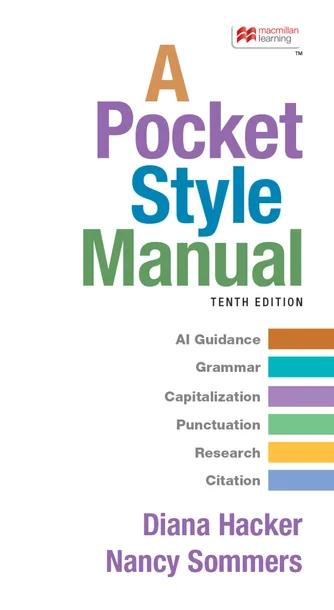
A Pocket Style Manual
by Diana Hacker, Nancy Sommers
10th Edition
Publisher: Bedford/St. Martin's
Book Details
| Print ISBN | 9781319413019 |
| eText ISBN | 9781319563172 |
| Publisher | Bedford/St. Martin's |
| Publishing Year | 2025 |
| Edition | 10th Edition |
| Language | English |
A Pocket Style Manual, 10th Edition, by Diana Hacker and Nancy Sommers, is a compact reference handbook published by Bedford/St. Martin's to support college writers. The guide offers direct instruction on sentence mechanics, clarity, research processes, and academic citation formats across diverse disciplines.
The manual structures core content into clear thematic sections. Writers learn to improve sentence clarity by repairing dangling modifiers, balancing parallel ideas, and finding an appropriate voice. Subsequent chapters address fundamental grammar, focusing on subject-verb agreement, verb tense issues, pronoun usage, and sentence fragments, along with tailored advice for multilingual writers.
Research chapters guide students through forming research questions, finding appropriate sources, and integrating literary quotations while avoiding plagiarism. This edition incorporates practical strategies for working responsibly with generative AI. College writers receive systematic formatting instructions covering MLA, APA, Chicago, and CDE documentation styles.
Table of Contents
Part 0: Becoming a College Writer: Using Academic Intelligence and Artificial Intelligence
Part 1: Clarity
Chapter 1: Tighten wordy sentences.
- • 1a Redundancies
- • 1b Empty or inflated phrases
- • 1c Needlessly complex structures
Chapter 2: Prefer active verbs.
- • 2a When to replace be verbs
- • 2b When to replace passive verbs
Chapter 3: Balance parallel ideas.
- • 3a Items in a series
- • 3b Paired ideas
Chapter 4: Add needed words.
- • 4a Words in compound structures
- • 4b The word that
- • 4c Words in comparisons
Chapter 5: Eliminate distracting shifts.
- • 5a Shifts in point of view
- • 5b Shifts in tense
Chapter 6: Untangle mixed constructions.
- • 6a Mixed grammatical structure
- • 6b Illogical connections
- • 6c Is when, is where, and reason . . . is because constructions
Chapter 7: Repair misplaced and dangling modifiers.
- • 7a Misplaced words
- • 7b Misplaced phrases and clauses
- • 7c Dangling modifiers
- • 7d Split infinitives
Chapter 8: Provide sentence variety.
- • 8a Combining choppy sentences
- • 8b Varying sentence openings
Chapter 9: Find an appropriate voice.
- • 9a Jargon
- • 9b Clichés
- • 9c Slang
- • 9d Sexist and noninclusive language
Part 2: Grammar
Chapter 10: Make subjects and verbs agree.
- • 10a Words between subject and verb
- • 10b Subjects joined with and
- • 10c Subjects joined with or or nor
- • 10d Indefinite pronouns such as someone
- • 10e Collective nouns such as jury
- • 10f Subject after verb
- • 10g Who, which, and that
- • 10h Plural form, singular meaning
- • 10i Titles, company names, and words mentioned as words
Chapter 11: Be alert to other problems with verbs.
- • 11a Irregular verbs
- • 11b Tense
- • 11c Mood
Chapter 12: Use pronouns with care.
- • 12a Pronoun-antecedent agreement
- • 12b Pronoun reference
- • 12c Case of personal pronouns (I vs. me etc.)
- • 12d Who vs. whom
Chapter 13: Use adjectives and adverbs appropriately.
- • 13a Adjectives
- • 13b Adverbs
- • 13c Comparatives and superlatives
Chapter 14: Repair sentence fragments.
- • 14a Fragmented clauses
- • 14b Fragmented phrases
Chapter 15: Revise run-on sentences.
- • 15a Revision with a comma and a coordinating conjunction
- • 15b Revision with a semicolon (or a colon or a dash)
- • 15c Revision by separating sentences
- • 15d Revision by restructuring the sentence
Chapter 16: Consider grammar topics for multilingual writers.
- • 16a Verbs
- • 16b Articles (a, an, the)
- • 16c Sentence structure
- • 16d Prepositions showing time and place
Part 3: Punctuation
Chapter 17: The comma
- • 17a Before a coordinating conjunction joining independent clauses
- • 17b After an introductory clause or phrase
- • 17c Between items in a series
- • 17d Between coordinate adjectives
- • 17e To set off a nonrestrictive element, but not a restrictive element
- • 17f To set off transitional and parenthetical expressions, absolute phrases, and word groups expressing contrast
- • 17g To set off nouns of direct address, the words yes and no, interrogative tags, and mild interjections
- • 17h To set off direct quotations introduced with expressions such as he said
- • 17i With dates, addresses, and titles
- • 17j Misuses of the comma
Chapter 18: The semicolon and the colon
- • 18a The semicolon
- • 18b The colon
Chapter 19: The apostrophe
- • 19a To indicate possession
- • 19b To mark contractions
- • 19c Conventional uses
- • 19d Misuses of the apostrophe
Chapter 20: Quotation marks
- • 20a To enclose direct quotations
- • 20b Around titles of short works
- • 20c To set off words used as words
- • 20d Other punctuation with quotation marks
- • 20e Misuses of quotation marks
Chapter 21: Other punctuation marks
- • 21a The period
- • 21b The question mark
- • 21c The exclamation point
- • 21d The dash
- • 21e Parentheses
- • 21f Brackets
- • 21g The ellipsis
- • 21h The slash
Part 4: Mechanics
Chapter 22: Capitalization
- • 22a Proper vs. common nouns
- • 22b Titles with proper names
- • 22c Titles of works
- • 22d First word of a sentence or quoted sentence
- • 22e First word following a colon
Chapter 23: Abbreviations, numbers, and italics
- • 23a Abbreviations
- • 23b Numbers
- • 23c Italics
Chapter 24: Hyphenation
- • 24a Compound words
- • 24b Words functioning together as an adjective
- • 24c Conventional uses
Part 5: Research
Chapter 25: Asking a research question
- • 25a Choosing a focused question
- • 25b Choosing a debatable question
- • 25c Choosing a question grounded in evidence
Chapter 26: Finding appropriate sources
- • 26a Using the library
- • 26b Using the web
- • 26c Using bibliographies and citations
- • 26d Conducting field research, if appropriate
Chapter 27: Evaluating sources
- • 27a Evaluating the reliability and usefulness of a source
- • 27b Reading with an open mind and a critical eye
- • 27d Constructing an annotated bibliography
Chapter 28: Managing information; avoiding plagiarism during research
- • 28a Maintaining a working bibliography
- • 28b Keeping track of source materials
- • 28c Taking notes responsibly: avoiding unintentional plagiarism
Chapter 29: Supporting a thesis
- • 29a Forming a thesis statement
- • 29b Organizing your ideas
- • 29c Using sources to inform and support your argument
Chapter 30: Avoiding plagiarism
- • 30a Citing quotations and borrowed ideas
- • 30b Using the MLA, APA, and Chicago citation systems to lead readers to your sources
- • 30c Using quotation marks around borrowed language
- • 30d Putting summaries and paraphrases in your own words
Chapter 31: Integrating sources
- • 31a Summarizing and paraphrasing effectively
- • 31b Using quotations effectively
- • 31c Using signal phrases to integrate sources
- • 31d Synthesizing sources
Chapter 32: Integrating literary quotations
- • 32a Introducing quotations from literary works
- • 32b Avoiding shifts in tense
- • 32c Formatting and citing literary passages
Part 6: MLA Style
Chapter 33: MLA documentation style
- • 33a MLA in-text citations
- • 33b MLA list of works cited
Chapter 34: MLA format; sample research essay
- • 34a MLA format
- • 34b Sample MLA research essay
Part 7: APA Style
Chapter 35: APA documentation style
- • 35a APA in-text citations
- • 35b APA list of references
Chapter 36: APA format; sample research essay
- • 36a APA format
- • 36b Sample APA research essay
Part 8: Chicago Style
Chapter 37: Chicago documentation style
- • 37a First and later notes for a source
- • 37b Chicago-style bibliography
- • 37c Model notes and bibliography entries
Chapter 38: Chicago format; sample pages
- • 38a Chicago format
- • 38b Sample pages from a Chicago research essay
Part 9: Glossaries
- • Glossary of usage
- • Glossary of grammatical terms
Customer Reviews
0.0
0 reviews
No reviews yet. Be the first to review this book!
Write a Review
Reviewed by GradeFocus Editorial Team
▶Research Sources (10)
- A Pocket Style Manual | Essential Grammar & Writing Guide
- A Pocket Style Manual Sixth Edition
- A Pocket Style Manual - Diana Hacker, Nancy Sommers
- A Pocket Style Manual 10th Edition | Diana Hacker
- A Pocket Style Manual Sixth Edition
- A Pocket Style Manual, 9th Edition | PDF | Verb | Comma
- A Pocket Style Manual with Exercises : Hacker, Diana, Nancy, Sommers
- A Pocket Style Manual By Diana Hacker and Nancy Sommers
- A Pocket Style Manual - Ivy Tech Community College Online Bookstore
- A pocket style manual : Hacker, Diana, 1942-2004, author : Free Download ...