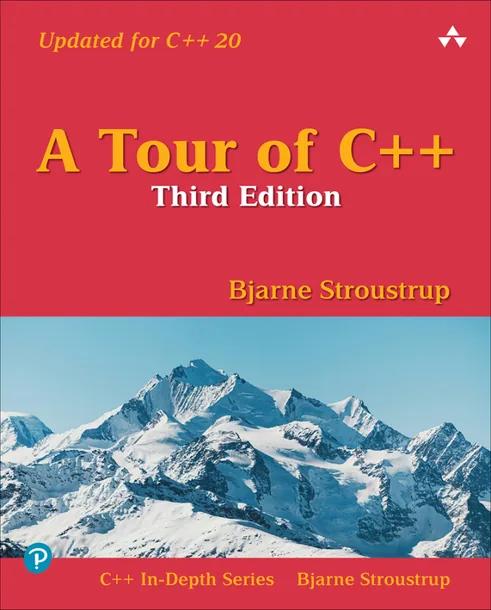
A Tour of C++
by Bjarne Stroustrup
3rd Edition
Publisher: Addison-Wesley Professional PTG
Book Details
| Print ISBN | 9780136816485 |
| eText ISBN | 9780136823544 |
| Publisher | Addison-Wesley Professional PTG |
| Publishing Year | 2023 |
| Edition | 3rd Edition |
| Language | English |
| Pages | 320 |
A Tour of C++, 3rd Edition, offers experienced programmers a concise overview of modern ISO C++ (C++20). Designed by Bjarne Stroustrup, the book focuses on core language facilities and standard-library components needed for effective development.
The volume presents language mechanisms in the context of the programming paradigms they support, including generic and object-oriented programming. Practical examples illustrate key language constructs while omitting general introductory instruction.
Targeting practicing C and C++ developers as well as programmers versed in other languages, this edition highlights major additions such as concepts, modules, ranges, and coroutines.
Table of Contents
Chapter 1: The Basics
- • 1.1 Introduction
- • 1.2 Programs
- • 1.3 Functions
- • 1.4 Types, Variables, and Arithmetic
- • 1.5 Scope and Lifetime
- • 1.6 Constants
- • 1.7 Pointers, Arrays, and References
- • 1.8 Tests
- • 1.9 Mapping to Hardware
- • 1.10 Advice
Chapter 2: User-Defined Types
- • 2.1 Introduction
- • 2.2 Structures
- • 2.3 Classes
- • 2.4 Enumerations
- • 2.5 Unions
- • 2.6 Advice
Chapter 3: Modularity
- • 3.1 Introduction
- • 3.2 Separate Compilation
- • 3.3 Namespaces
- • 3.4 Function Arguments and Return Values
- • 3.5 Advice
Chapter 4: Error Handling
- • 4.1 Introduction
- • 4.2 Exceptions
- • 4.3 Invariants
- • 4.4 Error-Handling Alternatives
- • 4.5 Assertions
- • 4.6 Advice
Chapter 5: Classes
- • 5.1 Introduction
- • 5.2 Concrete Types
- • 5.3 Abstract Types
- • 5.4 Virtual Functions
- • 5.5 Class Hierarchies
- • 5.6 Advice
Chapter 6: Essential Operations
- • 6.1 Introduction
- • 6.2 Copy and Move
- • 6.3 Resource Management
- • 6.4 Operator Overloading
- • 6.5 Conventional Operations
- • 6.6 User-Defined Literals
- • 6.7 Advice
Chapter 7: Templates
- • 7.1 Introduction
- • 7.2 Parameterized Types
- • 7.3 Parameterized Operations
- • 7.4 Template Mechanisms
- • 7.5 Advice
Chapter 8: Concepts and Generic Programming
- • 8.1 Introduction
- • 8.2 Concepts
- • 8.3 Generic Programming
- • 8.4 Variadic Templates
- • 8.5 Template Compilation Model
- • 8.6 Advice
Chapter 9: Library Overview
- • 9.1 Introduction
- • 9.2 Standard-Library Components
- • 9.3 Standard-Library Organization
- • 9.4 Advice
Chapter 10: Strings and Regular Expressions
- • 10.1 Introduction
- • 10.2 Strings
- • 10.3 String Views
- • 10.4 Regular Expressions
- • 10.5 Advice
Chapter 11: Input and Output
- • 11.1 Introduction
- • 11.2 Output
- • 11.3 Input
- • 11.4 I/O State
- • 11.5 I/O of User-Defined Types
- • 11.6 Output Formatting
- • 11.7 Streams
- • 11.8 C-style I/O
- • 11.9 File System
- • 11.10 Advice
Chapter 12: Containers
- • 12.1 Introduction
- • 12.2 vector
- • 12.3 list
- • 12.4 forward_list
- • 12.5 map
- • 12.6 unordered_map
- • 12.7 Allocators
- • 12.8 Container Overview
- • 12.9 Advice
Chapter 13: Algorithms
- • 13.1 Introduction
- • 13.2 Use of Iterators
- • 13.3 Iterator Types
- • 13.4 Use of Predicates
- • 13.5 Algorithm Overview
- • 13.6 Parallel Algorithms
- • 13.7 Advice
Chapter 14: Ranges
- • 14.1 Introduction
- • 14.2 Views
- • 14.3 Generators
- • 14.4 Pipelines
- • 14.5 Concepts Overview
- • 14.6 Advice
Chapter 15: Pointers and Containers
- • 15.1 Introduction
- • 15.2 Pointers
- • 15.3 Containers
- • 15.4 Alternatives
- • 15.5 Advice
Chapter 16: Utilities
- • 16.1 Introduction
- • 16.2 Time
- • 16.3 Function Adaption
- • 16.4 Type Functions
- • 16.5 source_location
- • 16.6 move() and forward()
- • 16.7 Bit Manipulation
- • 16.8 Exiting a Program
- • 16.9 Advice
Chapter 17: Numerics
- • 17.1 Introduction
- • 17.2 Mathematical Functions
- • 17.3 Numerical Algorithms
- • 17.4 Complex Numbers
- • 17.5 Random Numbers
- • 17.6 Vector Arithmetic
- • 17.7 Numeric Limits
- • 17.8 Type Aliases
- • 17.9 Mathematical Constants
- • 17.10 Advice
Chapter 18: Concurrency
- • 18.1 Introduction
- • 18.2 Tasks and threads
- • 18.3 Sharing Data
- • 18.4 Waiting for Events
- • 18.5 Communicating Tasks
- • 18.6 Coroutines
- • 18.8 Advice
Chapter 19: History and Compatibility
- • 19.1 History
- • 19.2 C++ Feature Evolution
- • 19.3 C/C++ Compatibility
- • 19.4 Bibliography
- • 19.5 Advice
Chapter Appendix: Module std
- • A.1 Introduction
- • A.2 Use What Your Implementation Offers
- • A.3 Use Headers
- • A.4 Make Your Own module std
- • A.5 Advice
Customer Reviews
0.0
0 reviews
No reviews yet. Be the first to review this book!
Write a Review
Reviewed by GradeFocus Editorial Team