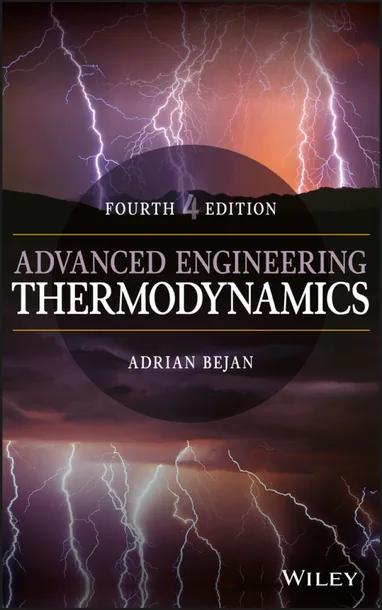
Advanced Engineering Thermodynamics
by Adrian Bejan
4th Edition
Publisher: John Wiley & Sons P&T
Book Details
| Print ISBN | 9781119052098 |
| eText ISBN | 9781119281047 |
| Publisher | John Wiley & Sons P&T |
| Publishing Year | 2016 |
| Edition | 4th Edition |
| Language | English |
| Pages | 800 |
Advanced Engineering Thermodynamics, 4th Edition, is an engineering textbook that explores the advanced principles of energy and work across diverse engineering fields. The volume bridges classical theory with practical engineering, linking core thermodynamic concepts to sustainability technologies and industrial systems.
Coverage addresses foundational thermodynamic laws, system behaviors across single-phase and multiphase environments, and the principles of power generation. The book also examines how entropy generation and exergy destruction govern the performance of thermal systems.
Designed expressly for engineering students, the volume offers targeted discussion and authoritative guidance on complex topics. Condensed introductory chapters allow readers to review essential fundamentals before moving into advanced engineering applications.
Table of Contents
Chapter 1: The First Law
- • 1.1 Terminology
- • 1.2 Closed Systems
- • 1.3 Work Transfer
- • 1.4 Heat Transfer
- • 1.5 Energy Change
- • 1.6 Open Systems
- • 1.7 History
- • References
- • Problems
Chapter 2: The Second Law
- • 2.1 Closed Systems
- • 2.2 Open Systems
- • 2.3 Local Equilibrium
- • 2.4 Entropy Maximum and Energy Minimum
- • 2.5 Carathéodory’s Two Axioms
- • 2.6 A Heat Transfer Man’s Two Axioms
- • 2.7 History
- • References
- • Problems
Chapter 3: Entropy Generation, Or Exergy Destruction
- • 3.1 Lost Available Work
- • 3.2 Cycles
- • 3.3 Nonflow Processes
- • 3.4 Steady-Flow Processes
- • 3.5 Mechanisms of Entropy Generation
- • 3.6 Entropy Generation Minimization
- • References
- • Problems
Chapter 4: Single-Phase Systems
- • 4.1 Simple System
- • 4.2 Equilibrium Conditions
- • 4.3 The Fundamental Relation
- • 4.4 Legendre Transforms
- • 4.5 Relations between Thermodynamic Properties
- • 4.6 Partial Molal Properties
- • 4.7 Ideal Gas Mixtures
- • 4.8 Real Gas Mixtures
- • References
- • Problems
Chapter 5: Exergy Analysis
- • 5.1 Nonflow Systems
- • 5.2 Flow Systems
- • 5.3 Generalized Exergy Analysis
- • 5.4 Air Conditioning
- • References
- • Problems
Chapter 6: Multiphase Systems
- • 6.1 The Energy Minimum Principle
- • 6.2 The Stability of a Simple System
- • 6.3 The Continuity of the Vapor and Liquid States
- • 6.4 Phase Diagrams
- • 6.5 Corresponding States
- • References
- • Problems
Chapter 7: Chemically Reactive Systems
- • 7.1 Equilibrium
- • 7.2 Irreversible Reactions
- • 7.3 Steady-Flow Combustion
- • 7.4 The Chemical Exergy of Fuels
- • 7.5 Combustion at Constant Volume
- • References
- • Problems
Chapter 8: Power Generation
- • 8.1 Maximum Power Subject to Size Constraint
- • 8.2 Maximum Power from a Hot Stream
- • 8.3 External Irreversibilities
- • 8.4 Internal Irreversibilities
- • 8.5 Advanced Steam Turbine Power Plants
- • 8.6 Advanced Gas Turbine Power Plants
- • 8.7 Combined Steam Turbine and Gas Turbine Power Plants
- • References
- • Problems
Chapter 9: Solar Power
- • 9.1 Thermodynamic Properties of Thermal Radiation
- • 9.2 Reversible Processes
- • 9.3 Irreversible Processes
- • 9.4 The Ideal Conversion of Enclosed Blackbody Radiation
- • 9.5 Maximization of Power Output Per Unit Collector Area
- • 9.6 Convectively Cooled Collectors
- • 9.7 Extraterrestrial Solar Power Plant
- • 9.8 Climate
- • 9.9 Self-Pumping and Atmospheric Circulation
- • References
- • Problems
Chapter 10: Refrigeration
- • 10.1 Joule–Thomson Expansion
- • 10.2 Work-Producing Expansion
- • 10.3 Brayton Cycle
- • 10.4 Intermediate Cooling
- • 10.5 Liquefaction
- • 10.6 Refrigerator Models with Internal Heat Leak
- • 10.7 Magnetic Refrigeration
- • References
- • Problems
Chapter 11: Entropy Generation Minimization
- • 11.1 Competing Irreversibilities
- • 11.2 Balanced Counterflow Heat Exchangers
- • 11.3 Storage Systems
- • 11.4 Power Maximization or Entropy Generation Minimization
- • 11.5 From Entropy Generation Minimization to Constructal Law
- • References
- • Problems
Chapter 12: Irreversible Thermodynamics
- • 12.1 Conjugate Fluxes and Forces
- • 12.2 Linearized Relations
- • 12.3 Reciprocity Relations
- • 12.4 Thermoelectric Phenomena
- • 12.5 Heat Conduction in Anisotropic Media
- • 12.6 Mass Diffusion
- • References
- • Problems
Chapter 13: The Constructal Law
- • 13.1 Evolution
- • 13.2 Mathematical Formulation of the Constructal Law
- • 13.3 Inanimate Flow Systems
- • 13.4 Animate Flow Systems
- • 13.5 Size and Efficiency: Economies of Scale
- • 13.6 Growth, Spreading, and Collecting
- • 13.7 Asymmetry and Vascularization
- • 13.8 Human Preferences for Shapes
- • 13.9 The Arrow of Time
- • References
- • Problems
Chapter Appendix: Appendix
- • Constants
- • Mathematical Formulas
- • Variational Calculus
- • Properties of Moderately Compressed Liquid States
- • Properties of Slightly Superheated Vapor States
- • Properties of Cold Water Near the Density Maximum
- • References
Chapter Symbols: Symbols
Customer Reviews
0.0
0 reviews
No reviews yet. Be the first to review this book!
Write a Review
Reviewed by GradeFocus Editorial Team
Related Books

Fundamentals of Thermal Fluid Sciences
Yunus A. Cengel

Manufacturing Processes for Engineering Materials
Serope Kalpakjian

Fundamentals of Engineering Thermodynamics
Michael J. Moran
Elementary Principles of Chemical Processes
Richard M. Felder

Precision Machining Technology
Peter J. Hoffman

Mechanical and Electrical Systems for Construction Managers
American Technical Publishers