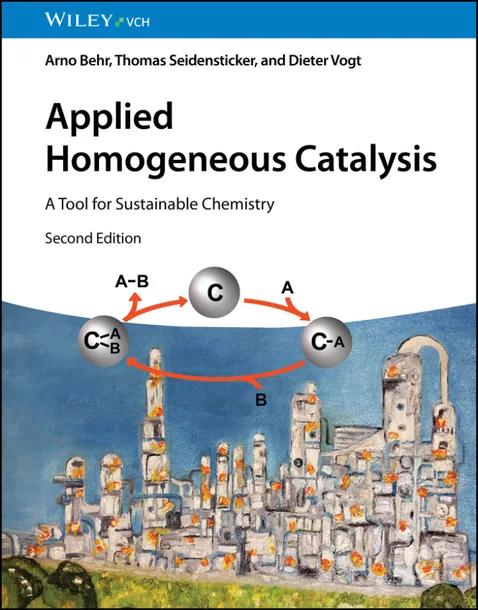
Applied Homogeneous Catalysis
A Tool for Sustainable Chemistry
by Arno Behr, Thomas Seidensticker, Dieter Vogt
2nd Edition
Publisher: Wiley-VCH
Book Details
| Print ISBN | 9783527351114 |
| eText ISBN | 9783527840076 |
| Publisher | Wiley-VCH |
| Publishing Year | 2025 |
| Edition | 2nd Edition |
| Language | English |
Applied Homogeneous Catalysis: A Tool for Sustainable Chemistry, 2nd Edition, offers a detailed reference on modern homogeneous catalysis tailored for sustainable industrial processes. Authors Arno Behr, Thomas Seidensticker, and Dieter Vogt present the chemical principles required to design efficient catalytic conversions. The work focuses on preparing Master's and PhD students in organic chemistry and chemical engineering for advanced research and industrial practice.
The technical content links organometallic chemistry, bonding principles, and asymmetric catalysis to practical transition metal complexes. Coverage expands into alternative catalytic modes, including organocatalysis, electrocatalysis, photocatalysis, and nanocatalysis. Further sections explore practical applications in feedstock diversification and polymer recycling to align chemical production with green chemistry principles.
A core pedagogical feature is the inclusion of clear learning objectives alongside more than 400 self-testing questions and answers. This verification framework assists readers in evaluating their understanding of reaction mechanisms. The volume directly supports industrial scientists and specialists across the pharmaceutical, polymer, fine chemicals, and bulk chemicals sectors.
Table of Contents
Chapter 0: Introduction: Adhering to the 12 Principles of Green Chemistry: How Does Homogeneous CatalysisContribute?
Chapter 1: Definition, Variants and Examples: What Actually Is Catalysis?
- • 1.1 Definition of Catalysis
- • 1.2 The Different Varieties of Catalysis
- • 1.3 The Directing Effect of the Catalyst
- • 1.4 Sources of Information About Catalysis
Chapter 2: A Brief History: Homogeneous Transition Metal Catalysis: A Young Science
- • 2.1 Phase I: Inorganic Basic Chemicals (1898–1918)
- • 2.2 Phase II: Refinery Processes: Syngas and Ethyne Chemistry (1919–1945)
- • 2.3 Phase III: Petrochemical Industrial Products (1946–1970)
- • 2.4 Phase IV: Fine Chemicals and Speciality Products (1971 to Date)
Chapter 3: Industrial Homogeneous Catalysis: What Is the Economic Importance?
- • 3.1 Application Areas of Catalysis
- • 3.2 Important Homogeneous Catalysed Processes
- • 3.3 Synthesis of Fine and Speciality Chemicals by Homogeneous Catalysis
- • 3.4 Atom Economy and Environmental Factor
Chapter 4: Definition of Important Terms: X, Y, S, STY, TON, TOF and more…
- • 4.1 Conversion
- • 4.2 Yield
- • 4.3 Selectivity
- • 4.3.1 Chemoselectivity
- • 4.3.2 Regioselectivity
- • 4.3.3 Diastereoselectivity
- • 4.3.4 Enantioselectivity
- • 4.4 Turnover Frequency
- • 4.5 Turnover Number
- • 4.6 Catalyst Lifetime
- • 4.7 Space–Time–Yield
- • 4.8 Catalyst Losses
- • 4.9 Catalyst Stability/Deactivation and Recycling
- • 4.10 Product Purity
- • 4.11 Further Important Terms
- • 4.12 The Choice Is Yours!
Chapter 5: Basics of Organometallic Chemistry: Bonds, Elementary Steps and Mechanisms
- • 5.1 Metal–Ligand Bonds
- • 5.2 Change of Oxidation State (OS)
- • 5.3 Change of Coordination Number (CN) and Coordination Geometry
- • 5.4 The Elementary Steps
- • 5.4.1 Association/Dissociation
- • 5.4.2 Oxidative Addition/Reductive Elimination
- • 5.4.3 Insertion/Extrusion
- • 5.4.4 Oxidative Coupling (Cycloaddition)/Reductive Cleavage (Retrocycloaddition)
- • 5.4.5 Further Elementary Steps
- • 5.4.6 A Review on the Elementary Steps
- • 5.5 Catalytic Cycles
Chapter 6: Transition Metal Compounds: The ‘Captains’ of Homogeneous Catalysis
- • 6.1 Group 3 and Lanthanides
- • 6.2 Metals of Group 4
- • 6.3 Metals of Groups 5–7
- • 6.4 The ‘Iron Metals’ of Groups 8–10
- • 6.5 The Noble Metals from Groups 8 to 10
- • 6.5.1 Ruthenium
- • 6.5.2 Osmium
- • 6.5.3 Rhodium
- • 6.5.4 Iridium
- • 6.5.5 Palladium
- • 6.5.6 Platinum
- • 6.6 Gold: A Noble Metal of Group 11
- • 6.7 The Costs of Catalyst Metals
- • 6.8 The Availability of Transition Metal Compounds
Chapter 7: Ligands: The ‘Helmsmen’ of Homogeneous Catalysis
- • 7.1 Steric Effects and Tolman's Ligand Cone Angle
- • 7.2 Ligand's Electronic Effects
- • 7.3 Chelating Ligands and Ligand Bite Angle
- • 7.4 Hemilabile Ligands
- • 7.5 Nitrogen‐Based Ligands
- • 7.6 Pincer Ligands
- • 7.7 Ligand Syntheses
- • 7.7.1 Phosphorus Ligands
- • 7.7.2 N‐Heterocyclic Carbene Ligands
- • 7.8 Ligand Stability and Decomposition
- • 7.8.1 Decomposition of Phosphines
- • 7.8.2 Decomposition of Phosphites
- • 7.9 Costs and Accessibility of Ligands
Chapter 8: Solvents in Homogeneous Catalysis: The Reaction Medium
- • 8.1 General Aspects of Solvents
- • 8.2 Physical Properties of Solvents – Solvent Parameters
- • 8.2.1 Dielectric Constant (Permittivity)
- • 8.2.2 Dipole Moment
- • 8.2.3 ET‐Value
- • 8.2.4 Solubility Parameter δ and Hansen Parameter
- • 8.2.5 Green Chemistry Criteria
- • 8.3 Influence of Solvents on Homogeneous Catalysts
- • 8.3.1 Solvent Effects on Solubility
- • 8.3.2 Solvent Effects on Mass Transfer
- • 8.3.3 Solvents Activating Substrates, Stabilising Intermediates or Capturing Products
- • 8.3.4 Solvent Effects on the Catalyst
- • 8.3.5 Solvents Stabilising Transition States
- • 8.4 Solvent Availability and Costs
- • 8.5 Solvent Purity
- • 8.6 Solvent Selection Guides
- • 8.7 Advanced Reaction Media for Homogeneous Catalysis
- • 8.7.1 Ionic liquids
- • 8.7.2 Deep Eutectic Solvents
- • 8.7.3 Supercritical Fluids
- • 8.7.4 Gas Expanded Liquids (GXLs)
- • 8.7.5 Fluorous Solvents
- • 8.7.6 Polyethers
Chapter 9: Enantioselective Catalysis: The “Special Case”
- • 9.1 A Glossary of Asymmetric Catalysis
- • 9.2 A Quick Look Back
- • 9.3 The Mechanism of Asymmetric Catalytic Hydrogenation
- • 9.4 Chiral Ligands
- • 9.5 Overview of Homogeneously Catalysed Asymmetric Syntheses
- • 9.6 Industrial Applications
Chapter 10: Thermodynamics of Homogeneous Catalysis: When Does a Chemical Reaction Run?
- • 10.1 Gibbs Energy and Energy Plot
- • 10.2 Calculation or Assessment of the Free Reaction Enthalpy
- • 10.3 Thermodynamic Analysis of Complex Reaction Systems
- • 10.4 Advances in Computational Tools for Thermodynamics in Homogeneous Catalysis
- • 10.4.1 Hybrid Functionals: Combining DFT and HF for Homogeneous Catalysis
- • 10.4.2 Calculation of Gibbs Energy Using Sampling Methods
- • 10.4.3 Machine Learning Methods
Chapter 11: Kinetics of Homogeneous Catalysis: How Does the Reaction Proceed?
- • 11.1 Frequently Occurring Kinetics
- • 11.2 The Use of Energy Profiles to Explain Selectivity
- • 11.3 Execution of Experiments to Determine the Kinetics of a Reaction
- • 11.4 A Concrete Example: Hydroformylation of Cyclooctene
- • 11.5 Pitfalls in Kinetic Measurements
Chapter 12: Overview of Spectroscopic Methods: Can We See into Homogeneous Catalysis?
- • 12.1 UV/Visible Spectroscopy
- • 12.2 IR Spectroscopy
- • 12.3 Raman Spectroscopy
- • 12.4 NMR Spectroscopy
- • 12.4.1 1H NMR Spectroscopy
- • 12.4.2 31P NMR Spectroscopy
- • 12.4.3 Metal NMR Spectroscopy
- • 12.4.4 Pulsed Gradient Spin Echo NMR
- • 12.5 Electrospray Ionisation Mass Spectroscopy (ESI-MS)
- • 12.6 X‐Ray Absorption Spectroscopy (XAS) and Extended X‐ray absorption fine Structure Analysis (EXAFS)
- • 12.7 Electron Paramagnetic Resonance Spectroscopy (EPR)
- • 12.8 Inductively Coupled Plasma Optical Emission Spectroscopy (ICP‐OES)
- • 12.9 In situ, Operando and Combined Spectroscopy
Chapter 13: Reactor Types: Where Homogeneous Catalysis Actually Occurs
- • 13.1 Stirred Tank Reactor
- • 13.1.1 General description
- • 13.1.2 Different Operation Modes
- • 13.1.3 Stirred‐Tank Pressure Reactors (Laboratory Autoclaves)
- • 13.2 Tubular Reactor
- • 13.3 Transition variants between stirred tank reactor and plug flow reactor
- • 13.3.1 Stirred‐Tank Reactor Cascade (CAS)
- • 13.3.2 Taylor–Couette Reactor (TCR)
- • 13.4 Reactors for Gas/Liquid Reactions
- • 13.4.1 Sparged Stirred‐Tank Reactor
- • 13.4.2 Bubble Column Reactor
- • 13.5 Loop Reactors
- • 13.6 Jet‐Loop Reactor
- • 13.7 Membrane Reactor
- • 13.8 Microreactors
- • 13.9 Special Reactors
- • 13.10 The ‘Agony of Choice’
Chapter 14: Overview of Catalyst Separation Techniques: How Catalyst and Product Go Their Separate Ways After the Reaction
- • 14.1 Separation Principles
- • 14.2 Separation by Distillation
- • 14.2.1 Example 1: Ethene Oxidation to Acetaldehyde
- • 14.2.2 Example 2: Methanol Carbonylation to Acetic Acid
- • 14.2.3 Example 3: Alkene Hydroformylation to Aldehydes
- • 14.3 Separation by Precipitation
- • 14.3.1 Chemical Precipitation
- • 14.3.2 Addition of a Solvent
- • 14.3.3 Removal of the Solvent
- • 14.3.4 Addition of Specific Precipitants
- • 14.3.5 Thermal Deposition of a Metal Catalyst
- • 14.3.6 Solubility‐Switching Tags
- • 14.4 Separation by Crystallisation
- • 14.5 Separation by Adsorption
- • 14.6 Separation by Heterogenisation on a Solid Support
- • 14.7 Separation by Membranes
- • 14.8 Separation by Extraction
- • 14.9 Separation of a Second Liquid Phase
Chapter 15: Catalyst Separation by Membranes: A Barrier Between Products and Catalysts
- • 15.1 Membranes
- • 15.2 Key Figures
- • 15.3 Technical Implementation
- • 15.4 Industrial Applications
Chapter 16: Immobilisation on Solid Supports: From Homogeneity to Heterogeneity
- • 16.1 The Basic Principles
- • 16.2 Solid‐Phase Immobilisation
- • 16.2.1 Organic Supports
- • 16.2.2 Inorganic Carrier Materials
- • 16.3 Supported‐Liquid Phase (SLP) Immobilisation
- • 16.4 Industrial Application
Chapter 17: Liquid–Liquid Multiphase Systems: The Smart Approach to Catalyst Separation
- • 17.1 Alteration of the Solubility of the Ligands by Selective Modifications
- • 17.2 Variants of Multiphase Catalysis
- • 17.2.1 Multiphase Catalysis with Self‐Separating Product(s)
- • 17.2.2 Multiphase Catalysis with Intensified Mixing
- • 17.2.3 Multiphase Catalysis with Co‐Solvents
- • 17.2.4 Multiphase Catalysis Assisted by Additives
- • 17.2.5 Switchable Multiphase Catalysis
Chapter 18: Switchable Multiphase Systems: Triggering Separation of Homogeneous Mixtures
- • 18.1 Temperature as a Switch
- • 18.1.1 Thermoregulated Phase‐Transfer Catalysis
- • 18.1.2 Thermoregulated Microemulsions
- • 18.1.3 Thermoregulated Fluorous Solvent Systems
- • 18.1.4 Thermoregulated Polymer‐Bound Catalysts
- • 18.1.5 Thermomorphic Multiphase Systems
- • 18.2 CO2 Switchable Systems
- • 18.2.1 Catalyst Recycling via Switchable Water (SW)
- • 18.2.2 Catalyst Recycling via Switchable Hydrophilicity Solvents
- • 18.2.3 Switchable Ligands and Transition Metal‐/Organocatalysts
- • 18.3 Concluding Remarks to Recycling Methods
Chapter 19: Optimisation Strategies: Combinatorial Synthesis, Design of Experiments and High-Throughput Screening
- • 19.1 Combinatorial Chemistry
- • 19.2 Design of Experiments (DoE)
- • 19.3 High‐Throughput Screening (HTS)
- • 19.3.1 Parallel Reactor Systems
- • 19.3.2 Sequential Reactor Systems
- • 19.4 Virtual Screening (Computational Screening, Machine Learning)
- • 19.4.1 Molecular Descriptors
- • 19.4.2 Quantitative Structure Activity Relationship (QSAR) Modelling
- • 19.4.3 Virtual Libraries
Chapter 20: Process Development in Miniplants: From Laboratory to Production
- • 20.1 Combination of TMSs with Other Reactor Types
- • 20.2 Improved Online Analytics
- • 20.3 Application of TMSs for Complex Reactions in Continuous Operation
- • 20.4 Combined Reaction Separation Processes
Chapter 21: An Overview of C–C‐Bond Formation: A Guide Through the Jungle
Chapter 22: Hydroformylation: The Industrial Route to Aldehydes and Alcohols
- • 22.1 Main and Side Reactions
- • 22.2 Catalysts
- • 22.2.1 Metals in Hydroformylation
- • 22.2.2 Ligands in Hydroformylation (see Chapter 7)
- • 22.2.3 Solvents for Hydroformylation
- • 22.2.4 Process Variants for Industrial Hydroformylation
- • 22.3 Mechanisms
- • 22.4 Substrates
- • 22.5 Asymmetric Hydroformylation
- • 22.6 Syngas Surrogates
Chapter 23: Carbonylation: The Versatile Insertions of Carbon Monoxide
- • 23.1 Reactions Between CO and Hydrogen
- • 23.2 Reactions of CO with Alkenes and Vinyl Arenes
- • 23.3 Reactions of CO with Dienes
- • 23.4 Reactions of CO with Alkynes
- • 23.5 Reactions of CO with Alcohols
- • 23.5.1 Carbonylation of Methanol
- • 23.5.2 Homologation of Alcohols
- • 23.6 New Trends
Chapter 24: Oligomerisation and Cyclooligomerisation: The Conversion of Unsaturated Aliphatics into Short Chains or Medium-Sized Rings
- • 24.1 Oligomerisation of Alkenes
- • 24.1.1 Ethene
- • 24.1.2 Propene
- • 24.1.3 Other Monoenes
- • 24.2 Dienes
- • 24.3 Alkynes
- • 24.4 Co‐Oligomerisations
- • 24.4.1 Ethene and Butadiene
- • 24.4.2 Ethene and Styrene
- • 24.4.3 Co‐Oligomerisations with Alkynes
Chapter 25: Metathesis: A ‘Change-Your-Partners’ Dance
- • 25.1 The Many Variants of Alkene Metathesis
- • 25.2 Mechanism and Catalysts
- • 25.3 Industrial Applications
- • 25.4 Other Types of Metatheses
- • 25.4.1 Alkyne Metathesis
- • 25.4.2 Enyne Metathesis
- • 25.4.3 Carbonylalkene Metathesis
- • 25.4.4 Alkane Metathesis (see Chapter 40)
- • 25.5 Some Trends
Chapter 26: Polymerisation: The Purposeful Assembly of Macromolecules
- • 26.1 Polyethylene and Ziegler Catalysts
- • 26.2 Polypropylene and Metallocene Catalysis
- • 26.3 Further Polyalkenes and Copolymers
- • 26.4 Polydienes
- • 26.5 Polyketones
- • 26.6 Polyalkynes
- • 26.7 Post‐Metallocenes
- • 26.8 Some Trends
Chapter 27: Telomerisation: The Construction of Functionalised Aliphatic Chains
- • 27.1 Reactions, Mechanisms and Catalysts
- • 27.2 Butadiene Telomerisation
- • 27.2.1 Butadiene and Oxygen Nucleophiles
- • 27.2.2 Butadiene and Nitrogen Nucleophiles
- • 27.2.3 Butadiene and Carbon Nucleophiles
- • 27.2.4 Carboxytelomerisation
- • 27.2.5 Cyclic Telomers with 1,3‐Butadiene
- • 27.3 Telomerisations with C5‐ and C6‐Dienes
- • 27.4 Terpenoic 1,3‐Dienes
- • 27.5 Enantioselective Telomerisations
- • 27.6 Some Trends
Chapter 28: Carbon–Carbon Coupling Reactions: Quite a lot of Name Reactions
- • 28.1 Mizoroki–Heck Reactions
- • 28.2 Sonogashira–Hagihara Reactions
- • 28.3 Suzuki–Miyaura Reaction
- • 28.4 Stille Coupling
- • 28.5 Hiyama Coupling
- • 28.6 Negishi Coupling
- • 28.7 Kumada Coupling
Chapter 29: Hydrogenation: C–H Bond Formation
- • 29.1 Catalysts and Mechanisms
- • 29.2 Asymmetric Hydrogenation
- • 29.3 Hydrogenation of Various Functional Groups
- • 29.3.1 C–C Multiple Bonds
- • 29.3.2 C=O Double Bonds
- • 29.3.3 C=N Double Bonds
- • 29.3.4 Nitriles
- • 29.4 Transfer Hydrogenations
- • 29.5 Industrial Applications
- • 29.5.1 (S)‐Metolachlor
- • 29.5.2 L‐DOPA
- • 29.5.3 Aspartame
- • 29.5.4 Naproxen
- • 29.5.5 Indinavir
- • 29.5.6 Carbapenem
- • 29.5.7 Biotin
- • 29.5.8 Production of Cyclohexane
- • 29.6 Some Trends
Chapter 30: Oxidation: C–O Bond Formation
- • 30.1 Wacker Oxidation
- • 30.2 Epoxidation
- • 30.3 Asymmetric Dihydroxylation
- • 30.4 Oxidative Cleavage of C=C Double Bonds
- • 30.5 Oxidation of Cyclohexane
- • 30.6 Oxidation of Alkyl Aromatics
- • 30.7 Oxidation of Alcohols
- • 30.8 Oxidation of Ketones (Baeyer–Villiger Oxidation)
Chapter 31: Amination and Hydroamination: C–N Bond Formation
- • 31.1 Amination of Aryl Halides
- • 31.2 Hydroamination of Alkenes
- • 31.3 Hydroaminations of 1,3‐Dienes and Allenes
- • 31.4 Hydroamination of Alkynes
- • 31.5 Amination of Functional Groups
- • 31.5.1 Alcohol Amination
- • 31.5.2 Reductive Amination
- • 31.6 Aminohydroxylation
Chapter 32: Hydrofunctionalisation: Formation of Further C–X Bonds
- • 32.1 Hydrosilylation
- • 32.1.1 Hydrosilylation of Alkenes
- • 32.1.2 Hydrosilylation of Dienes and Alkynes
- • 32.1.3 Hydrosilylation of Ketones and Aldehydes
- • 32.2 Hydroboration
- • 32.3 Hydration and Hydroalkoxylation
- • 32.4 Hydrometalation
- • 32.4.1 Hydrozirconation
- • 32.4.2 Further Hydrometalations
Chapter 33: Isomerisation and Rearrangement: Migration of Double Bonds and Rearrangement of the Carbon Backbone
- • 33.1 Isomerisation of Alkenes
- • 33.1.1 The Alkyl Mechanism
- • 33.1.2 The Allylic Mechanism
- • 33.1.3 The Hydrogen Atom Transfer Mechanism
- • 33.1.4 Important Applications of Alkene Isomerisation
- • 33.2 Isomerisation of Alkenes with Functional Groups
- • 33.2.1 Allylic Amines
- • 33.2.2 Allylic Alcohols
- • 33.2.3 Isomerisation of Oleochemicals
- • 33.3 Isomerisation of 1,3‐Dienes, Allenes and Alkynes
- • 33.4 Cyclic Compounds: Formation, Rearrangement and Splitting
Chapter 34: Tandem Reactions: Multiple Synthesis Steps in One Pot
- • 34.1 General Taxonomy
- • 34.1.1 One‐Pot Reactions
- • 34.1.2 Domino Reactions
- • 34.1.3 Cascade or Zip Reactions
- • 34.1.4 Tandem Reactions
- • 34.1.5 Orthogonal Tandem Catalysis
- • 34.1.6 Auto‐tandem Reactions
- • 34.1.7 Assisted
Customer Reviews
0.0
0 reviews
No reviews yet. Be the first to review this book!
Write a Review
Reviewed by GradeFocus Editorial Team
▶Research Sources (12)
- Applied Homogeneous Catalysis by Vogt, Arno Behr; Thomas ...
- Applied Homogeneous Catalysis, eBook by Arno Behr | A Tool for ...
- Applied Homogeneous Catalysis : start reading for free
- https://www.etsy.com/listing/973970731/junk-journa...
- Search - Snapplify Kenya
- Search - Unisa Ebooks
- Applied Homogeneous Catalysis: A Tool for Sustainable ...
- Applied Homogeneous Catalysis, 2nd Edition by Arno Behr
- [PDF] Applied Homogeneous Catalysis by Arno Behr, 2nd ...
- Applied Homogeneous Catalysis : A Tool for Sustainable ...
- Applied Homogeneous Catalysis
- Applied Homogeneous Catalysis A Tool for Sustainable ...