GradeFocus
BooksCategoriesAuthorsAboutContact
GradeFocus

Find textbooks and academic resources at competitive prices. Compare listings from VitalSource, Amazon, and more to save money on your course materials.

Browse

  • Books
  • Categories
  • Authors

Company

  • About
  • Contact
  • FAQ

Legal

  • Privacy
  • Terms
  • DMCA

© 2026 GradeFocus. All rights reserved.

PrivacyTermsSitemap
  1. Home
  2. /Mechanical Engineering
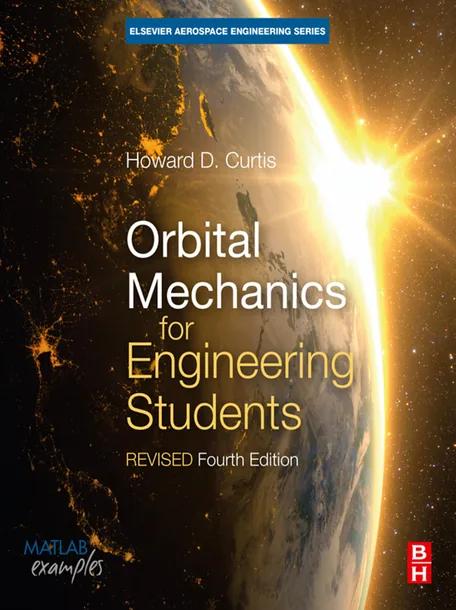
Orbital Mechanics for Engineering Students cover

Orbital Mechanics for Engineering Students

Revised Reprint

by Howard D. Curtis

4th Edition

Publisher: Elsevier Butterworth Heinemann

(0 reviews)

Compare Prices

VitalSourceReflowable Layout$78.99Amazon KindleKindle$63.19Best PriceeTextShelfPDF$38.00

Book Details

Print ISBN9780128240250
eText ISBN9780323853453
PublisherElsevier Butterworth Heinemann
Publishing Year2021
Edition4th Edition
LanguageEnglish
Pages780

Aspiring aerospace engineers require a rigorous yet highly accessible foundation to navigate the complexities of modern space mission design. **Orbital Mechanics for Engineering Students 4th Edition** delivers exactly this, serving as an indispensable academic resource in an era of rapidly expanding commercial spaceflight and deep-space exploration. Howard D. Curtis provides a masterfully structured introduction to the mathematical and physical principles governing spacecraft motion. By balancing theoretical depth with practical engineering applications, this updated volume ensures that students and practicing aerospace professionals can confidently analyze orbital trajectories, plan complex maneuvers, and understand the dynamics of satellite attitude control in a rapidly evolving global aerospace landscape.

The textbook's comprehensive scope spans the fundamental physics of point masses to the intricate dynamics of rigid bodies and multi-stage rocket vehicles. Curtis employs a highly effective, practical teach-by-example methodology, guiding readers through the classical two-body problem, three-dimensional orbits, and preliminary orbit determination. Key themes include coordinate transformations, orbital perturbations, and relative motion, which are critical for rendezvous operations. The author's analytical perspective is bolstered by robust computational tools, particularly downloadable MATLAB algorithms, which empower students to translate abstract mathematical formulations into functional, real-world engineering simulations. This seamless blend of theory and computation provides a holistic view of modern astrodynamics.

Designed primarily for upper-level undergraduate and introductory graduate courses in aerospace engineering, **Orbital Mechanics for Engineering Students 4th Edition** stands out for its exceptional pedagogical support and student-focused design. This revised edition introduces a brand-new chapter on the circular restricted three-body problem, including low-energy trajectories, alongside updated coverage of interplanetary mission design, lunar missions, and non-Hohmann transfers. Instructors and students benefit from an extensive support package containing fully worked solutions, PowerPoint lecture slides, and interactive animations of selected topics. For those seeking a flexible digital learning experience, the **Orbital Mechanics for Engineering Students 4th Edition PDF** offers seamless, anytime access to these vital resources, making it the premier choice for academic institutions worldwide.

Table of Contents

  1. Chapter 1: Dynamics of point masses

    • • Kinematics
    • • Mass, force and Newton's law of gravitation
    • • Newton's law of motion
    • • Time derivatives of moving vectors
    • • Relative motion
  2. Chapter 2: The two-body problem

    • • Equations of motion in an inertial frame
    • • Equations of relative motion
    • • Angular momentum and the orbit formulas
    • • The energy law
    • • Circular, elliptical, parabolic, and hyperbolic orbits
    • • Perifocal frame
    • • The Lagrange coefficients
    • • Restricted three-body problem
  3. Chapter 3: Orbital position as a function of time

    • • Time since periapsis
    • • Kepler's equation for elliptical, parabolic, and hyperbolic orbits
    • • Universal variables
  4. Chapter 4: Orbits in three dimensions

    • • Geocentric right ascension-declination frame
    • • State vector and the geocentric equatorial frame
    • • Orbital elements and the state vector
    • • Coordinate transformations
    • • Effects of the earth's oblateness
  5. Chapter 5: Preliminary orbit determination

    • • Gibbs' method
    • • Lambert's problem
    • • Sidereal time
    • • Topocentric coordinate systems
    • • Gauss's method
  6. Chapter 6: Orbital maneuvers

    • • Impulsive maneuvers
    • • Hohmann and bi-elliptic transfers
    • • Phasing maneuvers
    • • Non-Hohmann transfers
    • • Apse line rotation
    • • Plane change maneuvers
  7. Chapter 7: Relative motion and rendezvous

    • • Relative motion in orbit
    • • Clohessy-Wiltshire equations
    • • Two-impulse rendezvous maneuvers
  8. Chapter 8: Interplanetary trajectories

    • • Interplanetary Hohmann transfers
    • • Rendezvous opportunities
    • • Sphere of influence
    • • Method of patched conics
    • • Planetary departure, flyby, and arrival
  9. Chapter 9: Lunar trajectories

    • • Motion in the Earth-Moon system
    • • Lunar flight trajectory design
    • • Patched conic approximation for lunar missions
  10. Chapter 10: Introduction to orbital perturbations

    • • Non-spherical Earth gravity
    • • Atmospheric drag
    • • Solar radiation pressure
    • • Third-body gravity perturbations
  11. Chapter 11: Rigid body dynamics

    • • Kinematics of rigid bodies
    • • Equations of translational and rotational motion
    • • Moments of inertia
    • • Euler's equations
    • • Euler angles
  12. Chapter 12: Spacecraft attitude dynamics

    • • Torque-free motion and stability
    • • Dual-spin spacecraft
    • • Nutation dampers
    • • Attitude control thrusters
    • • Yo-yo despin mechanism
    • • Gyroscopic attitude control
    • • Gravity-gradient stabilization
  13. Chapter 13: Rocket vehicle dynamics

    • • Equations of motion and the thrust equation
    • • Rocket performance
    • • Restricted and optimal staging

Customer Reviews

0.0

0 reviews

5 stars
0
4 stars
0
3 stars
0
2 stars
0
1 stars
0

No reviews yet. Be the first to review this book!

Write a Review

Select rating

0/20 characters minimum

By submitting a review, you agree that it may be published after moderation.

Reviewed by GradeFocus

▶Research Sources (13)
  • [PDF] ORBITAL MECHANICS FOR ENGINEERING STUDENTS - hlevkin
  • Orbital Mechanics for Engineering Students: Revised Reprint
  • eBook - Orbital Mechanics for Engineering Students-9780323853453
  • Orbital Mechanics for Engineering Students - The Ohio Digital Library
  • Orbital Mechanics for Engineering Students Revised Reprint 4th
  • [PDF] ORBITAL MECHANICS FOR ENGINEERING STUDENTS - UFPR
  • Orbital Mechanics for Engineering Students - 5th Edition
  • Orbital Mechanics for Engineering Students Howard D. Curtis
  • Orbital Mechanics for Engineering Students - ScienceDirect.com
  • Orbital Mechanics for Engineering Students | Elsevier Shop
  • Orbital Mechanics for Engineering Students, 4th edition - MathWorks
  • Orbital Mechanics for Engineering Students | PDF | Euclidean Vector

  • Orbital Mechanics for Engineering Students: Revised Reprint ...

Related Books

Fundamentals of Heat and Mass Transfer

Fundamentals of Heat and Mass Transfer

Theodore L. Bergman

Fundamentals of Thermal-Fluid Sciences

Fundamentals of Thermal-Fluid Sciences

Yunus A. Cengel

Thermodynamics

Thermodynamics

Yunus A. Cengel