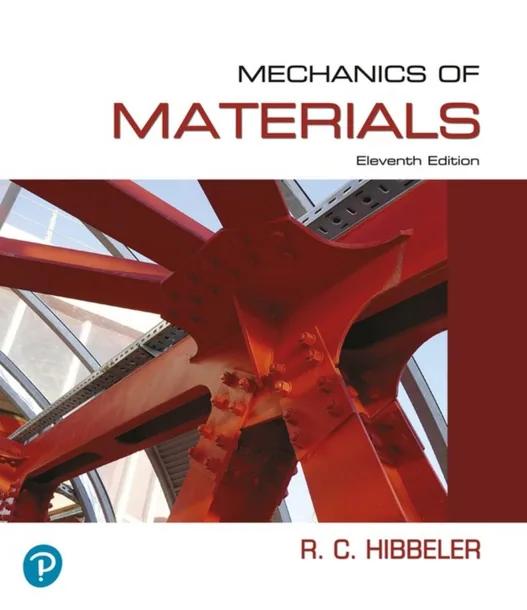
Mechanics of Materials (Pearson+)
by Russell Hibbeler
11th Edition
Publisher: Pearson
Book Details
| Print ISBN | 9780137605521 |
| eText ISBN | 9780137605385 |
| Publisher | Pearson |
| Publishing Year | 2023 |
| Edition | 11th Edition |
| Language | English |
Mechanics of Materials (Pearson+), 11th Edition, presents fundamental mechanics of materials principles alongside their practical engineering applications. Authored by Russell Hibbeler and published by Pearson, this introductory textbook gives college and university students a structured framework for understanding how physical components react under force.
The text organizes core topics into sequential thematic areas. It starts with basic definitions of stress and strain before investigating the mechanical properties of materials. Subsequent chapters detail how structural elements respond to specific forces, covering axial load, torsion, bending, transverse shear, and combined loadings.
This 11th edition features updated problem types designed around realistic engineering situations across varied difficulty levels. These practice exercises help students develop problem-solving skills in introductory mechanics courses while offering instructional material for faculty teaching undergraduate engineering.
Table of Contents
Chapter 1: Stress
- • 1.1 Introduction
- • 1.2 Equilibrium of a Deformable Body
- • 1.3 Stress
- • 1.4 Average Normal Stress in an Axially Loaded Bar
- • 1.5 Average Shear Stress
- • 1.6 Allowable Stress Design
- • 1.7 Limit State Design
Chapter 2: Strain
- • 2.1 Deformation
- • 2.2 Strain
Chapter 3: Mechanical Properties of Materials
- • 3.1 The Tension and Compression Test
- • 3.2 The Stress--Strain Diagram
- • 3.3 Stress--Strain Behavior of Ductile and Brittle Materials
- • 3.4 Strain Energy
- • 3.5 Poisson's Ratio
- • 3.6 The Shear Stress--Strain Diagram
- • *3.7 Failure of Materials Due to Creep and Fatigue
Chapter 4: Axial Load
- • 4.1 Saint-Venant's Principle
- • 4.2 Elastic Deformation of an Axially Loaded Member
- • 4.3 Principle of Superposition
- • 4.4 Statically Indeterminate Axially Loaded Members
- • 4.5 The Force Method of Analysis for Axially Loaded Members
- • 4.6 Thermal Stress
- • 4.7 Stress Concentrations
- • *4.8 Inelastic Axial Deformation
- • *4.9 Residual Stress
Chapter 5: Torsion
- • 5.1 Torsional Deformation of a Circular Shaft
- • 5.2 The Torsion Formula
- • 5.3 Power Transmission
- • 5.4 Angle of Twist
- • 5.5 Statically Indeterminate Torque-Loaded Members
- • *5.6 Solid Noncircular Shafts
- • *5.7 Thin-Walled Tubes Having Closed Cross Sections
- • 5.8 Stress Concentration
- • *5.9 Inelastic Torsion
- • *5.10 Residual Stress
Chapter 6: Bending
- • 6.1 Shear and Moment Diagrams
- • 6.2 Graphical Method for Constructing Shear and Moment Diagrams
- • 6.3 Bending Deformation of a Straight Member
- • 6.4 The Flexure Formula
- • 6.5 Unsymmetric Bending
- • *6.6 Composite Beams
- • *6.7 Reinforced Concrete Beams
- • *6.8 Curved Beams
- • 6.9 Stress Concentrations
- • *6.10 Inelastic Bending
Chapter 7: Transverse Shear
- • 7.1 Shear in Straight Members
- • 7.2 The Shear Formula
- • 7.3 Shear Flow in Built-Up Members
- • 7.4 Shear Flow in Thin-Walled Members
- • *7.5 Shear Center for Open Thin-Walled Members
Chapter 8: Combined Loadings
- • 8.1 Thin-Walled Pressure Vessels
- • 8.2 State of Stress Caused by Combined Loadings
Chapter 9: Stress Transformation
- • 9.1 Plane-Stress Transformation
- • 9.2 General Equations of Plane-Stress Transformation
- • 9.3 Principal Stresses and Maximum In-Plane Shear Stress
- • 9.4 Mohr's Circle-Plane Stress
- • 9.5 Absolute Maximum Shear Stress
Chapter 10: Strain Transformation
- • 10.1 Plane Strain
- • 10.2 General Equations of Plane-Strain Transformation
- • *10.3 Mohr's Circle-Plane Strain
- • *10.4 Absolute Maximum Shear Strain
- • 10.5 Strain Rosettes
- • 10.6 Material Property Relationships
- • *10.7 Theories of Failure
Chapter 11: Design of Beams and Shafts
- • 11.1 Basis for Beam Design
- • 11.2 Prismatic Beam Design
- • *11.3 Fully Stressed Beams
- • *11.4 Shaft Design
Chapter 12: Deflection of Beams and Shafts
- • 12.1 The Elastic Curve
- • 12.2 Slope and Displacement by Integration
- • *12.3 Discontinuity Functions
- • *12.4 Slope and Displacement by the Moment-Area Method
- • 12.5 Method of Superposition
- • 12.6 Statically Indeterminate Beams and Shafts
- • 12.7 Statically Indeterminate Beams and Shafts - Method of Integration
- • *12.8 Statically Indeterminate Beams and Shafts - Moment-Area Method
- • 12.9 Statically Indeterminate Beams and Shafts - Method of Superposition
Chapter 13: Buckling of Columns
- • 13.1 Critical Load
- • 13.2 Ideal Column with Pin Supports
- • 13.3 Columns Having Various Types of Supports
- • *13.4 The Secant Formula
- • *13.5 Inelastic Buckling
- • *13.6 Design of Columns for Concentric Loading
- • *13.7 Design of Columns for Eccentric Loading
Chapter 14: Energy Methods
- • 14.1 External Work and Strain Energy
- • 14.2 Elastic Strain Energy for Various Types of Loading
- • 14.3 Conservation of Energy
- • 14.4 Impact Loading
- • *14.5 Principle of Virtual Work
- • *14.6 Method of Virtual Forces Applied to Trusses
- • *14.7 Method of Virtual Forces Applied to Beams
- • *14.8 Castigliano's Theorem
- • *14.9 Castigliano's Theorem Applied to Trusses
- • *14.10 Castigliano's Theorem Applied to Beams
Customer Reviews
0.0
0 reviews
No reviews yet. Be the first to review this book!
Write a Review
Reviewed by GradeFocus Editorial Team
▶Research Sources (14)
- 9780137605385 / CEI (Pearson) / Hibbeler 11E / Mechanics of ...
- Mechanics of Materials (Pearson+) - ISBN 9780137605385
- Untitled
- ISBN 9780137605385 - Mechanics of Materials 11th Edition ...
- 9780137605385: Mechanics of Materials (Pearson+)
- Mechanics of Materials - R. C. Hibbeler
- Mechanics of Materials - ISBN 9780137605521
- Mechanics of Materials [Rental... | Rent | 9780137605521
- Mechanics of Materials 11th edition (9780137605521) - Textbooks.com
- Mechanics of Materials, Eleventh Edition by R. C. Hibbeler - Pearson
- Mechanics of Materials [RENTAL EDITION]
- Mechanics of Materials - 11th Edition - Solutions and Answers
- Hibbeler mechanics of materials 11th edition pdf
- ISBN 9780137605521 - Mechanics of Materials 11th Edition ...