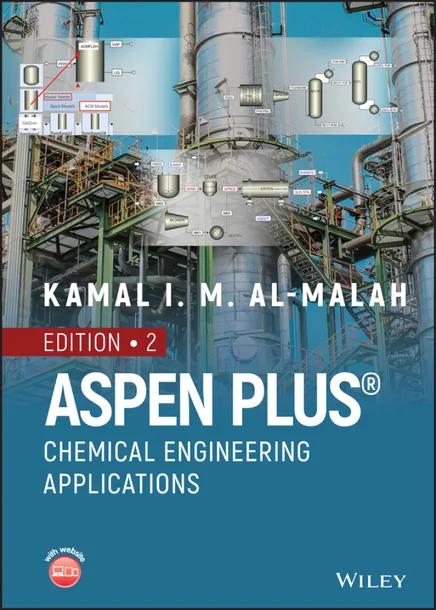
Aspen Plus
Chemical Engineering Applications
by Kamal I. M. Al-Malah
2nd Edition
Publisher: Wiley-Blackwell
Book Details
| Print ISBN | 9781119868699 |
| eText ISBN | 9781119868712 |
| Publisher | Wiley-Blackwell |
| Publishing Year | 2022 |
| Edition | 2nd Edition |
| Language | English |
| Pages | 656 |
Aspen Plus: Chemical Engineering Applications, 2nd Edition is a textbook designed for chemical engineering students, instructors, and industry professionals. Written by Kamal I. M. Al-Malah, this volume demonstrates how to implement Aspen Plus V12.1 to solve operational challenges across chemical process industries.
The technical content establishes a clear sequence through essential unit operations and physical property modeling. Early chapters cover flowsheet features, flash separation, and distillation columns, followed by liquid-liquid extraction and heat exchanger design. Subsequent chapters explore reactors with simple and complex kinetic forms, electrolyte chemistry, polymerization, solids handling, safety measures, and energy saving approaches.
To build practical simulation skills, the text provides step-by-step examples, analytical explanations, and direct screenshots of Aspen Plus software interfaces. End-of-chapter problems and long-term project problems offer students structured practice in applying these software tools to process engineering calculations.
Table of Contents
Chapter Ch1.: Introducing Aspen Plus
- • 1.1 What does ASPEN stand for?
- • 1.2 What is Aspen Plus Process Simulation Model?
- • 1.3 Launching Aspen Plus V12.0
- • 1.4 Beginning a Simulation
- • 1.5 Entering Components
- • 1.6 Specifying the Property Method
- • 1.7 Improvement of the Property Method Accuracy
- • 1.8 File Saving
- • 1.9 Exercise 1.1
- • 1.10 Good Flowsheeting Practice
- • 1.11 Aspen Plus Built-in Help
- • 1.12 For More Information
- • 1.13 Home/Class Work 1.1 (Pxy)
- • 1.14 Home/Class Work 1.2 (Gmix)
- • 1.15 Home/Class Work 1.3 (Likes Dissolve Likes) as Envisaged by NRTL Property Method
- • 1.16 Home/Class Work 1.4 (The Mixing Rule)
Chapter Ch2.: More on Aspen Plus Flowsheet Features (1)
- • 2.1 Problem Description
- • 2.2 Entering and Naming Compounds
- • 2.3 Binary Interactions
- • 2.4 The “Simulation” Environment: Activation Dashboard
- • 2.5 Placing a Block and Material Stream from Model Palette
- • 2.6 Block and Stream Manipulation
- • 2.7 Data Input, Project Title, & Report Options
- • 2.8 Running the Simulation
- • 2.9 The Difference among Recommended Property Methods
- • 2.10 NIST/TDE Experimental Data
- • 2.11 Home-/Class-Work 2.1 (Water-Alcohol System)
- • 2.12 Home-/Class-Work 2.2 (Water-Acetone-EIPK System with NIST/DTE Data)
- • 2.13 Home-/Class-Work 2.3 (Water-Acetone-EIPK System without NIST/DTE Data)
Chapter Ch3.: More on Aspen Plus Flowsheet Features (2)
- • 3.1 Problem Description: Continuation to Chapter Two Problem
- • 3.2 The Clean Parameters Step
- • 3.3 Simulation Results Convergence
- • 3.4 Adding Stream Table
- • 3.5 Property Sets
- • 3.6 Adding Stream Conditions
- • 3.7 Printing from Aspen Plus
- • 3.8 Viewing the Input Summary
- • 3.9 Report Generation
- • 3.10 Stream Properties
- • 3.11 Adding a Flash Separation Unit
- • 3.12 The Required Input for “Flash3”-Type Separator
- • 3.13 Running the Simulation and Checking the Results
- • 3.14 Home-/Class-Work 3.1 (Output of Input Data & Results)
- • 3.15 Home-/Class-Work 3.2 (Output of Input Data & Results)
- • 3.16 Home-/Class-Work 3.3 (Output of Input Data & Results)
- • 3.17 Home-/Class-Work 3.4 (The Partition Coefficient of a Solute)
Chapter Ch4.: Flash Separation & Distillation Columns
- • 4.1 Problem Description
- • 4.2 Adding a Second Mixer and Flash
- • 4.3 Design Specifications Study
- • 4.4 Exercise 4.1 (Design Spec)
- • 4.5 Aspen Plus Distillation Column Options
- • 4.6 “DSTWU” Distillation Column
- • 4.7 “Distl” Distillation column
- • 4.8 “RadFrac” Distillation Column
- • 4.9 Home/Class Work 4.1 (Water-Alcohol System)
- • 4.10 Home/Class Work 4.2 (Water-Acetone-EIPK System with NIST/DTE Data)
- • 4.11 Home/Class Work 4.2 (Water-Acetone-EIPK System without NIST/DTE Data)
- • 4.12 Home/Class Work 4.4 (Scrubber)
Chapter Ch5.: Liquid-Liquid Extraction Process
- • 5.1 Problem Description
- • 5.2 The Proper Selection for Property Method for Extraction Processes
- • 5.3 Defining New Property Sets
- • 5.4 Property Method Validation versus Experimental Data Using Sensitivity Analysis
- • 5.5 A Multi-Stage Extraction Column
- • 5.6 The Triangle Diagram
- • 5.7 References
- • 5.8 Home/Class Work 5.1 (Separation of MEK from Octanol)
- • 5.9 Home/Class Work 5.2 (Separation of MEK from Water Using Octane)
- • 5.10 Home/Class Work 5.3 (Separation of Acetic Acid from Water Using Iso-Propyl Butyl Ether)
- • 5.11 Home/Class Work 5.4 (Separation of Acetone from Water Using Tri-Chloro-Ethane)
- • 5.12 Home/Class Work 5.5 (Separation of Propionic Acid from Water Using MEK)
Chapter Ch6.: Reactors with Simple Reaction Kinetic Forms
- • 6.1 Problem Description
- • 6.2 Defining Reaction Rate Constant to Aspen Plus Environment
- • 6.3 Entering Components and Method of Property
- • 6.4 The Rigorous Plug Flow Reactor (RPLUG)
- • 6.5 Reactor and Reaction Specifications for RPLUG (PFR)
- • 6.6 Running the Simulation (PFR Only)
- • 6.7 Exercise 6.1
- • 6.8 Compressor (CMPRSSR) and RadFrac Rectifying Column (RECTIF)
- • 6.9 Running the Simulation (PFR + CMPRSSR + RECTIF)
- • 6.10 Exercise 6.2
- • 6.11 RadFrac Distillation Column (DSTL)
- • 6.12 Running the Simulation (PFR + CMPRSSR + RECTIF+DSTL)
- • 6.13 Reactor and Reaction Specifications for RCSTR
- • 6.14 Running the Simulation (PFR + CMPRSSR + RECTIF+DSTL+RCSTR)
- • 6.15 Exercise 6.3
- • 6.16 Sensitivity Analysis: The Reactor’s Optimum Operating Conditions
- • 6.17 References
- • 6.18 Home/Class Work 6.1 (Hydrogen Peroxide Shelf-Life)
- • 6.19 Home/Class Work 6.2 (Esterification Process)
- • 6.20 Home/Class Work 6.3 (Liquid-Phase Isomerization of n-Butane)
Chapter Ch7.: Reactors with Complex (Non-Conventional) Reaction Kinetic Forms
- • 7.1 Problem Description
- • 7.2 Non-Conventional Kinetics: LHHW Type Reaction
- • 7.3 General Expressions for Specifying LHHW Type Reaction in Aspen Plus
- • 7.3.1 The “Driving Force” for the Non-Reversible (Irreversible) Case
- • 7.3.2 The “Driving Force” for the Reversible Case
- • 7.3.3 The “Adsorption Expression”
- • 7.4 The Property Method: “SRK”
- • 7.5 RPLUG Flowsheet for Methanol Production
- • 7.6 Entering Input Parameters
- • 7.7 Defining Methanol Production Reactions as LHHW Type
- • 7.8 Sensitivity Analysis: Effect of Temperature and Pressure on Selectivity
- • 7.9 References
- • 7.10 Home/Class Work 7.1 (Gas-Phase Oxidation of Chloroform)
- • 7.11 Home/Class Work 7.2 (Formation of Styrene from Ethyl-Benzene)
- • 7.12 Home/Class Work 7.3 (Combustion of Methane over Steam-Aged Pt-Pd Catalyst)
Chapter Ch8.: Pressure Drop, Friction Factor, NPSHA, and Cavitation
- • 8.1 Problem Description
- • 8.2 The Property Method: “STEAMNBS”
- • 8.3 A Water Pumping Flowsheet
- • 8.4 Entering Pipe, Pump, & Fittings Specifications
- • 8.5 Results: Frictional Pressure Drop, the Pump Work, Valve Choking, and ANPSH versus RNPSH
- • 8.6 Exercise 8.1
- • 8.7 Model Analysis Tools: Sensitivity for the Onset of Cavitation or Valve Choking Condition
- • 8.8 References
- • 8.9 Home/Class Work 8.1 (Pentane Transport)
- • 8.10 Home/Class Work 8.2 (Glycerol Transport)
- • 8.11 Home/Class Work 8.3 (Air Compression)
Chapter Ch9.: The Optimization Tool
- • 9.1 Problem Description: Defining the Objective Function
- • 9.2 The Property Method: “STEAMNBS”
- • 9.3 A Flowsheet for Water Transport
- • 9.4 Entering Stream, Pump, and Pipe Specifications
- • 9.5 Model Analysis Tools: The Optimization Tool
- • 9.6 Model Analysis Tools: The Sensitivity Tool
- • 9.7 Last Comments
- • 9.8 References
- • 9.9 Home/Class Work 9.1 (Swamee-Jain Equation)
- • 9.10 Home/Class Work 9.2 (A Simplified Pipe Diameter Optimization)
- • 9.11 Home/Class Work 9.3 (The Optimum Diameter for a Viscous Flow)
- • 9.12 Home/Class Work 9.4 (The Selectivity of Parallel Reactions)
Chapter Ch10.: Heat Exchanger (H.E.) Design
- • 10.1 Problem Description
- • 10.2 Types of Heat Exchanger Models in Aspen Plus
- • 10.3 The Simple Heat Exchanger Model (“Heater”)
- • 10.4 The Rigorous Heat Exchanger Model (“HeatX”)
- • 10.5 The Rigorous Exchanger Design and Rating (EDR) Procedure
- • 10.5.1 The EDR Exchanger Feasibility Panel
- • 10.5.2 The Rigorous Mode within the “HeatX” Block
- • 10.6 General Footnotes on EDR Exchanger
- • 10.7 References
- • 10.8 Home/Class Work 10.1 (Heat Exchanger with Phase Change)
- • 10.9 Home/Class Work 10.2 (High Heat Duty Heat Exchanger)
- • 10.10 Home/Class Work 10.3 (Design Spec Heat Exchanger)
Chapter Ch11.: Electrolytes
- • 11.1 Problem Description: Water De-Souring
- • 11.2 What is an Electrolyte?
- • 11.3 The Property Method for Electrolytes
- • 11.4 The Electrolyte Wizard
- • 11.5 Water De-Souring Process Flowsheet
- • 11.6 Entering the Specifications of Feed Streams and the Stripper
- • 11.7 Appendix: Development of “ELECNRTL” Model
- • 11.8 References
- • 11.9 Home/Class Work 11.1 (An Acidic Sludge Neutralization)
- • 11.10 Home/Class Work 11.2 (CO2 Removal from Natural Gas)
- • 11.11 Home/Class Work 11.3 (pH of Aqueous Solutions of Salts)
Chapter Ch12.: Polymerization Processes
- • 12.1 The Theoretical Background
- • 12.1.1 Polymerization Reactions
- • 12.1.2 Catalyst Types
- • 12.1.3 Ethylene Process Types
- • 12.1.4 Reaction Kinetic Scheme
- • 12.1.5 Reaction Steps
- • 12.1.6 Catalyst States
- • 12.2 High-Density Poly-Ethylene (HDPE) High Temperature Solution Process
- • 12.2.1 Problem Definition
- • 12.2.2 Process Conditions
- • 12.3 Creating Aspen Plus Flowsheet for HDPE
- • 12.4 Improving Convergence
- • 12.5 Presenting the Property Distribution of Polymer
- • 12.6 Home/Class Work 12.1 (Maximizing the Degree of HDPE Polymerization)
- • 12.7 Home/Class Work 12.2 (Styrene Acrylo-Nitrile (SAN) Polymerization)
- • 12.8 References
- • 12.9 Appendix A: The Main Features & Assumptions of Aspen Plus Chain Polymerization Model
- • 12.9.1 Polymerization Mechanism
- • 12.9.2 Co-polymerization Mechanism
- • 12.9.3 Rate Expressions
- • 12.9.4 Rate Constants
- • 12.9.5 Catalyst Pre-Activation
- • 12.9.6 Catalyst Site Activation
- • 12.9.7 Site Activation Reactions
- • 12.9.8 Chain Initiation
- • 12.9.9 Propagation
- • 12.9.10 Chain Transfer to Small Molecules
- • 12.9.11 Chain Transfer to Monomer
- • 12.9.12 Site Deactivation
- • 12.9.13 Site Inhibition
- • 12.9.14 Co-Catalyst Poisoning
- • 12.9.15 Terminal Double Bond Polymerization
- • 12.9.16 Phase Equilibria
- • 12.9.17 Rate Calculations
- • 12.9.18 Calculated Polymer Properties
- • 12.10 Appendix B: The Number Average Molecular Weight (MWN) and Weight Average Molecular Weight (MWW)
Chapter Ch13.: Characterization of Drug-Like Molecules Using Aspen Properties
- • 13.1 Introduction
- • 13.2 Problem Description
- • 13.3 Creating Aspen Plus Pharmaceutical Template
- • 13.3.1 Entering the User-Defined Benzamide (BNZMD-UD) as Conventional
- • 13.3.2 Specifying Properties to Estimate
- • 13.4 Defining Molecular Structure of BNZMD-UD
- • 13.5 Entering Property Data
- • 13.6 Contrasting Aspen Plus Databank (BNZMD-DB) versus BNZMD-UD
- • 13.7 References
- • 13.8 Home/Class Work 13.1 (Vanillin)
- • 13.9 Home/Class Work 13.2 (Ibuprofen)
Chapter Ch14.: Solids Handling
- • 14.1 Introduction
- • 14.2 Problem Description #1: The Crusher
- • 14.3 Creating Aspen Plus Flowsheet
- • 14.3.1 Entering Components Information
- • 14.3.2 Adding the Flowsheet Objects
- • 14.3.3 Defining the Particle Size Distribution (PSD)
- • 14.3.4 Calculation of the Outlet PSD
- • 14.4 Exercise 14.1: (Determine Crusher Outlet PSD from Comminution Power)
- • 14.5 Exercise 14.2: (Specifying Crusher Outlet PSD)
- • 14.6 Problem Description #2: The Fluidized Bed for Alumina Dehydration
- • 14.7 Creating Aspen Plus Flowsheet
- • 14.7.1 Entering Components Information
- • 14.7.2 Adding the Flowsheet Objects
- • 14.7.3 Entering Input Data
- • 14.7.4 Results
- • 14.8 Exercise 14.3: (Re-Converging the Solution for an Input Change)
- • 14.9 References
- • 14.10 Home/Class Work 14.1 (KCl Drying)
- • 14.11 Home/Class Work 14.2 (KCl Crystallization)
- • 14.12 APPENDIX A: Solids Unit Operations
- • 14.12.1 Unit Operation Solids Models
- • 14.12.2 Solids Separators Models
- • 14.12.3 Solids Handling M
Customer Reviews
0.0
0 reviews
No reviews yet. Be the first to review this book!
Write a Review
Reviewed by GradeFocus Editorial Team
▶Research Sources (15)
- Aspen Plus
- Please verify you are human - Captcha
- Literature & Thought
- Search for Textbooks
- Browse Books | Page 6
- Aspen Plus eBook by Kamal I. M. Al-Malah - EPUB
- Thompson Learn.
- Aspen Plus (ebook), Kamal I. M. Al-Malah - Bol
- Aspen Plus: Chemical Engineering Applications 2nd Edition
- Aspen Plus: Chemical Engineering Applications
- Aspen Plus (2nd edition)
- Learn Aspen Plus in 24 Hours (2nd Edition)
- Chemical Engineering: Aspen Plus - Research Guides
- Aspen Plus, 2nd Edition by Kamal IM Al-Malah - The Nile
- Aspen Plus 11.1 User Guide
Related Books
Industrial Chemical Process Analysis and Design
Mariano Martín Martín
Industrial Water Conservation
Dominic Foo
Ionic Liquids in Biomass Processing
Harish K. Chopra

Artificial Intelligence in Chemical Engineering
Farooq Sher

Ozone Gas Sensing Technologies
Niravkumar J. Joshi
Machine Learning for Membrane Separation Applications
Mashallah Rezakazemi