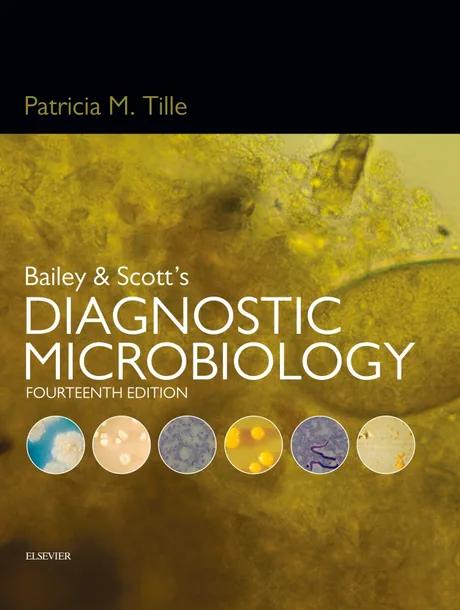
Bailey & Scott's Diagnostic Microbiology
by Patricia M. Tille
14th Edition
Publisher: Mosby
Book Details
| Print ISBN | 9780323354820 |
| eText ISBN | 9780323428927 |
| Publisher | Mosby |
| Publishing Year | 2018 |
| Edition | 14th Edition |
| Language | English |
| Pages | 1136 |
Bailey & Scott's Diagnostic Microbiology, 14th Edition, serves as a bench reference for practicing microbiologists and a textbook for clinical laboratory science students. It provides topical scientific information and practical guidance for laboratory testing.
Core subject areas include fundamental medical microbiology, laboratory safety, specimen management, and diagnostic approaches such as microscopy, traditional cultivation, and nucleic acid detection. The volume also examines antimicrobial susceptibility testing and includes expanded sections on parasitology, mycology, and virology.
Case studies present diverse diagnostic scenarios that allow readers to apply information to realistic laboratory situations. These exercises help students and practitioners develop the critical thinking and decision-making skills required for clinical diagnostic work.
Table of Contents
Chapter 1: Microbial Taxonomy
Chapter 2: Bacterial Genetics, Metabolism, and Structure
Chapter 3: Host-Microorganism Interactions
Chapter 4: Laboratory Safety
Chapter 5: Specimen Management
Chapter 6: Role of Microscopy
Chapter 7: Traditional Cultivation and Identification
Chapter 8: Nucleic Acid-Based Analytic Methods for Microbial Identification and Characterization
Chapter 9: Overview of Immunochemical Methods Used for Organism Detection
Chapter 10: Principles of Antimicrobial Action & Resistance
Chapter 11: Laboratory Methods and Strategies for Antimicrobial Susceptibility Testing
Chapter 12: Overview of Bacterial Identification Methods and Strategies
Chapter 13: Staphylococcus, Micrococcus, and Similar Organisms
Chapter 14: Streptococcus, Enterococcus, and Similar Organisms
Chapter 15: Bacillus and Similar Organisms
Chapter 16: Listeria, Corynebacterium, and Similar Organisms
Chapter 17: Erysipelothirix, Lactobacillus, and Similar Organisms
Chapter 18: Nocardia, Streptomyces, Rhodococcus, and Similar Organisms
Chapter 19: Enterobacteriaceae
Chapter 20: Acinetobacter, Stenotrophomonas, and Other Organisms
Chapter 21: Pseudomonas, Burkholderia, and Similar Organisms
Chapter 22: Achromobacter, Rhizobium, Ochrobactrum, and Similar Organisms
Chapter 23: Chryseobacterium, Sphingobacterium, and Similar Organisms
Chapter 24: Alcaligenes, Bordetella (Nonpertussis), Comamonas, and Similar Organisms
Chapter 25: Vibrio, Aeromonas, Plesiomonas shigelloides, and Chromobacterium violaceum
Chapter 26: Sphingomonas paucimobilis and Similar Organisms
Chapter 27: Moraxella
Chapter 28: Eikenella corrodens and Similar Organisms
Chapter 29: Pasteurella and Similar Organisms
Chapter 30: Actinobacillus, Kingella, Cardiobacterium, Capnocytophaga, and Similar Organisms
Chapter 31: Haemophilus
Chapter 32: Bartonella and Afipia
Chapter 33: Campylobacter, Arcobacter, and Helicobacter
Chapter 34: Legionella
Chapter 35: Brucella
Chapter 36: Bordetella pertussis and Bordetella parapertussis
Chapter 37: Francisella
Chapter 38: Streptobacillus moniliformis and Spirillum minus
Chapter 39: Neisseria and Moraxella catarrhalis
Chapter 40: Overview and General Considerations
Chapter 41: Laboratory Considerations
Chapter 42: Mycobacteria
Chapter 43: Obligate Intracellular and Nonculturable Bacterial Agents
Chapter 44: Cell Wall-Deficient Bacteria: Mycoplasma and Ureaplasma
Chapter 45: The Spirochetes
Chapter 46: Overview of the Methods and Strategies in Parasitology
Chapter 47: Intestinal Protozoa
Chapter 48: Blood and Tissue Protoza
Chapter 49: Protozoa from Other Body Sites
Chapter 50: Intestinal Nematodes
Chapter 51: Tissue Nematodes
Chapter 52: Blood Nematodes
Chapter 53: Intestinal Cestodes
Chapter 54: Tissue Cestodes
Chapter 55: Intestinal Trematodes
Chapter 56: Liver and Lung Trematodes
Chapter 57: Blood Trematodes
Chapter 58: Overview of Fungal Identification Methods and Strategies
Chapter 59: Hyaline Molds, Zygomycetes, Dermatophytes, and Opportunitistic and Systemic Mycoses
Chapter 60: Dematiaceious Molds
Chapter 61: Opportunistic Atypical Fungs: P. jiroveci
Chapter 62: The Yeasts
Chapter 63: Antifungal Susceptibility Testing, Therapy and Prevention
Chapter 64: Overview of the Methods and Strategies in Virology
Chapter 65: Viruses in Human Disease
Chapter 66: Antiviral Therapy, Susceptibility Testing and Prevention
Chapter 67: Bloodstream Infections
Chapter 68: Infections of the Lower Respiratory Tract
Chapter 69: Upper Respiratory Tract Infections and Other Infections of the Oral Cavity and Neck
Chapter 70: Meningitis and Other Infections of the Central Nervous Systems
Chapter 71: Infections of the Eyes, Ears, and Sinuses
Chapter 72: Infections of the Urinary Tract
Chapter 73: Genital Tract Infections
Chapter 74: Gastrointestinal Tract Infections
Chapter 75: Skin, Soft Tissue, and Wound Infections
Chapter 76: Normally Sterile Body Fluids, Bone and Bone Marrow, and Solid Tissues
Chapter 77: Quality in the Clinical Microbiology Laboratory
Chapter 78: Infection Control
Chapter 79: Sentinel Laboratory Response to Bioterrorism
Customer Reviews
0.0
0 reviews
No reviews yet. Be the first to review this book!
Write a Review
Reviewed by GradeFocus Editorial Team