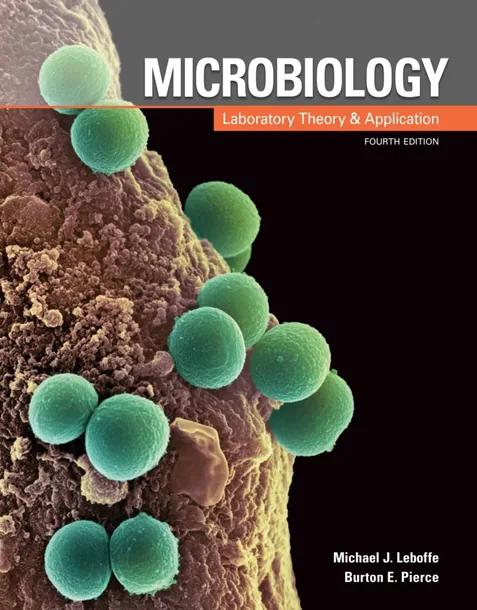
Microbiology: Laboratory Theory & Application
by Michael J. Leboffe, Burton E. Pierce
4th Edition
Publisher: Morton Publishing Company
Book Details
| Print ISBN | 9781617312502 |
| eText ISBN | 9781617312502 |
| Publisher | Morton Publishing Company |
| Publishing Year | 2015 |
| Edition | 4th Edition |
| Language | English |
| Pages | 912 |
Microbiology: Laboratory Theory & Application, 4th Edition is a full-color laboratory manual by Michael J. Leboffe and Burton E. Pierce designed for both majors and nonmajors. Each experiment combines step-by-step procedures with dedicated Theory and Application sections detailing general principles and practical outcomes for lab activities.
Across 119 distinct exercises, the manual covers core techniques and specialized topics in clinical and applied microbiology. Key laboratory areas include microbial growth, microscopy, staining, selective media, differential tests, and quantitative techniques. Specialized investigations explore clinical biofilms, soil slide culture, the Winogradsky column, restriction digest, polymerase chain reaction, and phage typing of E. coli strains.
Visual guides include full-color photographs, micrographs, detailed illustrations, and step-by-step procedural diagrams that support proper student technique. For this fourth edition, data sheets appear right after each corresponding exercise for immediate entry during lab work. This clear visual and practical structure supports course needs for majors and nonmajors alike.
Table of Contents
Chapter Introduction: Safety and Laboratory Guidelines
Section 1: Fundamental Skills for the Microbiology Laboratory
- • Exercise 1-1: A Comparison of Hand-Cleansing Agents
- • Exercise 1-2: Nutrient Broth and Nutrient Agar Preparation
- • Exercise 1-3: Common Aseptic Transfers and Inoculation Methods
- • Exercise 1-4: Streak Plate Methods of Isolation
- • Exercise 1-5: Spread Plate Method of Isolation
Section 2: Microbial Growth
- • Exercise 2-1: Ubiquity of Microorganisms
- • Exercise 2-2: Colony Morphology
- • Exercise 2-3: Growth Patterns on Slants
- • Exercise 2-4: Growth Patterns in Broth
- • Exercise 2-5: Evaluation of Media
- • Exercise 2-6: Agar Deep Stabs
- • Exercise 2-7: Fluid Thioglycollate Broth
- • Exercise 2-8: Anaerobic Jar
- • Exercise 2-9: The Effect of Temperature on Microbial Growth
- • Exercise 2-10: The Effect of pH on Microbial Growth
- • Exercise 2-11: The Effect of Osmotic Pressure on Microbial Growth
- • Exercise 2-12: Steam Sterilization
- • Exercise 2-13: The Lethal Effect of Ultraviolet Radiation on Microbial Growth
- • Exercise 2-14: Chemical Germicides: Disinfectants and Antiseptics
Section 3: Microscopy and Staining
- • Exercise 3-1: Introduction to the Light Microscope
- • Exercise 3-2: Calibration of the Ocular Micrometer
- • Exercise 3-3: Microscopic Examination of Eukaryotic Microbes
- • Exercise 3-4: Microscopic Examination of Freshwater Microbes
- • Exercise 3-5: Simple Stains
- • Exercise 3-6: Negative Stains
- • Exercise 3-7: Gram Stain
- • Exercise 3-8: Acid-Fast Stains
- • Exercise 3-9: Capsule Stain
- • Exercise 3-10: Endospore Stain
- • Exercise 3-11: Wet Mount and Hanging Drop Preparations
- • Exercise 3-12: Flagella Stain
- • Exercise 3-13: Morphological Unknown
Section 4: Selective Media
- • Exercise 4-1: Phenylethyl Alcohol Agar
- • Exercise 4-2: Columbia CNA With 5% Sheep Blood Agar
- • Exercise 4-3: Bile Esculin Agar
- • Exercise 4-4: Mannitol Salt Agar
- • Exercise 4-5: MacConkey Agar
- • Exercise 4-6: Eosin Methylene Blue Agar (Levine)
- • Exercise 4-7: Hektoen Enteric Agar
- • Exercise 4-8: Xylose Lysine Desoxycholate Agar
Section 5: Differential Tests
- • Exercise 5-1: Reduction Potential
- • Exercise 5-2: Oxidation-Fermentation Test
- • Exercise 5-3: Phenol Red Broth
- • Exercise 5-4: Methyl Red and Voges-Proskauer Tests
- • Exercise 5-5: ONPG Test
- • Exercise 5-6: Catalase Test
- • Exercise 5-7: Oxidase Test
- • Exercise 5-8: Nitrate Reduction Test
- • Exercise 5-9: Citrate Utilization Test
- • Exercise 5-10: Malonate Utilization Test
- • Exercise 5-11: Decarboxylation Tests
- • Exercise 5-12: Phenylalanine Deaminase test
- • Exercise 5-13: Starch Hydrolysis (Amylase Test)
- • Exercise 5-14: DNA Hydrolysis (DNase Test)
- • Exercise 5-15: Lipid Hydrolysis (Lipase Test)
- • Exercise 5-16: Casein Hydrolysis (Casease Test)
- • Exercise 5-17: Gelatin Hydrolysis (Gelatinase Test)
- • Exercise 5-18: Urea Hydrolysis (Urease Test)
- • Exercise 5-19: PYR Test
- • Exercise 5-20: SIM Medium (Sulfur Reduction, Indole Production, Motility)
- • Exercise 5-21: Triple Sugar Iron Agar / Kligler Iron Agar
- • Exercise 5-22: Lysine Iron Agar
- • Exercise 5-23: Litmus Milk Medium
- • Exercise 5-24: Bacitracin, Novobiocin, and Optochin Susceptibility Tests
- • Exercise 5-25: Blood Agar
- • Exercise 5-26: Camp Test
- • Exercise 5-27: Coagulase and Clumping Factor Tests
- • Exercise 5-28: Motility Test
- • Exercise 5-29: api 20 E Identification System for Enterobacteriaceae
- • Exercise 5-30: EnteroPluri-Test (Enterotube® II)
- • Exercise 5-31: Bacterial Unknowns Project
Section 6: Quantitative Techniques
- • Exercise 6-1: Standard Plate Count (Viable Count)
- • Exercise 6-2: Urine Culture
- • Exercise 6-3: Direct Count (Petroff-Hausser)
- • Exercise 6-4: Closed-System Growth
- • Exercise 6-5: Plaque Assay of Virus Titre
- • Exercise 6-6: Thermal Death Time Versus Decimal Reduction Value
Section 7: Medical Microbiology
- • Exercise 7-1: Snyder Test
- • Exercise 7-2: Lysozyme Assay
- • Exercise 7-3: Antimicrobial Susceptibility Test: Disk Diffusion (Kirby-Bauer) Method
- • Exercise 7-4: Clinical Biofilms
- • Exercise 7-5: Morbidity and Mortality Weekly Report (MMWR) Assignment
- • Exercise 7-6: Epidemic Simulation
- • Exercise 7-7: Identification of Enterobacteriaceae
- • Exercise 7-8: Identification of Gram-positive Cocci
- • Exercise 7-9: Identification of Gram-positive Rods
Section 8: Environmental Microbiology
- • Exercise 8-1: Winogradsky Column
- • Exercise 8-2: Nitrogen Fixation
- • Exercise 8-3: Nitrification: The Production of Nitrate
- • Exercise 8-4: Ammonification
- • Exercise 8-5: Denitrification: Nitrate Reduction
- • Exercise 8-6: Photosynthetic Sulfur Bacteria
- • Exercise 8-7: Chemolithotrophic Sulfur-Oxidizing Bacteria
- • Exercise 8-8: Sulfur-Reducing Bacteria
- • Exercise 8-9: Bioluminescence
- • Exercise 8-10: Soil Slide Culture
- • Exercise 8-11: Soil Microbial Count
- • Exercise 8-12: Membrane Filter Technique
- • Exercise 8-13: Multiple Tube Fermentation Method for Determining Water Quality
Section 9: Food Microbiology
- • Exercise 9-1: Methylene Blue Reductase Test
- • Exercise 9-2: Making Yogurt
- • Exercise 9-3: Yogurt CFU Density of an Active and Live Culture and Identification of a Yogurt Unknown
Section 10: Microbial Genetics
- • Exercise 10-1: Extraction of DNA from Bacterial Cells
- • Exercise 10-2: Restriction Digest
- • Exercise 10-3: Bacterial Transformation: The pGLOTM System
- • Exercise 10-4: Polymerase Chain Reaction
- • Exercise 10-5: Ultraviolet Radiation Damage and Repair
- • Exercise 10-6: Ames Test
- • Exercise 10-7: Phage Typing of E. coli Strains
Section 11: Hematology and Serology
- • Exercise 11-1: Differential Blood Cell Count
- • Exercise 11-2: Precipitin Ring Test
- • Exercise 11-3: Double Gel Immunodiffusion
- • Exercise 11-4: Slide Agglutination
- • Exercise 11-5: Blood Typing
- • Exercise 11-6: ELISA for Detecting Antibodies in a Patient's Sample (The Antibody Capture Method)
Section 12: Eukaryotic Microbes
- • Exercise 12-1: Representative Fungi of Medical and Economic Importance
- • Exercise 12-2: Fungal Slide Culture
- • Exercise 12-3: Examination of Simple Eukaryotic Pathogens
- • Exercise 12-4: Parasitic Helminths
Chapter Appendix A: Biochemical Pathways
Chapter Appendix B: Miscellaneous Transfer Methods
Chapter Appendix C: Transfer from a Broth Culture Using a Glass Pipette
Chapter Appendix D: Transfer from a Broth Culture Using a Digital Pipette
Chapter Appendix E: The Spectrophotometer
Chapter Appendix F: Alternative Procedures for Section 6
Chapter Appendix G: Agarose Gel Electrophoresis
Chapter Appendix H: Medium, Reagent, and Stain Recipes
Customer Reviews
0.0
0 reviews
No reviews yet. Be the first to review this book!
Write a Review
Reviewed by GradeFocus Editorial Team
▶Research Sources (11)
- Microbiology: Laboratory Theory & Application, 4e
- ePUB Microbiology: Laboratory Theory & Application by Michael J. ...
- Microbiology: Laboratory Theory & Application
- Microbiology: Laboratory Theory & Application, 4e
- Microbiology | Rent | 9781617312502
- Microbiology : laboratory theory & application : Leboffe, Michael J. ...
- Details for: Microbiology : laboratory theory & application ...
- Microbiology: Laboratory Theory & Application 4th edition Free PDF?
- Microbiology: Laboratory Theory & Application, 4e
- Microbiology Laboratory Theory & Application: Fourth Edition Manual
- Microbiology: Laboratory Theory & Application (4th Edition) Solutions