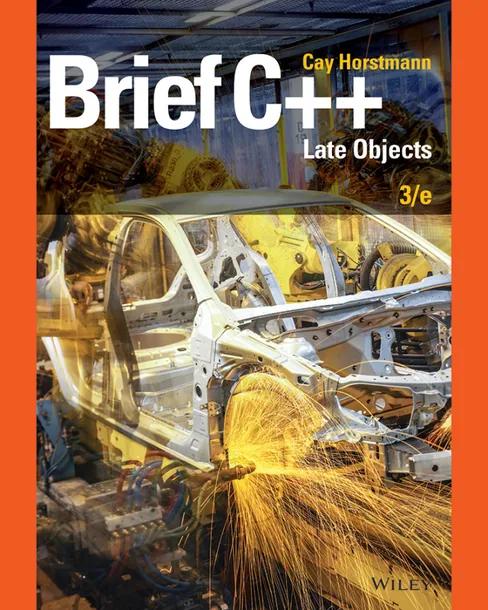
Brief C++: Late Objects, Enhanced eText
by Cay S. Horstmann
3rd Edition
Publisher: Wiley
Book Details
| Print ISBN | 9781118674260 |
| eText ISBN | 9781119400424 |
| Publisher | Wiley |
| Publishing Year | 2017 |
| Edition | 3rd Edition |
| Language | English |
| Pages | 560 |
Brief C++: Late Objects, Enhanced eText, 3rd Edition, is a textbook designed for a two-semester introduction to programming sequence. Written by Cay S. Horstmann, it introduces fundamental programming techniques and design skills while assuming no prior coding experience and only high school algebra.
The volume covers foundational concepts, data management, and object-oriented programming. Early sections use objects where appropriate, while custom class design begins in Section 9. The presentation also incorporates features from the C++ 2011 and C++ 2014 standards as recommended practices or special topics.
To support student practice, every section of the enhanced eText provides built-in activities, open-ended review exercises, programming exercises, and projects with immediate feedback.
Table of Contents
Chapter 1: Introduction
- • 1.1 What is Programming?
- • 1.2 The Anatomy of a Computer
- • 1.3 Machine Code and Programming Languages
- • 1.4 Becoming Familiar with Your Programming Environment
- • 1.5 Analyzing Your First Program
- • 1.6 Errors
- • 1.7 PROBLEM SOLVING Algorithm Design
Chapter 2: Fundamental Data Types
- • 2.1 Variables
- • 2.2 Arithmetic
- • 2.3 Input and Output
- • 2.4 PROBLEM SOLVING First Do It By Hand
- • 2.5 Strings
Chapter 3: Decisions
- • 3.1 The if Statement
- • 3.2 Comparing Numbers and Strings
- • 3.3 Multiple Alternatives
- • 3.4 Nested Branches
- • 3.5 PROBLEM SOLVING Flowcharts
- • 3.6 PROBLEM SOLVING Test Cases
- • 3.7 Boolean Variables and Operators
- • 3.8 APPLICATION Input Validation
Chapter 4: Loops
- • 4.1 The while Loop
- • 4.2 PROBLEM SOLVING Hand-Tracing
- • 4.3 The for Loop
- • 4.4 The do Loop
- • 4.5 Processing Input
- • 4.6 PROBLEM SOLVING Storyboards
- • 4.7 Common Loop Algorithms
- • 4.8 Nested Loops
- • 4.9 PROBLEM SOLVING Solve a Simpler Problem First
- • 4.10 Random Numbers and Simulations
Chapter 5: Functions
- • 5.1 Functions as Black Boxes
- • 5.2 Implementing Functions
- • 5.3 Parameter Passing
- • 5.4 Return Values
- • 5.5 Functions Without Return Values
- • 5.6 PROBLEM SOLVING Reusable Functions
- • 5.7 PROBLEM SOLVING Stepwise Refinement
- • 5.8 Variable Scope and Global Variables
- • 5.9 Reference Parameters
- • 5.10 Recursive Functions (Optional)
Chapter 6: Arrays and Vectors
- • 6.1 Arrays
- • 6.2 Common Array Algorithms
- • 6.3 Arrays and Functions
- • 6.4 PROBLEM SOLVING Adapting Algorithms
- • 6.5 PROBLEM SOLVING Discovering Algorithms by Manipulating Physical Objects
- • 6.6 Two-Dimensional Arrays
- • 6.7 Vectors
Chapter 7: Pointers and Structures
- • 7.1 Defining and Using Pointers
- • 7.2 Arrays and Pointers
- • 7.3 C and C++ Strings
- • 7.4 Dynamic Memory Allocation
- • 7.5 Arrays and Vectors of Pointers
- • 7.6 PROBLEM SOLVING Draw a Picture
- • 7.7 Structures
- • 7.8 Pointers and Structures
Chapter 8: Streams
- • 8.1 Reading and Writing Text Files
- • 8.2 Reading Text Input
- • 8.3 Writing Text Output
- • 8.4 Parsing and Formatting Strings
- • 8.5 Command Line Arguments
- • 8.6 Random Access and Binary Files
Chapter 9: Classes
- • 9.1 Object-Oriented Programming
- • 9.2 Implementing a Simple Class
- • 9.3 Specifying the Public Interface of a Class
- • 9.4 Designing the Data Representation
- • 9.5 Member Functions
- • 9.6 Constructors
- • 9.7 PROBLEM SOLVING Tracing Objects
- • 9.8 PROBLEM SOLVING Discovering Classes
- • 9.9 Separate Compilation
- • 9.10 Pointers to Objects
- • 9.11 PROBLEM SOLVING Patterns for Object Data
Chapter 10: Inheritance
- • 10.1 Inheritance Hierarchies
- • 10.2 Implementing Derived Classes
- • 10.3 Overriding Member Functions
- • 10.4 Virtual Functions and Polymorphism
Customer Reviews
0.0
0 reviews
No reviews yet. Be the first to review this book!
Write a Review
Reviewed by GradeFocus Editorial Team