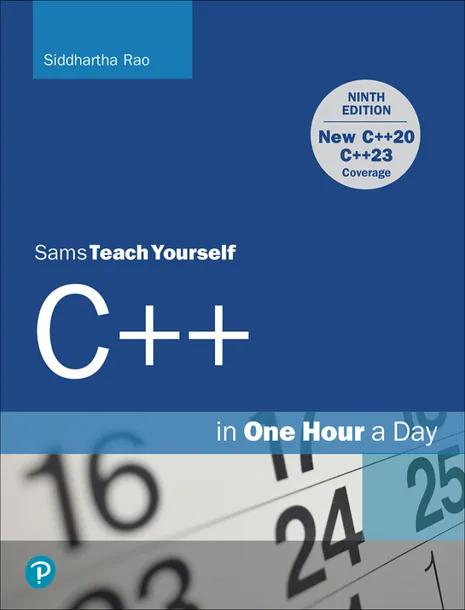
C++ in One Hour a Day, Sams Teach Yourself
by Siddhartha Rao
9th Edition
Publisher: Sams Publishing PTG
Book Details
| Print ISBN | 9780137334681 |
| eText ISBN | 9780137334582 |
| Publisher | Sams Publishing PTG |
| Publishing Year | 2022 |
| Edition | 9th Edition |
| Language | English |
| Pages | 848 |
C++ in One Hour a Day, Sams Teach Yourself, 9th Edition, written by Siddhartha Rao, is an introductory book designed to guide readers through C++ programming. The publication establishes a structured framework for systematically exploring basic language syntax and software organization.
The content addresses modern C++ development by updating material for the C++20 standard while providing an early preview of expected C++23 improvements. The text systematically covers variables, constants, expressions, statements, and array management alongside object-oriented programming concepts, including the construction of classes and objects, inheritance, polymorphism, and operator overloading.
A defining feature of the presentation is its inclusion of nearly 300 code samples accompanied by detailed explanations. These practical code examples demonstrate real execution behavior and clarify syntax rules for learners progressing through discrete daily study units.
Table of Contents
Chapter Lesson 1: Getting Started
- • A Brief History of C++
- • Connection to C
- • Advantages of C++
- • Evolution of the C++ Standard
- • Who Uses Programs Written in C++?
- • Programming a C++ Application
- • Steps in Building an Executable
- • Analyzing Errors and Debugging
- • Integrated Development Environments
- • Programming Your First C++ Application
- • Building and Executing Your First C++ Application
- • Understanding Compiler Errors
- • What’s New in C++20?
- • Summary
- • Q&A
- • Workshop
- • Quiz
- • Exercises
Chapter Lesson 2: The Anatomy of a C++ Program
- • Parts of the Hello World Program
- • Preprocessor Directive #include
- • The Body of Your Program: main()
- • Returning a Value
- • The Concept of Namespaces
- • Comments in C++ Code
- • Functions in C++
- • Basic Input Using std::cin and Output Using std::cout
- • Summary
- • Q&A
- • Workshop
- • Quiz
- • Exercises
Chapter Lesson 3: Using Variables, Declaring Constants
- • What Is a Variable?
- • Memory and Addressing in Brief
- • Declaring Variables to Access and Use Memory
- • Declaring and Initializing Multiple Variables of a Type
- • Understanding the Scope of a Variable
- • Global Variables
- • Naming Conventions
- • Common Compiler-Supported C++ Variable Types
- • Using Type bool to Store Boolean Values
- • Using Type char to Store Character Values
- • The Concept of Signed and Unsigned Integers
- • Signed Integer Types short, int, long, and long long
- • Unsigned Integer Types unsigned short, unsigned int, unsigned long, and unsigned long long
- • Avoiding Overflow Errors by Selecting Correct Data Types
- • Floating-Point Types float and double
- • Determining the Size of a Variable by Using sizeof()
- • Avoid Narrowing Conversion Errors by Using List Initialization
- • Automatic Type Inference Using auto
- • Using typedef to Substitute a Variable’s Type
- • What Is a Constant?
- • Literal Constants
- • Declaring Variables as Constants Using const
- • Constant Expressions Using constexpr
- • C++20 Immediate Functions Using consteval
- • Enumerations
- • Scoped Enumerations
- • Defining Constants by Using #define
- • Keywords You Cannot Use as Variable or Constant Names
- • Summary
- • Q&A
- • Workshop
- • Quiz
- • Exercises
Chapter Lesson 4: Managing Arrays and Strings
- • What Is an Array?
- • The Need for Arrays
- • Declaring and Initializing Static Arrays
- • How Data Is Stored in an Array
- • Accessing Data Stored in an Array
- • Modifying Data Stored in an Array
- • Multidimensional Arrays
- • Declaring and Initializing Multidimensional Arrays
- • Accessing Elements in a Multidimensional Array
- • Dynamic Arrays
- • C-Style Character Strings
- • C++ Strings: Using std::string
- • Summary
- • Q&A
- • Workshop
- • Quiz
- • Exercises
Chapter Lesson 5: Working with Expressions, Statements, and Operators
- • Statements
- • Compound Statements, or Blocks
- • Using Operators
- • The Assignment Operator (=)
- • Understanding l-Values and r-Values
- • Operators to Add (+), Subtract (-), Multiply (*), Divide (/), and Modulo Divide (%)
- • Operators to Increment (++) and Decrement (--)
- • To Postfix or to Prefix?
- • Equality Operators (== and !=)
- • Relational Operators
- • C++20 Three-Way Comparison Operator (<=>)
- • Logical Operations NOT, AND, OR, and XOR
- • Using C++ Logical Operators NOT (!), AND (&&), and OR (||)
- • Bitwise NOT (~), AND (&), OR (|), and XOR (^) Operators
- • Bitwise Right Shift (>>) and Left Shift (<<) Operators
- • Compound Assignment Operators
- • Using the sizeof() Operator to Determine the Memory Occupied by a Variable
- • Operator Precedence and Associativity
- • Summary
- • Q&A
- • Workshop
- • Quiz
- • Exercises
Chapter Lesson 6: Controlling Program Flow
- • Conditional Execution Using if.else
- • Conditional Programming Using if.else
- • Conditional Execution of Statements Within a Block
- • Nested if Statements
- • Conditional Processing Using switch-case
- • Conditional Execution Using the ?: Operator
- • Getting Code to Execute in Loops
- • A Rudimentary Loop Using goto
- • The while Loop
- • The do.while Loop
- • The for Loop
- • The Range-Based for Loop
- • Modifying Loop Behavior Using continue and break
- • Loops That Don’t End: Infinite Loops
- • Controlling Infinite Loops
- • Programming Nested Loops
- • Using Nested Loops to Walk a Multidimensional Array
- • Using Nested Loops to Calculate Fibonacci Numbers
- • Summary
- • Q&A
- • Workshop
- • Quiz
- • Exercises
Chapter Lesson 7: Organizing Code with Functions
- • The Need for Functions
- • What Is a Function Prototype?
- • What Is a Function Definition?
- • What Is a Function Call, and What Are Arguments?
- • Programming a Function with Multiple Parameters
- • Programming Functions with No Parameters or No Return Values
- • Function Parameters with Default Values
- • Recursion: Functions That Invoke Themselves
- • Functions with Multiple Return Statements
- • Using Functions to Work with Different Forms of Data
- • Overloading Functions
- • Passing an Array of Values to a Function
- • Passing Arguments by Reference
- • How Function Calls Are Handled by the Microprocessor
- • Inline Functions
- • Automatic Return Type Deduction
- • Lambda Functions
- • Summary
- • Q&A
- • Workshop
- • Quiz
- • Exercises
Chapter Lesson 8: Pointers and References Explained
- • What Is a Pointer?
- • Declaring a Pointer
- • Determining the Address of a Variable by Using the Reference Operator (&)
- • Using Pointers to Store Addresses
- • Accessing Pointed Data Using the Dereference Operator (*)
- • What Is the Size of a Pointer?
- • Dynamic Memory Allocation
- • Using the Operators new and delete to Allocate and Release
- • Memory Dynamically
- • Effects of the Increment (++) and Decrement (--) Operators on Pointers
- • Using the const Keyword on Pointers
- • Passing Pointers to Functions
- • Similarities Between Arrays and Pointers
- • Common Programming Mistakes When Using Pointers
- • Memory Leaks
- • Pointers Pointing to Invalid Memory Locations
- • Dangling Pointers (Also Called Stray or Wild Pointers)
- • Checking Whether an Allocation Request Using new Succeeded
- • Pointer Programming Best Practices
- • What Is a Reference?
- • What Makes References Useful?
- • Using the Keyword const on References
- • Passing Arguments by Reference to Functions
- • Summary
- • Q&A
- • Workshop
- • Quiz
- • Exercises
Chapter Lesson 9: Classes and Objects
- • The Concept of Classes and Objects
- • Declaring a Class
- • An Object as an Instance of a Class
- • Accessing Members by Using the Dot Operator (.)
- • Accessing Members by Using the Pointer Operator (->)
- • The Keywords public and private
- • Abstraction of Data via the Keyword private
- • Constructors
- • Declaring and Implementing a Constructor
- • When and How to Use Constructors
- • Overloading Constructors
- • A Class Without a Default Constructor
- • Constructor Parameters with Default Values
- • Constructors with Initialization Lists
- • Destructor
- • Declaring and Implementing a Destructor
- • When and How to Use a Destructor
- • The Copy Constructor
- • Shallow Copying and Associated Problems
- • Ensuring a Deep Copy Using a Copy Constructor
- • Using Move Constructors to Improve Performance
- • Different Uses of Constructors and the Destructor
- • A Class That Does Not Permit Copying
- • A Singleton Class That Permits a Single Instance
- • A Class That Prohibits Instantiation on the Stack
- • Using Constructors to Convert Types
- • The this Pointer
- • Using sizeof() with a Class
- • The Keyword struct and Its Differences from class
- • Declaring a friend of a class
- • Union: A Special Data Storage Mechanism
- • Declaring a Union
- • Where Would You Use a Union?
- • Using Aggregate Initialization on Classes and structs
- • constexpr with Classes and Objects
- • Summary
- • Q&A
- • Workshop
- • Quiz
- • Exercises
Chapter Lesson 10: Implementing Inheritance
- • Basics of Inheritance
- • Inheritance and Derivation
- • C++ Syntax of Derivation
- • The Access Specifier Keyword protected
- • Base Class Initialization: Passing Parameters to the Base Class
- • A Derived Class Overriding the Base Class’s Methods
- • Invoking Overridden Methods of a Base Class
- • Invoking Methods of a Base Class in a Derived Class
- • A Derived Class Hiding the Base Class’s Methods
- • Order of Construction
- • Order of Destruction
- • Private Inheritance
- • Protected Inheritance
- • The Problem of Slicing
- • Multiple Inheritance
- • Avoiding Inheritance Using final
- • Summary
- • Q&A
- • Workshop
- • Quiz
- • Exercises
Chapter Lesson 11: Polymorphism
- • Basics of Polymorphism
- • Need for Polymorphic Behavior
- • Polymorphic Behavior Implemented Using Virtual Functions
- • Need for Virtual Destructors
- • How Do Virtual Functions Work? Understanding the Virtual Function Table
- • Abstract Base Classes and Pure Virtual Functions
- • Using Virtual Inheritance to Solve the Diamond Problem
- • Using the Specifier override to Indicate the Intention to Override
- • Using final to Prevent Function Overriding
- • Virtual Copy Constructors?
- • Summary
- • Q&A
- • Workshop
- • Quiz
- • Exercises
Chapter Lesson 12: Operator Types and Operator Overloading
- • What Are Operators in C++?
- • Unary Operators
- • Unary Increment (++) and Decrement (--) Operators
- • Conversion Operators
- • The Dereference Operator (*) and Member Selection Operator (->)
- • Binary Operators
- • The Binary Addition (a+b) and Subtraction (a-b) Operators
- • The Addition Assignment (+=) and Subtraction Assignment (-=) Operators
- • The Equality (==) and Inequality (!=) Operators
- • The <, >, <=, and >= Operators
- • The C++20 Three-Way Comparison Operator (<=>)
- • The Copy Assignment Operator (=)
- • The Subscript Operator ([])
- • The Function Operator (())
- • The Move Constructor and Move Assignment Operator for High-Performance Programming
- • The Problem of Unwanted Copy Steps
- • Declaring a Move Constructor and Move Assignment Operator
- • User-Defined Literals
- • Operators That Cannot Be Overloaded
- • Summary
- • Q&A
- • Workshop
- • Quiz
- • Exercises
Chapter Lesson 13: Casting Operators
- • The Need for Casting
- • Why C-Style Casts Are Not Popular with Some C++ Programmers
- • The C++ Casting Operators
- • Using static_cast
- • Using dynamic_cast and Runtime Type Identification
- • Using reinterpret_cast
- • Using const_cast
- • Problems with the C++ Casting Operators
- • Summary
- • Q&A
- • Workshop
- • Quiz
- • Exercises
Chapter Lesson 14: An Introduction to Macros and Templates
- • The Preprocessor and the Compiler
- • Using the Macro #define to Define Constants
- • Using Macros for Protection Against Multiple Inclusion
- • Using #define to Write Macro Functions
- • Why All the Parentheses?
- • Using the assert Macro to Validate Expressions
- • Advantages and Disadvantages of Using Macro Functions
- • An Introduction to Templates
- • Template Declaration Syntax
- • The Different Types of Template Declarations
- • Template Functions
- • Templates and Type Safety
- • Template Classes
- • Declaring Templates with Multiple Parameters
- • Declaring Templates with Default Parameters
- • Sample Template Class: HoldsPair
- • Template Instantiation and Specialization
- • Template Classes and static Members
- • Variable Templates
- • Using static_assert to Perform Compile-Time Checks
- • Using Templates in Practical C++ Programming
- • Summary
- • Q&A
- • Workshop
- • Quiz
- • Exercises
Chapter Lesson 15: An Introduction to the Standard Template Library
- • STL Containers
- • Sequential Containers
- • Associative Containers
- • Container Adapters
- • STL Iterators
- • STL Algorithms
- • Interaction Between Containers and Algorithms Using Iterators
- • Using the Keyword auto to Let a Compiler Define Type
- • Choosing the Right Container
- • STL String Classes
- • Summary
- • Q&A
- • Workshop
- • Quiz
Chapter Lesson 16: The STL String Class
- • The Need for String Manipulation Classes
- • Working with the STL string Class
- • Instantiating the STL string Class and Making Copies
- • Accessing Character Contents of std::string
- • Concatenating One String to Another
- • Finding a Character or Substring in a String
- • Truncating an STL String
- • String Reversal
- • String Case Conversion
- • Template-Based Implementation of an STL String
- • operator ""s in std::string
- • Using std::string_view (Amended in C++20)
- • Summary
- • Q&A
- • Workshop
- • Quiz
- • Exercises
Chapter Lesson 17: STL Dynamic Array Classes
- • The Characteristics of std::vector
- • Typical Vector Operations
Customer Reviews
0.0
0 reviews
No reviews yet. Be the first to review this book!
Write a Review
Reviewed by GradeFocus Editorial Team
▶Research Sources (14)
- eBook Details
- C++ in One Hour a Day, Sams Teach Yourself
- E-raamat: Sams Teach Yourself C++ in One Hour a Day
- https://lernerbooks.com/products/search_results?se...
- Untitled
- eBook Details | BCTC Campus Store | BibliU
- Sams Teach Yourself - Siddhartha Rao - E-bok (9780137334582)
- Sams Teach Yourself C++ in One Hour a Day
- Sams Teach Yourself C++ in One Hour a Day, 9th Edition
- C++ in One Hour a Day, Sams Teach Yourself
- C++ in One Hour a Day, Sams Teach Yourself
- [C++] Sams Teach Yourself C++ in One Hour a Day
- learncppnow/9E
- Sams teach yourself C++ in one hour a day. 9th ed