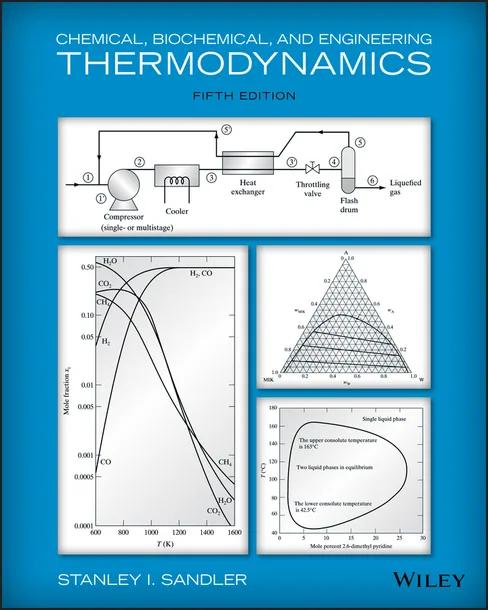
Chemical and Engineering Thermodynamics
by Stanley I. Sandler
5th Edition
Publisher: Wiley
Book Details
| Print ISBN | 9780470504796 |
| eText ISBN | 9781119321286 |
| Publisher | Wiley |
| Publishing Year | 2017 |
| Edition | 5th Edition |
| Language | English |
| Pages | 1040 |
Chemical and Engineering Thermodynamics, 5th Edition, provides comprehensive instruction in fundamental thermodynamic principles for undergraduate and graduate courses. Authored by Stanley I. Sandler, the textbook balances foundational theory with practical chemical engineering applications.
The text examines conservation balances for mass, energy, and entropy, the thermodynamic properties of real substances, and chemical and phase equilibria. Coverage explores environmental and safety topics alongside applications in biotechnology, biochemical engineering, polymers, and solid-state processing.
Utilizing SI units throughout, this edition incorporates thermodynamic illustrations and homework problems that apply ASPEN simulation software to assist students in completing practical engineering calculations.
Table of Contents
Chapter 1: Introduction
- • Instructional Objectives for Chapter 1
- • Important Notation Introduced in This Chapter
- • 1.1 The Central Problems of Thermodynamics
- • 1.2 A System of Units
- • 1.3 The Equilibrium State
- • 1.4 Pressure, Temperature, and Equilibrium
- • 1.5 Heat, Work, and the Conservation of Energy
- • 1.6 Specification of the Equilibrium State; Intensive and Extensive Variables; Equations of State
- • 1.7 A Summary of Important Experimental Observations
- • 1.8 A Comment on the Development of Thermodynamics
- • Problems
Chapter 2: Conservation of Mass
- • Instructional Objectives for Chapter 2
- • Important Notation Introduced in This Chapter
- • 2.1 A General Balance Equation and Conserved Quantities
- • 2.2 Conservation of Mass for a Pure Fluid
- • 2.3 The Mass Balance Equations for a Multicomponent System with a Chemical Reaction
- • 2.4 The Microscopic Mass Balance Equations in Thermodynamics and Fluid Mechanics (Optional - only on the website for this book)
- • Problems
Chapter 3: Conservation of Energy
- • Instructional Objectives for Chapter 3
- • Notation Introduced in This Chapter
- • 3.1 Conservation of Energy
- • 3.2 Several Examples of Using the Energy Balance
- • 3.3 The Thermodynamic Properties of Matter
- • 3.4 Applications of the Mass and Energy Balances
- • 3.5 Conservation of Momentum
- • 3.6 The Microscopic Energy Balance (Optional - only on website for this book)
- • Problems
Chapter 4: Entropy: An Additional Balance Equation
- • Instructional Objectives for Chapter 4
- • Notation Introduced in This Chapter
- • 4.1 Entropy: A New Concept
- • 4.2 The Entropy Balance and Reversibility
- • 4.3 Heat, Work, Engines, and Entropy
- • 4.4 Entropy Changes of Matter
- • 4.5 Applications of the Entropy Balance
- • 4.6 Availability and the Maximum Useful Shaft Work that can be obtained In a Change of State
- • 4.7 The Microscopic Entropy Balance (Optional - only on website for this book)
- • Problems
Chapter 5: Liquefaction, Power Cycles, and Explosions
- • Instructional Objectives for Chapter 5
- • Notation Introduced in this Chapter
- • 5.1 Liquefaction
- • 5.2 Power Generation and Refrigeration Cycles
- • 5.3 Thermodynamic Efficiencies
- • 5.4 The Thermodynamics of Mechanical Explosions
- • Problems
Chapter 6: The Thermodynamic Properties of Real Substances
- • Instructional Objectives for Chapter 6
- • Notation Introduced in this Chapter
- • 6.1 Some Mathematical Preliminaries
- • 6.2 The Evaluation of Thermodynamic Partial Derivatives
- • 6.3 The Ideal Gas and Absolute Temperature Scales
- • 6.4 The Evaluation of Changes in the Thermodynamic Properties of Real Substances Accompanying a Change of State
- • 6.5 An Example Involving the Change of State of a Real Gas
- • 6.6 The Principle of Corresponding States
- • 6.7 Generalized Equations of State
- • 6.8 The Third Law of Thermodynamics
- • 6.9 Estimation Methods for Critical and Other Properties
- • 6.10 Sonic Velocity
- • 6.11 More About Thermodynamic Partial Derivatives (Optional - only on website for this book)
- • Problems
Chapter 7: Equilibrium and Stability in One-Component Systems
- • Instructional Objectives for Chapter 7
- • Notation Introduced in This Chapter
- • 7.1 The Criteria for Equilibrium
- • 7.2 Stability of Thermodynamic Systems
- • 7.3 Phase Equilibria: Application of the Equilibrium and Stability Criteria to the Equation of State
- • 7.4 The Molar Gibbs Energy and Fugacity of a Pure Component
- • 7.5 The Calculation of Pure Fluid-Phase Equilibrium: The Computation of Vapor Pressure from an Equation of State
- • 7.6 Specification of the Equilibrium Thermodynamic State of a System of Several Phases: The Gibbs Phase Rule for a One-Component System
- • 7.7 Thermodynamic Properties of Phase Transitions
- • 7.8 Thermodynamic Properties of Small Systems, or Why Subcooling and Superheating Occur
- • Problems
Chapter 8: The Thermodynamics of Multicomponent Mixtures
- • Instructional Objectives for Chapter 8
- • Notation Introduced in this chapter
- • 8.1 The Thermodynamic Description of Mixtures
- • 8.2 The Partial Molar Gibbs Energy and the Generalized Gibbs-Duhem Equation
- • 8.3 A Notation for Chemical Reactions
- • 8.4 The Equations of Change for a Multicomponent System
- • 8.5 The Heat of Reaction and a Convention for the Thermodynamic Properties of Reacting Mixtures
- • 8.6 The Experimental Determination of the Partial Molar Volume and Enthalpy
- • 8.7 Criteria for Phase Equilibrium in Multicomponent Systems
- • 8.8 Criteria for Chemical Equilibrium, and Combined Chemical and Phase Equilibrium
- • 8.9 Specification of the Equilibrium Thermodynamic State of a Multicomponent, Multiphase System; the Gibbs Phase Rule
- • 8.10 A Concluding Remark
- • Problems
Chapter 9: Estimation of The Gibbs Energy and Fugacity of A Component in a Mixture
- • Instructional Objectives for Chapter 9
- • Notation Introduced in this Chapter
- • 9.1 The Ideal Gas Mixture
- • 9.2 The Partial Molar Gibbs Energy and Fugacity
- • 9.3 Ideal Mixture and Excess Mixture Properties
- • 9.4 Fugacity of Species in Gaseous, Liquid, and Solid Mixtures
- • 9.5 Several Correlative Liquid Mixture Activity Coefficient Models
- • 9.6 Two Predictive Activity Coefficient Models
- • 9.7 Fugacity of Species in Nonsimple Mixtures
- • 9.8 Some Comments on Reference and Standard States
- • 9.9 Combined Equation-of-State and Excess Gibbs Energy Model
- • 9.10 Electrolyte Solutions
- • 9.11 Choosing the Appropriate Thermodynamic Model
- • Appendix A9.1 A Statistical Mechanical Interpretation of the Entropy of Mixing in an Ideal Mixture (Optional – only on the website for this book)
- • Appendix A9.2 Multicomponent Excess Gibbs Energy (Activity Coefficient) Models
- • Appendix A9.3 The Activity Coefficient of a Solvent in an Electrolyte Solution
- • Problems
Chapter 10: Vapor-Liquid Equilibrium in Mixtures
- • Instructional Objectives for Chapter 10
- • Notation Introduced in this Chapter
- • 10.0 Introduction to Vapor-Liquid Equilibrium
- • 10.1 Vapor-Liquid Equilibrium in Ideal Mixtures
- • Problems for Section 10.1
- • 10.2 Low-Pressure Vapor-Liquid Equilibrium in Nonideal Mixtures
- • Problems for Section 10.2
- • 10.3 High-Pressure Vapor-Liquid Equilibria Using Equations of State (_φ_-_φ_ Method)
- • Problems for Section 10.3
Chapter 11: Other Types of Phase Equilibria in Fluid Mixtures
- • Instructional Objectives for Chapter 11
- • Notation Introduced in this Chapter
- • 11.1 The Solubility of a Gas in a Liquid
- • Problems for Section 11.1
- • 11.2 Liquid-Liquid Equilibrium
- • Problems for Section 11.2
- • 11.3 Vapor-Liquid-Liquid Equilibrium
- • Problems for Section 11.3
- • 11.4 The Partitioning of a Solute Among Two Coexisting Liquid Phases; The Distribution Coefficient
- • Problems for Section 11.4
- • 11.5 Osmotic Equilibrium and Osmotic Pressure
- • Problems for Section 11.5
Chapter 12: Mixture Phase Equilibria Involving Solids
- • Instructional Objectives for Chapter 12
- • Notation Introduced in this Chapter
- • 12.1 The Solubility of a Solid in a Liquid, Gas, or Supercritical Fluid
- • Problems for Section 12.1
- • 12.2 Partitioning of a Solid Solute Between Two Liquid Phases
- • Problems for Section 12.2
- • 12.3 Freezing-Point Depression of a Solvent Due to the Presence of a Solute; the Freezing Point of Liquid Mixtures
- • Problems for Section 12.3
- • 12.4 Phase Behavior of Solid Mixtures
- • Problems for Section 12.4
- • 12.5 The Phase Behavior Modeling of Chemicals in the Environment
- • Problems for Section 12.5
- • 12.6 Process Design and Product Design
- • Problems for Section 12.6
- • 12.7 Concluding Remarks on Phase Equilibria
Chapter 13: Chemical Equilibrium
- • Instructional Objectives for Chapter 13
- • Important Notation Introduced in This Chapter
- • 13.1 Chemical Equilibrium in a Single-Phase System
- • 13.2 Heterogeneous Chemical Reactions
- • 13.3 Chemical Equilibrium When Several Reactions Occur in a Single Phase
- • 13.4 Combined Chemical and Phase Equilibrium
- • 13.5 Ionization and the Acidity of Solutions
- • 13.6 Ionization of Biochemicals
- • 13.7 Partitioning of Amino Acids and Proteins Between Two Liquids
- • Problems
Chapter 14: The Balance Equations For Chemical Reactors, Availability, and Electrochemistry
- • Instructional Objectives for Chapter 14
- • Notation Introduced in this Chapter
- • 14.1 The Balance Equations for a Tank-Type Chemical Reactor
- • 14.2 The Balance Equations for a Tubular Reactor
- • 14.3 Overall Reactor Balance Equations and the Adiabatic Reaction Temperature
- • 14.4 Thermodynamics of Chemical Explosions
- • 14.5 Maximum Useful Work and Availability in Chemically Reacting Systems
- • 14.6 Introduction to Electrochemical Processes
- • 14.7 Fuel Cells and Batteries
- • Problems
Chapter 15: Some Additional Biochemical Applications of Thermodynamics
- • Instructional Objectives for Chapter 15
- • Notation Introduced in this Chapter
- • 15.1 Solubilities of Weak Acids, Weak Bases, and Amino Acids as a Function of pH
- • 15.2 The Solubility of Amino Acids and Proteins as a function of Ionic Strength and Temperature
- • 15.3 Binding of a Ligand to a Substrate
- • 15.4 Some Other Examples of Biochemical Reactions
- • 15.5 The Denaturation of Proteins
- • 15.6 Coupled Biochemical Reactions: The ATP-ADP Energy Storage and Delivery Mechanism
- • 15.7 Thermodynamic Analysis of Fermenters and Other Bioreactors
- • 15.8 Gibbs-Donnan Equilibrium and Membrane Potentials
- • 15.9 Protein Concentration in an Ultracentrifuge
- • Problems
Chapter Appendix A: Thermodynamic Data
- • Appendix A.I Conversion Factors for SI Units
- • Appendix A.II The Molar Heat Capacities of Gases in the Ideal Gas (Zero Pressure) State
- • Appendix A.III The Thermodynamic Properties of Water and Steam
- • Appendix A.IV Enthalpies and Free Energies of Formation
- • Appendix A.V Heats of Combustion
Chapter Appendix B: Brief Descriptions of Computer Aids for Use with This Book
Chapter Appendix B (On Website Only): Descriptions of Computer Programs and Computer Aids for Use with This Book
- • Appendix B.I Windows-based Visual Basic Programs
- • Appendix B.II DOS-based Basic Programs
- • Appendix B.III MATHCAD Worksheets
- • Appendix B.IV MATLAB Programs
Chapter Appendix C: Aspen Illustration Input Files. These are on The Website for This Book
Chapter Appendix D: Answers To Selected Problems
Customer Reviews
0.0
0 reviews
No reviews yet. Be the first to review this book!
Write a Review
Reviewed by GradeFocus Editorial Team
Related Books
Industrial Chemical Process Analysis and Design
Mariano Martín Martín

Industrial Water Conservation
Dominic Foo
Ionic Liquids in Biomass Processing
Harish K. Chopra

Artificial Intelligence in Chemical Engineering
Farooq Sher

Ozone Gas Sensing Technologies
Niravkumar J. Joshi

Machine Learning for Membrane Separation Applications
Mashallah Rezakazemi