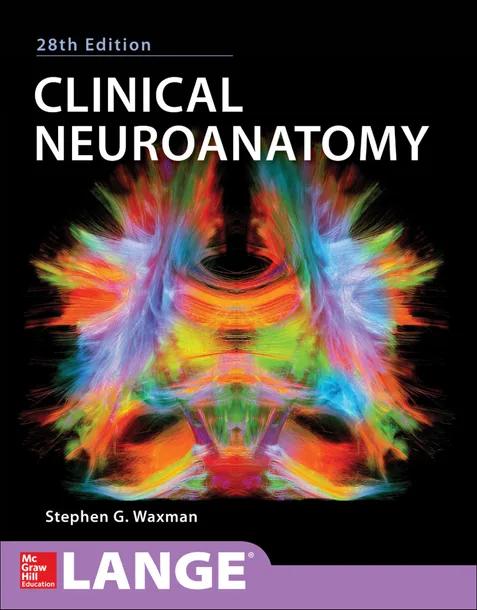
Clinical Neuroanatomy
by Stephen G. Waxman
28th Edition
Publisher: McGraw-Hill Education / Medical
Book Details
| Print ISBN | 9780071847704 |
| eText ISBN | 9780071847711 |
| Publisher | McGraw-Hill Education / Medical |
| Publishing Year | 2017 |
| Edition | 28th Edition |
| Language | English |
| Pages | 384 |
Clinical Neuroanatomy, 28th Edition, by Stephen G. Waxman, is an illustrated textbook from McGraw-Hill Education / Medical that connects nervous system structure to clinical neurology.
The volume details the organization and function of the brain, spinal cord, and peripheral nerves alongside presentations of disease processes involving specific structures. The text covers topics such as cellular development, signaling, sensory systems, and motor control.
Case studies demonstrate how anatomical principles apply to patient care, supporting board review and clinical practice.
Table of Contents
Chapter 1: Fundamentals of the Nervous System
- • General Plan of the Nervous System
- • Peripheral Nervous System
- • Planes and Terms
Chapter 2: Development and Cellular Constituents of the Nervous System
- • Cellular Aspects of Neural Development
- • Neurons
- • Neuronal Groupings and Connections
- • Neuroglia
- • Degeneration and Regeneration
- • Neurogenesis
Chapter 3: Signaling in the Nervous System
- • Membrane Potential
- • Generator Potentials
- • Action Potentials
- • The Nerve Cell Membrane Contains Ion Channels
- • The Effects of Myelination
- • Conduction of Action Potentials
- • Synapses
- • Synaptic Transmission
- • Excitatory and Inhibitory Synaptic Actions
- • Synaptic Plasticity and Long-Term Potentiation
- • Presynaptic Inhibition
- • The Neuromuscular Junction and the End-Plate Potential
- • Neurotransmitters
Chapter 4: The Relationship Between Neuroanatomy and Neurology
- • Symptoms and Signs of Neurologic Diseases
- • Where Is the Lesion?
- • What Is the Lesion?
- • The Role of Neuroimaging and Laboratory Investigations
- • The Treatment of Patients with Neurologic Disease
Chapter 5: The Spinal Cord
- • Development
- • External Anatomy of the Spinal Cord
- • Spinal Roots and Nerves
- • Internal Divisions of the Spinal Cord
- • Pathways in White Matter
- • Reflexes
- • Lesions in the Motor Pathways
- • Examples of Specific Spinal Cord Disorders
Chapter 6: The Vertebral Column and Other Structures Surrounding the Spinal Cord
- • Investing Membranes
- • Spinal Cord Circulation
- • The Vertebral Column
- • Lumbar Puncture
- • Imaging of the Spine and Spinal Cord
Chapter 7: The Brain Stem and Cerebellum
- • Development of the Brain Stem and Cranial Nerves
- • Brain Stem Organization
- • Cranial Nerve Nuclei in the Brain Stem
- • Medulla
- • Pons
- • Midbrain
- • Vascularization
- • Cerebellum
Chapter 8: Cranial Nerves and Pathways
- • Origin of Cranial Nerve Fibers
- • Functional Components of the Cranial Nerves
- • Anatomic Relationships of the Cranial Nerves
Chapter 9: Diencephalon
- • Thalamus
- • Hypothalamus
- • Subthalamus
- • Epithalamus
- • Circumventricular Organs
Chapter 10: Cerebral Hemispheres/Telencephalon
- • Development
- • Anatomy of the Cerebral Hemispheres
- • Microscopic Structure of the Cortex
- • Physiology of Specialized Cortical Regions
- • Basal Ganglia
- • Internal Capsule
Chapter 11: Ventricles and Coverings of the Brain
- • Ventricular System
- • Meninges and Submeningeal Spaces
- • CSF
- • Barriers in the Nervous System
- • Skull
Chapter 12: Vascular Supply of the Brain
- • Arterial Supply of the Brain
- • Venous Drainage
- • Cerebrovascular Disorders
Chapter 13: Control of Movement
- • Control of Movement
- • Major Motor Systems
- • Motor Disturbances
Chapter 14: Somatosensory Systems
- • Receptors
- • Connections
- • Sensory Pathways
- • Cortical Areas
- • Pain
Chapter 15: The Visual System
- • The Eye
- • Visual Pathways
- • The Visual Cortex
Chapter 16: The Auditory System
- • Anatomy and Function
- • Auditory Pathways
Chapter 17: The Vestibular System
- • Anatomy
- • Vestibular Pathways
- • Functions
Chapter 18: The Reticular Formation
- • Anatomy
- • Functions
Chapter 19: The Limbic System
- • The Limbic Lobe and Limbic System
- • Olfactory System
- • Hippocampal Formation
- • Functions and Disorders
- • Septal Area
Chapter 20: The Autonomic Nervous System
- • Autonomic Outflow
- • Autonomic Innervation of the Head
- • Visceral Afferent Pathways
- • Hierarchical Organization of the Autonomic Nervous System
- • Transmitter Substances
Chapter 21: Higher Cortical Functions
- • Frontal Lobe Functions
- • Language and Speech
Customer Reviews
0.0
0 reviews
No reviews yet. Be the first to review this book!
Write a Review
Reviewed by GradeFocus Editorial Team