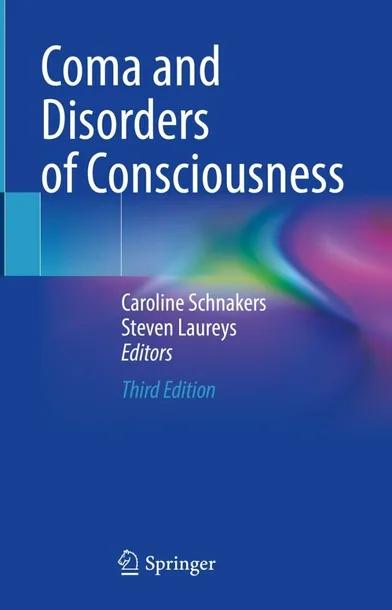
Coma and Disorders of Consciousness
by Caroline Schnakers, Steven Laureys
3rd Edition
Publisher: Springer
Book Details
| Print ISBN | 9783031505621 |
| eText ISBN | 9783031505638 |
| Publisher | Springer |
| Publishing Year | 2024 |
| Edition | 3rd Edition |
| Language | English |
| Pages | 335 |
Coma and Disorders of Consciousness, 3rd Edition, edited by Caroline Schnakers and Steven Laureys, delivers a comprehensive review of clinical coma science for clinicians and researchers. The opening material outlines fundamental neurological concepts, focusing on neural correlates of consciousness across sleep, anesthesia, and pathological states.
The volume shifts from theoretical foundations to patient assessment by detailing validated behavioral evaluation methods. It discusses tools such as the Coma Recovery Scale-Revised and Individualized Quantitative Behavioral Assessment, alongside applications of brain-computer interfaces and body-computer interfaces for patients with disorders of consciousness.
Treatment strategies focus on targeted pharmacological interventions. The text evaluates specific medications, including amantadine, apomorphine, levodopa, methylphenidate, bromocriptine, modafinil, selegiline, zolpidem, and baclofen. This progression provides clinicians and researchers with clear context for diagnostic and therapeutic decision-making.
Table of Contents
Chapter 1: Neural Correlates of Consciousness
- • Introduction
- • The Neural Correlates of Consciousness
- • Neurophysiological Techniques Used in the Study of the NCC
- • Physiological States of Consciousness: NCC in Sleep
- • Pharmacological States of Consciousness: NCC in Anesthesia
- • Pathological States of Consciousness: NCC in Disorders of Consciousness
- • Conclusions
- • References
Chapter 2: Behavioral Assessment and Diagnosis of Disorders of Consciousness
- • Introduction
- • Disorders of Consciousness
- • Coma
- • Vegetative State/Unresponsive Wakefulness Syndrome
- • Minimally Conscious State
- • Covert Awareness
- • Bedside Assessment
- • The Coma Recovery Scale-Revised
- • Individualized Quantitative Behavioral Assessment (IQBA)
- • Pain Assessment
- • Language Assessment
- • Diagnostic Accuracy
- • Conclusion
- • References
Chapter 3: Brain–Computer Interfaces and Their Place in the Management of Disorders of Consciousness
- • What Are BCIs and How Can Patients with a Disorder of Consciousness Benefit From Them?
- • BCIs Help to Refine the Taxonomy of Disorders of Consciousness
- • The Applications of BCIs in Research for Patients with a Disorder of Consciousness
- • P3
- • Motor Imagery
- • SSVEP
- • Hybrid BCIs
- • Body–Computer Interfaces (Biofeedback Machines)
- • Recommendations for BCI Use According to Current Guidelines for Clinical Management of Patients with a Disorder of Consciousness
- • Future Research and Clinical Directions to Encourage Development and Implementation of BCIs for Patients with a Disorder of Consciousness
- • Conclusion
- • References
Chapter 4: Prognosis in Disorders of Consciousness
- • Introduction
- • Evolution
- • Prognostic Issues
- • Conclusion
- • References
Chapter 5: Neuromedical Comorbidities and Their Management in Patients with DoC
- • Introduction
- • Comorbidities Assessment
- • Respiratory Complications and Dysphagia
- • Neurosurgical Complications
- • Spasticity and Other Motor Disorders
- • Heterotopic Ossification and Bed Best Syndrome
- • ICU-Acquired Weakness (ICU-AW)/Critical Illness Polyneuropathy (CIP)
- • Pain Assessment and Treatment
- • Language Disorders
- • Epilepsy
- • Hypopituitarism
- • Paroxysmal Sympathetic Hyperactivity (PSH)
- • Metabolic and Gastrointestinal Complications
- • Discussion and Conclusions
- • Appendix
- • References
Chapter 6: Music as Sensory Stimulation and Therapeutic Intervention
- • Introduction: Sensory Stimulation in Comatose and DoC Patients
- • The Beneficial Effects of Music
- • Music in DoC Patients
- • Behavioral and Physiological Modulations
- • Brain Modulations
- • Music Therapy/Intervention
- • Music Interventions Using Patient-Preferred Music
- • Music Interventions Using Improvised Music
- • Combined Approaches
- • Music Therapy Within Interdisciplinary Rehabilitation
- • Protocols for Music Interventions
- • Working with Families
- • New Perspectives for Music and Coma
- • References
Chapter 7: Pharmacological Treatments
- • Introduction
- • Potential Pharmacological Agents
- • Amantadine
- • Apomorphine
- • Levodopa
- • Methylphenidate
- • Bromocriptine
- • Modafinil
- • Selegiline
- • Zolpidem
- • Baclofen
- • Underlying Pharmacological Mechanisms
- • Clinical Considerations
- • Off-Label Use of Specific Medication
- • Limitations of Current Research
- • Future Directions
- • Psychedelics
- • The Potential of Whole-Brain Computational Modeling
- • Conclusion
- • References
Chapter 8: Emerging Treatment for Patients with Disorders of Consciousness: The Field of Neuromodulation
- • Introduction
- • Defining the Neurostimulation Target
- • Major Neurostimulatory Techniques Being Tested for DOC Treatment
- • Central Techniques
- • Deep Brain Stimulation (DBS)
- • Transcranial Focused Ultrasound Stimulation (tFUS)
- • Bottom-Up Techniques
- • Spinal Cord Stimulation (SCS)
- • Median Nerve Stimulation (MNS)
- • Vagus Nerve Stimulation (VNS)
- • Top-Down Techniques
- • Transcranial Magnetic Stimulation (TMS)
- • Transcranial Electrical Stimulation (tES)
- • Conclusion
- • Limitations, Future Directions, and Opportunities
- • References
Chapter 9: The Ethics in the Management of Patients with Disorders of Consciousness
- • Introduction
- • A Heuristic Approach for Identifying Emerging Ethical Issues: Fundamental vs. Practical
- • Fundamental Ethical Issues Arising from DOCs
- • The Inferential Diagnosis of DOCs
- • The Ethical Relevance of the Unconscious
- • Practical Ethical Issues
- • Misdiagnosis
- • Nosology
- • The Distributed Responsibility Model
- • Institutional Issues
- • Clinical Issues
- • Interpersonal Issues
- • Conclusion
- • References
Chapter 10: Taking Care of Patients with Disorders of Consciousness: Caregivers’ Burden and Quality of Life
- • Introduction
- • Who Is the Informal Caregiver of a Patient with DOC?
- • Sociodemographic Characteristics of DOC Patients’ Caregivers
- • Hours of Care and Support for Caring
- • Motivations for Caregiving
- • Burden: Definition and Concepts
- • Burden and Emotional Distress: The Impact on the Emotional Domain
- • Burden as the Impact on Employment, Economic Status, and Leisure Activities of Caregivers
- • Burden and Coping Strategies
- • Burden as the Impact on Caregivers’ Quality of Life
- • Caregivers’ Involvement During Patients’ Assessments
- • Caregivers Within the International Guidelines
- • Concluding Remarks
- • References
Chapter 11: Models and Systems of Care for Patients with Disorders of Consciousness
- • Introduction
- • Characteristics of Successful Care Systems in Non-neurological Diseases
- • Health Service Delivery Gaps and Opportunities
- • Existing Models of Systems-Level DoC Care and Research
- • The Dutch Model
- • History
- • Chain of Care Model
- • Research Activities Associated with the Chain of Care Model
- • Traumatic Brain Injury Model Systems
- • TBIMS Infrastructure and Mission
- • TBIMS DoC Special Interest Group
- • TBIMS DoC-Related Accomplishments
- • The Curing Coma Campaign
- • Gaps in the Understanding of the Natural History of Coma Recovery
- • Impact of the Lack of Data in Hyperacute Management
- • COMPOSE Study Addresses the Gap in the Natural History of Coma Recovery
- • Moving Toward an Integrated DoC Model System for Clinical Care and Research
- • Barrier 1: No Systematic Surveillance Systems to Track and Characterize DoC Admissions
- • Barrier 2: Variability in Approaches to Diagnosis, Intervention, and Outcome Assessment in Acute and Chronic Care
- • Barrier 3: Limited and Non-Standardized Assessment of Long-Term Recovery
- • Barrier 4: Lack of an Infrastructure to Integrate Clinical Data into a Research Database
- • A Lesson from the TBI Model Systems
- • Conclusion
- • References
Chapter 12: Pediatric DOC: Diagnosis, Prognosis, and Treatment
- • Introduction
- • Diagnosis
- • Neurobehavioral Assessment
- • Multi-Modal Assessment
- • Neural Abnormalities in Pediatric DoC
- • Abnormalities at Rest
- • Circadian Abnormalities
- • Evoked Abnormalities
- • Neuroimaging
- • Neurophysiology
- • Gaps and Future Directions
- • Outcome and Prognosis
- • Patient Characteristics
- • Treatment
- • Summary and Conclusions
- • References
Chapter 13: Near-Death Experiences: What Do We Know?
- • Description of the Phenomenon
- • Identifying NDEs
- • NDE Characteristics
- • NDEs Not “Near Death”
- • Negative NDEs
- • NDE Experiencers’ Characteristics
- • NDEs and Its Consequences
- • Limits and Debates in NDE Research
- • Explicative Models for NDEs
- • Psychological Theories
- • Neurobiological Theories
- • Conclusion
- • References
Chapter 14: Future Perspectives of Clinical Coma Science
- • In the Past …
- • Recent Findings on Assessment and Treatment
- • In the Future …
- • References
Customer Reviews
0.0
0 reviews
No reviews yet. Be the first to review this book!
Write a Review
Reviewed by GradeFocus Editorial Team
▶Research Sources (14)
- Coma and Disorders of Consciousness [3 
- Details for Coma and disorders of consciousness › UTHSC Library ...
- Coma and Disorders of Consciousness - 9783031505638 - E-raamat
- https://www.broadleafbooks.com/store/search/allpro...
- Coma and Disorders of Consciousness eBook - Numilog.com
- Coma and Disorders of Consciousness - Caroline Schnakers ...
- https://lernerbooks.com/products/search_results?se...
- Pediatric DOC: Diagnosis, Prognosis, and Treatment - Johns ...
- Captcha
- Coma and Disorders of Consciousness [9783031505621]
- (PDF) Coma and Disorders of Consciousness
- Coma and Disorders of Consciousness: An Overview
- Disorders of Consciousness: A 40-Year Journey From ...
- Coma and Disorders of Consciousness - AccessMedicine