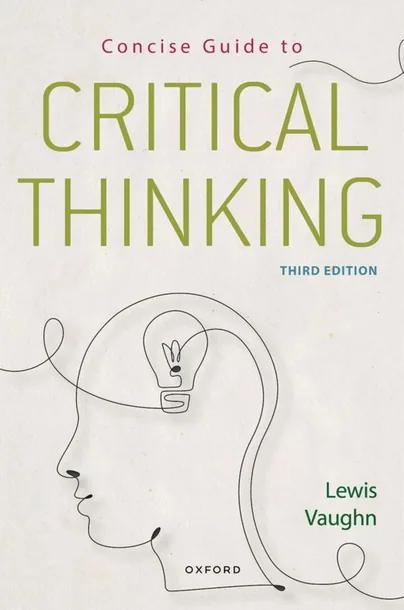
Concise Guide to Critical Thinking
by Lewis Vaughn
3rd Edition
Publisher: Oxford University Press
Book Details
| Print ISBN | 9780197768365 |
| eText ISBN | 9780197768372 |
| Publisher | Oxford University Press |
| Publishing Year | 2024 |
| Edition | 3rd Edition |
| Language | English |
| Pages | 392 |
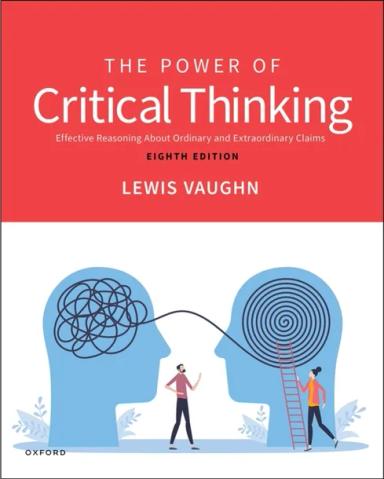
Concise Guide to Critical Thinking, 3rd Edition, is a concise textbook that introduces critical analysis and argumentative writing. Based on The Power of Critical Thinking, this volume establishes foundational methods for examining claims, evaluating reasons, and developing well-reasoned arguments.
Coverage focuses on core principles of deductive and inductive reasoning, the assessment of evidence and credibility, and scientific inquiry. It also investigates common impediments to rational thought, exploring logical fallacies, rhetorical persuaders, advertising techniques, and the spread of misinformation.
Designed to help students cultivate practical analytical habits, the textbook reinforces its lessons through varied exercises. Chapters incorporate review questions, structured writing assignments, and self-assessment quizzes to support student learning and critical analysis.
Table of Contents
Chapter 1: Critical Thinking, Facts, and Feelings
- • WHY IT MATTERS
- • Critical Thinking Skills Test
- • CLAIMS AND REASONS
- • REASONS AND ARGUMENTS
- • ARGUMENTS IN THE ROUGH
- • Key Words
- • Exercises
- • Self-Assessment Quiz
- • Writing Assignments
Chapter 2: Obstacles to Critical Thinking
- • PSYCHOLOGICAL OBSTACLES
- • Is It Wrong to Believe without Good Reasons?
- • Self-Centered Thinking
- • Group-Centered Thinking
- • Implicit Bias
- • Resisting Contrary Evidence
- • Left-Wing Right-Wing Bias
- • Looking for Confirming Evidence
- • Preferring Available Evidence
- • Motivated Reasoning
- • Homophily
- • Mere Exposure Effect
- • Illusion-of-Truth Effect
- • False Consensus Effect
- • THE DUNNING-KRUGER EFFECT
- • The Internet versus Critical Thinking
- • PHILOSOPHICAL OBSTACLES
- • Subjective Relativism
- • Social Relativism
- • Skepticism
- • Key Words
- • Exercises
- • Self-Assessment Quiz
- • Writing Assignments
Chapter 3: Identifying and Evaluating Arguments
- • ARGUMENT BASICS
- • No Arguments, Just Fluff
- • JUDGING ARGUMENTS
- • UNCOVERING IMPLIED PREMISES
- • The Smart Way to Argue Online
- • ASSESSING LONG ARGUMENTS
- • Key Words
- • Exercises
- • Self-Assessment Quiz
- • Writing Assignments
Chapter 4: Deductive Argument Patterns
- • COMMON FORMS
- • Modus Ponens
- • Modus Tollens
- • Hypothetical Syllogism
- • Disjunctive Syllogism
- • Invalid Argument Forms
- • Valid and Invalid Argument Forms
- • REDUCTIO AD ABSURDUM
- • Key Words
- • Exercises
- • Self-Assessment Quiz
- • Writing Assignments
Chapter 5: Inductive Arguments and Statistics
- • ENUMERATIVE INDUCTION
- • Sample Size
- • Representativeness
- • Mean, Median, and Mode
- • OPINION POLLS
- • How Survey Questions Go Wrong
- • ANALOGICAL INDUCTION
- • Relevant Similarities
- • Relevant Dissimilarities
- • The Number of Instances Compared
- • Diversity Among Cases
- • Key Words
- • Exercises
- • Self-Assessment Quiz
- • Writing Assignments
Chapter 6: Evidence and Experts
- • EXPERTS AND NONEXPERTS
- • Fact and Opinion
- • JUDGING EXPERTS
- • Hierarchy of Reliability
- • EXPERTS AND PERSONAL EXPERIENCE
- • I Just Know!
- • Impairment
- • Expectation
- • Eyewitness Testimony and Wrongful Convictions
- • INNUMERACY AND PROBABILITY
- • Key Words
- • Exercises
- • Self-Assessment Quiz
- • Writing Assignments
Chapter 7: Fake News
- • TAXONOMY OF MISINFORMATION
- • A Fake News Masterpiece
- • TELLING FAKE FROM REAL
- • Read Laterally
- • The Ethics of Sharing Fake News
- • Read Critically
- • Use Google and Wikipedia Carefully
- • Check Your Own Biases
- • Trustworthy Fact-Checkers
- • FAKE IMAGES
- • Key Words
- • Exercises
- • Self-Assessment Quiz
- • Writing Assignments
Chapter 8: Advertising: Commercial and Political
- • HOW ADVERTISING WORKS
- • INTERNET ADVERTISING
- • OLD SCHOOL ADVERTISING TRICKS
- • POLITICAL ADVERTISING
- • Key Words
- • Exercises
- • Self-Assessment Quiz
- • Writing Assignments
Chapter 9: Causal Arguments
- • TESTING FOR CAUSES
- • Agreement or Difference
- • Both Agreement and Difference
- • Correlation
- • CAUSAL CONFUSIONS
- • Misidentifying Relevant Factors
- • Mishandling Multiple Factors
- • Coincidence, Birth Dates, and US Presidents
- • Being Misled by Coincidence
- • Confusing Cause with Temporal Order
- • Confusing Cause and Effect
- • The Deadly Post Hoc Fallacy
- • NECESSARY AND SUFFICIENT CONDITIONS
- • Key Words
- • Exercises
- • Self-Assessment Quiz
- • Writing Assignments
Chapter 10: Inference to the Best Explanation
- • EXPLANATIONS AND INFERENCE
- • Darwin and the Best Explanation
- • THEORIES AND CONSISTENCY
- • THEORIES AND CRITERIA
- • Testability
- • Fruitfulness
- • Scope
- • Simplicity
- • Conservatism
- • TELLING GOOD THEORIES FROM BAD
- • A Doomed Flight
- • An Amazing Cure
- • Key Words
- • Exercises
- • Self-Assessment Quiz
- • Writing Assignments
Chapter 11: Judging Scientific Theories
- • WHAT SCIENCE IS AND IS NOT
- • THE SCIENTIFIC METHOD
- • TESTING SCIENTIFIC THEORIES
- • Nonintervention (Population) Studies
- • JUDGING SCIENTIFIC THEORIES
- • Copernicus Versus Ptolemy
- • Climate Change
- • Is It Too Late to Prevent Climate Change?
- • If the World Is Warming, Why Are Winters and Summers Still Very cold??
- • SCIENCE AND WEIRD THEORIES
- • MAKING WEIRD MISTAKES
- • Leaping to the Weirdest Theory
- • Mixing What Seems with What Is
- • Misunderstanding the Possibilities
- • JUDGING WEIRD THEORIES
- • Crop Circles
- • Eyewitness Testimony and Extraordinary Things
- • Talking with the Dead
- • Exercises
- • Self-Assessment Quiz
- • Writing Assignments
Chapter 12: Fallacies and Persuaders
- • FALLACIES: IRRELEVANT PREMISES
- • Genetic Fallacy
- • Composition
- • Division
- • Appeal to the Person
- • How to Respond to Ad Hominem Attacks
- • Equivocation
- • Appeal to Popularity
- • Appeal to Tradition
- • Appeal to Ignorance
- • Can You Prove a Negative?
- • Appeal to Emotion
- • Red Herring
- • Straw Man
- • Two Wrongs Make a Right
- • FALLACIES: UNACCEPTABLE PREMISES X
- • Begging the Question
- • False Dilemma
- • Decision-Point Fallacy
- • Slippery Slope
- • Hasty Generalization
- • PERSUADERS: RHETORICAL MOVES
- • Innuendo
- • Euphemisms and Dysphemisms
- • Stereotyping
- • Ridicule
- • Rhetorical Definitions
- • Key Words
- • Exercises
- • Self-Assessment Quiz
- • Writing Assignments
Chapter 13: Critical Thinking and Extremism
- • PARTISAN BLINDNESS
- • Whose Pants Are on Fire?
- • Political Bias and Consistency
- • CONSPIRACY THEORIES
- • Challenging Conspiracy Thinking
- • Key Words
- • Exercises
- • Self-Assessment Quiz
- • Writing Assignments
Customer Reviews
0.0
0 reviews
No reviews yet. Be the first to review this book!
Write a Review
Reviewed by GradeFocus Editorial Team