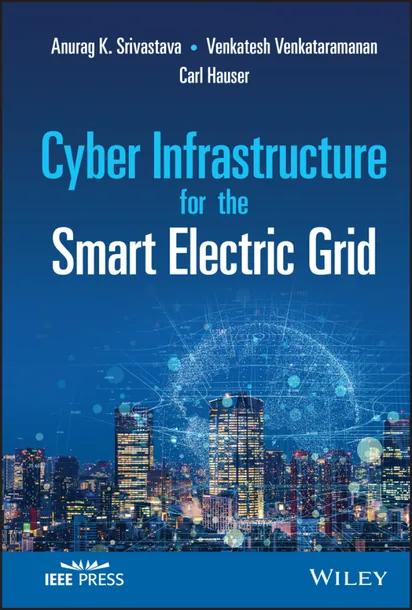
Cyber Infrastructure for the Smart Electric Grid
by Anurag K. Srivastava, Venkatesh Venkataramanan, Carl Hauser
1st Edition
Publisher: Wiley-IEEE Press
Book Details
| Print ISBN | 9781119460756 |
| eText ISBN | 9781119460787 |
| Publisher | Wiley-IEEE Press |
| Publishing Year | 2023 |
| Edition | 1st Edition |
| Language | English |
| Pages | 208 |
Cyber Infrastructure for the Smart Electric Grid, 1st Edition, is a textbook that introduces the fundamental principles governing smart grid operation, control, sensing, and data management. It examines the operational interdependencies required to sense, communicate, compute, and control grid systems securely.
The volume surveys communication network models, utility information technology architectures, and cybersecurity measures specific to modern power grids. It analyzes communication delays, application protocols, and risk mitigation strategies.
Supplied with software modules in executable format for exercises and demonstrations, this work is designed for utility professionals, vendors, national lab researchers, and engineering students.
Table of Contents
Chapter 1: Introduction to the Smart Grid
- • 1.1 Overview of the electric power grid
- • 1.2 What can go wrong in power grid operation
- • 1.3 Learning from past events
- • 1.4 Towards a smarter electric grid
- • 1.5 Summary
- • 1.6 Problems
- • 1.7 Questions
Chapter 2: Sense, communicate, compute and control in secure way
- • 2.1 Sensing in smart grid
- • 2.2 Communication infrastructure in smart grid
- • 2.3 Computational infrastructure and control requirements in smart grid
- • 2.4 Cyber security in smart grid
- • 2.5 Summary
- • 2.6 Problems
- • 2.7 Questions
Chapter 3: Smart Grid Operational Structure and Standards
- • 3.1 Organization to ensure system reliability
- • 3.2 Smart grid standards and interoperability
- • 3.3 Operational structure in the rest of the world
- • 3.4 Summary
- • 3.5 Problems
- • 3.6 Questions
Chapter 4: Communication performance and factors that Affect it
- • 4.1 Introduction
- • 4.2 Propagation Delay
- • 4.3 Transmission Delay
- • 4.4 Queuing Delay and Jitter
- • 4.5 Processing Delay
- • 4.6 Delay in Multi-hop networks
- • 4.7 Data Loss and Corruption
- • 4.8 Summary
- • 4.9 Exercises
Chapter 5: Layered communication model
- • 5.1 Introduction
- • 5.2 Physical layer
- • 5.3 Link layer: service models
- • 5.4 Network layer: addressing and routing
- • 5.5 Transport layer: datagram and stream protocols
- • 5.6 Application layer
- • 5.7 Glue protocols: ARP, DNS
- • 5.8 Comparison between OST and TCP/IP models
- • 5.9 Summary
- • 5.10 Problems
- • 5.11 Questions
Chapter 6: Power system application-layer protocols
- • 6.1 Introduction
- • 6.2 SCADA protocols
- • 6.3 ICCP
- • 6.4 C37.118
- • 6.5 Smart metering and distributed energy resources
- • 6.6 Time synchronization
- • 6.7 Summary
- • 6.8 Problems
- • 6.9 Questions
Chapter 7: Utility IT infrastructures for control center and Fault-tolerant computing
- • 7.1 Conventional control centers
- • 7.2 Modern Control Centers
- • 7.3 Future Control Centers
- • 7.4 UML, XML, RDF,and CIM
- • 7.5 Basics of Fault-tolerant computing
- • 7.6 Cloud computing
- • 7.7 Summary
- • 7.8 Problems
- • 7.9 Questions
Chapter 8: Basic security concepts, cryptographic protocols, and access control
- • 8.1 Introduction
- • 8.2 Basic Cybersecurity Concepts and Threats to Power systems
- • 8.3 The CIA Triad and Other Core Security Properties
- • 8.4 Introduction to Encryption and Authentication
- • 8.5 Cryptography in power systems
- • 8.6 Access control
- • 8.7 Summary
- • 8.8 Problems
- • 8.9 Questions
Chapter 9: Network attacks and protection
- • 9.1 Attacks to network communications
- • 9.2 Mitigation mechanisms against network attacks
- • 9.3 Network protection through rewalls
- • 9.4 Intrusion detection
- • 9.5 Summary
- • 9.6 Problems
- • 9.7 Questions
Chapter 10: Vulnerabilities, and Risk Management
- • 10.1 System vulnerabilities
- • 10.2 Security mechanisms: Access control and Malware Detection
- • 10.3 Assurance and Evaluation
- • 10.4 Compliance: Industrial practice to implement NERC CIP
- • 10.5 Summary
- • 10.6 Problems
- • 10.7 Questions
Chapter 11: Smart grid case studies
- • 11.1 Smart Grid Demonstration Projects
- • 11.2 Smart grid metrics
- • 11.3 Smart Grid Challenges: Attack case-studies
- • 11.4 Mitigation using NIST Cybersecurity Framework
- • 11.5 Summary
- • 11.6 Problems
- • 11.7 Questions
Customer Reviews
0.0
0 reviews
No reviews yet. Be the first to review this book!
Write a Review
Reviewed by GradeFocus Editorial Team
Related Books

Electronics Use in Harsh Environments
Rajan Ambat

Digital Design using VerilogHDL
Shilpi Birla
Artificial Intelligence Empowered Smart Energy Systems
Qiang Yang

Stability Analysis of Converter-Rich Power Grids
Jun Liang

Multiphase Power Electronic Converters
Salman Ahmad
Robust Dynamic State Estimation of Power Systems
Junbo Zhao