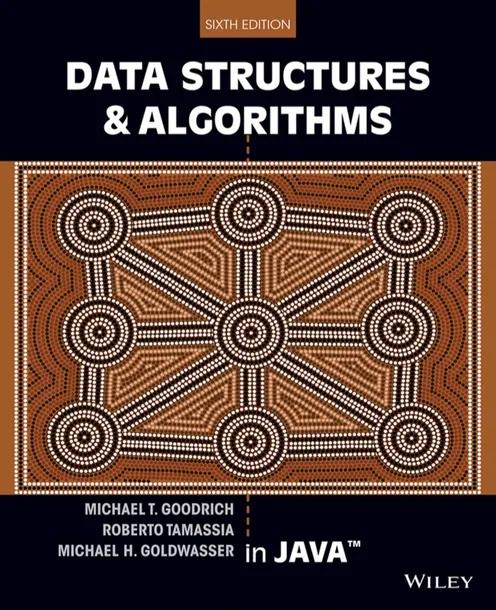
Data Structures and Algorithms in Java
by Michael T. Goodrich, Roberto Tamassia, Michael H. Goldwasser
6th Edition
Publisher: Wiley
Book Details
| Print ISBN | 9781118771334 |
| eText ISBN | 9781118803141 |
| Publisher | Wiley |
| Publishing Year | 2014 |
| Edition | 6th Edition |
| Language | English |
| Pages | 736 |
Data Structures and Algorithms in Java, 6th Edition, is a textbook that presents fundamental data structures and algorithmic design within an object-oriented framework. It introduces Java programming principles alongside formal algorithm analysis and core software design concepts.
The volume covers essential data organizations and techniques, including stacks, queues, priority queues, and search trees. It also addresses topics such as maps, hash tables, sorting, selection, and text processing.
To support student learning, end-of-chapter problems are organized by objective into reinforcement exercises to evaluate comprehension, creativity problems that involve authoring classes, and programming projects requiring complete implementations.
Table of Contents
Chapter 1: Java Primer
- • 1.1 Getting Started
- • 1.1.1 Base Types
- • 1.2 Classes and Objects
- • 1.2.1 Creating and Using Objects
- • 1.2.2 Defining a Class
- • 1.3 Strings, Wrappers, Arrays, and Enum Types
- • 1.4 Expressions
- • 1.4.1 Literals
- • 1.4.2 Operators
- • 1.4.3 Type Conversions
- • 1.5 Control Flow
- • 1.5.1 The If and Switch Statements
- • 1.5.2 Loops
- • 1.5.3 Explicit Control-Flow Statements
- • 1.6 Simple Input and Output
- • 1.7 An Example Program
- • 1.8 Packages and Imports
- • 1.9 Software Development
- • 1.9.1 Design
- • 1.9.2 Pseudocode
- • 1.9.3 Coding
- • 1.9.4 Documentation and Style
- • 1.9.5 Testing and Debugging
- • 1.10 Exercises
Chapter 2: Object-Oriented Design
- • 2.1 Goals, Principles, and Patterns
- • 2.1.1 Object-Oriented Design Goals
- • 2.1.2 Object-Oriented Design Principles
- • 2.1.3 Design Patterns
- • 2.2 Inheritance
- • 2.2.1 Extending the CreditCard Class
- • 2.2.2 Polymorphism and Dynamic Dispatch
- • 2.2.3 Inheritance Hierarchies
- • 2.3 Interfaces and Abstract Classes
- • 2.3.1 Interfaces in Java
- • 2.3.2 Multiple Inheritance for Interfaces
- • 2.3.3 Abstract Classes
- • 2.4 Exceptions
- • 2.4.1 Catching Exceptions
- • 2.4.2 Throwing Exceptions
- • 2.4.3 Java’s Exception Hierarchy
- • 2.5 Casting and Generics
- • 2.5.1 Casting
- • 2.5.2 Generics
- • 2.6 Nested Classes
- • 2.7 Exercises
Chapter 3: Fundamental Data Structures
- • 3.1 Using Arrays
- • 3.1.1 Storing Game Entries in an Array
- • 3.1.2 Sorting an Array
- • 3.1.3 java.util Methods for Arrays and Random Numbers
- • 3.1.4 Simple Cryptography with Character Arrays
- • 3.1.5 Two-Dimensional Arrays and Positional Games
- • 3.2 Singly Linked Lists
- • 3.2.1 Implementing a Singly Linked List Class
- • 3.3 Circularly Linked Lists
- • 3.3.1 Round-Robin Scheduling
- • 3.3.2 Designing and Implementing a Circularly Linked List
- • 3.4 Doubly Linked Lists
- • 3.4.1 Implementing a Doubly Linked List Class
- • 3.5 Equivalence Testing
- • 3.5.1 Equivalence Testing with Arrays
- • 3.5.2 Equivalence Testing with Linked Lists
- • 3.6 Cloning Data Structures
- • 3.6.1 Cloning Arrays
- • 3.6.2 Cloning Linked Lists
- • 3.7 Exercises
Chapter 4: Algorithm Analysis
- • 4.1 Experimental Studies
- • 4.1.1 Moving Beyond Experimental Analysis
- • 4.2 The Seven Functions Used in This Book
- • 4.2.1 Comparing Growth Rates
- • 4.3 Asymptotic Analysis
- • 4.3.1 The “Big-Oh” Notation
- • 4.3.2 Comparative Analysis
- • 4.3.3 Examples of Algorithm Analysis
- • 4.4 Simple Justification Techniques
- • 4.4.1 By Example
- • 4.4.2 The “Contra” Attack
- • 4.4.3 Induction and Loop Invariants
- • 4.5 Exercises
Chapter 5: Recursion
- • 5.1 Illustrative Examples
- • 5.1.1 The Factorial Function
- • 5.1.2 Drawing an English Ruler
- • 5.1.3 Binary Search
- • 5.1.4 File Systems
- • 5.2 Analyzing Recursive Algorithms
- • 5.3 Further Examples of Recursion
- • 5.3.1 Linear Recursion
- • 5.3.2 Binary Recursion
- • 5.3.3 Multiple Recursion
- • 5.4 Designing Recursive Algorithms
- • 5.5 Recursion Run Amok
- • 5.5.1 Maximum Recursive Depth in Java
- • 5.6 Eliminating Tail Recursion
- • 5.7 Exercises
Chapter 6: Stacks, Queues, and Deques
- • 6.1 Stacks
- • 6.1.1 The Stack Abstract Data Type
- • 6.1.2 A Simple Array-Based Stack Implementation
- • 6.1.3 Implementing a Stack with a Singly Linked List
- • 6.1.4 Reversing an Array Using a Stack
- • 6.1.5 Matching Parentheses and HTML Tags
- • 6.2 Queues
- • 6.2.1 The Queue Abstract Data Type
- • 6.2.2 Array-Based Queue Implementation
- • 6.2.3 Implementing a Queue with a Singly Linked List
- • 6.2.4 A Circular Queue
- • 6.3 Double-Ended Queues
- • 6.3.1 The Deque Abstract Data Type
- • 6.3.2 Implementing a Deque
- • 6.3.3 Deques in the Java Collections Framework
- • 6.4 Exercises
Chapter 7: List and Iterator ADTs
- • 7.1 The List ADT
- • 7.2 Array Lists
- • 7.2.1 Dynamic Arrays
- • 7.2.2 Implementing a Dynamic Array
- • 7.2.3 Amortized Analysis of Dynamic Arrays
- • 7.2.4 Java’s StringBuilder class
- • 7.3 Positional Lists
- • 7.3.1 Positions
- • 7.3.2 The Positional List Abstract Data Type
- • 7.3.3 Doubly Linked List Implementation
- • 7.4 Iterators
- • 7.4.1 The Iterable Interface and Java’s For-Each Loop
- • 7.4.2 Implementing Iterators
- • 7.5 The Java Collections Framework
- • 7.5.1 List Iterators in Java
- • 7.5.2 Comparison to Our Positional List ADT
- • 7.5.3 List-Based Algorithms in the Java Collections Framework
- • 7.6 Sorting a Positional List
- • 7.7 Case Study: Maintaining Access Frequencies
- • 7.7.1 Using a Sorted List
- • 7.7.2 Using a List with the Move-to-Front Heuristic
- • 7.8 Exercises
Chapter 8: Trees
- • 8.1 General Trees
- • 8.1.1 Tree Definitions and Properties
- • 8.1.2 The Tree Abstract Data Type
- • 8.1.3 Computing Depth and Height
- • 8.2 Binary Trees
- • 8.2.1 The Binary Tree Abstract Data Type
- • 8.2.2 Properties of Binary Trees
- • 8.3 Implementing Trees
- • 8.3.1 Linked Structure for Binary Trees
- • 8.3.2 Array-Based Representation of a Binary Tree
- • 8.3.3 Linked Structure for General Trees
- • 8.4 Tree Traversal Algorithms
- • 8.4.1 Preorder and Postorder Traversals of General Trees
- • 8.4.2 Breadth-First Tree Traversal
- • 8.4.3 Inorder Traversal of a Binary Tree
- • 8.4.4 Implementing Tree Traversals in Java
- • 8.4.5 Applications of Tree Traversals
- • 8.4.6 Euler Tours
- • 8.5 Exercises
Chapter 9: Priority Queues
- • 9.1 The Priority Queue Abstract Data Type
- • 9.1.1 Priorities
- • 9.1.2 The Priority Queue ADT
- • 9.2 Implementing a Priority Queue
- • 9.2.1 The Entry Composite
- • 9.2.2 Comparing Keys with Total Orders
- • 9.2.3 The AbstractPriorityQueue Base Class
- • 9.2.4 Implementing a Priority Queue with an Unsorted List
- • 9.2.5 Implementing a Priority Queue with a Sorted List
- • 9.3 Heaps
- • 9.3.1 The Heap Data Structure
- • 9.3.2 Implementing a Priority Queue with a Heap
- • 9.3.3 Analysis of a Heap-Based Priority Queue
- • 9.3.4 Bottom-Up Heap Construction ⋆
- • 9.3.5 Using the java.util.PriorityQueue Class
- • 9.4 Sorting with a Priority Queue
- • 9.4.1 Selection-Sort and Insertion-Sort
- • 9.4.2 Heap-Sort
- • 9.5 Adaptable Priority Queues
- • 9.5.1 Location-Aware Entries
- • 9.5.2 Implementing an Adaptable Priority Queue
- • 9.6 Exercises
Chapter 10: Maps, Hash Tables, and Skip Lists
- • 10.1 Maps
- • 10.1.1 The Map ADT
- • 10.1.2 Application: Counting Word Frequencies
- • 10.1.3 An AbstractMap Base Class
- • 10.1.4 A Simple Unsorted Map Implementation
- • 10.2 Hash Tables
- • 10.2.1 Hash Functions
- • 10.2.2 Collision-Handling Schemes
- • 10.2.3 Load Factors, Rehashing, and Efficiency
- • 10.2.4 Java Hash Table Implementation
- • 10.3 Sorted Maps
- • 10.3.1 Sorted Search Tables
- • 10.3.2 Two Applications of Sorted Maps
- • 10.4 Skip Lists
- • 10.4.1 Search and Update Operations in a Skip List
- • 10.4.2 Probabilistic Analysis of Skip Lists ⋆
- • 10.5 Sets, Multisets, and Multimaps
- • 10.5.1 The Set ADT
- • 10.5.2 The Multiset ADT
- • 10.5.3 The Multimap ADT
- • 10.6 Exercises
Chapter 11: Search Trees
- • 11.1 Binary Search Trees
- • 11.1.1 Searching Within a Binary Search Tree
- • 11.1.2 Insertions and Deletions
- • 11.1.3 Java Implementation
- • 11.1.4 Performance of a Binary Search Tree
- • 11.2 Balanced Search Trees
- • 11.2.1 Java Framework for Balancing Search Trees
- • 11.3 AVL Trees
- • 11.3.1 Update Operations
- • 11.3.2 Java Implementation
- • 11.4 Splay Trees
- • 11.4.1 Splaying
- • 11.4.2 When to Splay
- • 11.4.3 Java Implementation
- • 11.4.4 Amortized Analysis of Splaying ⋆
- • 11.5 (2,4) Trees
- • 11.5.1 Multiway Search Trees
- • 11.5.2 (2,4)-Tree Operations
- • 11.6 Red-Black Trees
- • 11.6.1 Red-Black Tree Operations
- • 11.6.2 Java Implementation
- • 11.7 Exercises
Chapter 12: Sorting and Selection
- • 12.1 Merge-Sort
- • 12.1.1 Divide-and-Conquer
- • 12.1.2 Array-Based Implementation of Merge-Sort
- • 12.1.3 The Running Time of Merge-Sort
- • 12.1.4 Merge-Sort and Recurrence Equations ⋆
- • 12.1.5 Alternative Implementations of Merge-Sort
- • 12.2 Quick-Sort
- • 12.2.1 Randomized Quick-Sort
- • 12.2.2 Additional Optimizations for Quick-Sort
- • 12.3 Studying Sorting through an Algorithmic Lens
- • 12.3.1 Lower Bound for Sorting
- • 12.3.2 Linear-Time Sorting: Bucket-Sort and Radix-Sort
- • 12.4 Comparing Sorting Algorithms
- • 12.5 Selection
- • 12.5.1 Prune-and-Search
- • 12.5.2 Randomized Quick-Select
- • 12.5.3 Analyzing Randomized Quick-Select
- • 12.6 Exercises
Chapter 13: Text Processing
- • 13.1 Abundance of Digitized Text
- • 13.1.1 Notations for Character Strings
- • 13.2 Pattern-Matching Algorithms
- • 13.2.1 Brute Force
- • 13.2.2 The Boyer-Moore Algorithm
- • 13.2.3 The Knuth-Morris-Pratt Algorithm
- • 13.3 Tries
- • 13.3.1 Standard Tries
- • 13.3.2 Compressed Tries
- • 13.3.3 Suffix Tries
- • 13.3.4 Search Engine Indexing
- • 13.4 Text Compression and the Greedy Method
- • 13.4.1 The Huffman Coding Algorithm
- • 13.4.2 The Greedy Method
- • 13.5 Dynamic Programming
- • 13.5.1 Matrix Chain-Product
- • 13.5.2 DNA and Text Sequence Alignment
- • 13.6 Exercises
Chapter 14: Graph Algorithms
- • 14.1 Graphs
- • 14.1.1 The Graph ADT
- • 14.2 Data Structures for Graphs
- • 14.2.1 Edge List Structure
- • 14.2.2 Adjacency List Structure
- • 14.2.3 Adjacency Map Structure
- • 14.2.4 Adjacency Matrix Structure
- • 14.2.5 Java Implementation
- • 14.3 Graph Traversals
- • 14.3.1 Depth-First Search
- • 14.3.2 DFS Implementation and Extensions
- • 14.3.3 Breadth-First Search
- • 14.4 Transitive Closure
- • 14.5 Directed Acyclic Graphs
- • 14.5.1 Topological Ordering
- • 14.6 Shortest Paths
- • 14.6.1 Weighted Graphs
- • 14.6.2 Dijkstra’s Algorithm
- • 14.7 Minimum Spanning Trees
- • 14.7.1 Prim-Jarn´ýk Algorithm
- • 14.7.2 Kruskal’s Algorithm
- • 14.7.3 Disjoint Partitions and Union-Find Structures
- • 14.8 Exercises
Chapter 15: Memory Management and B-Trees
- • 15.1 Memory Management
- • 15.1.1 Stacks in the Java Virtual Machine
- • 15.1.2 Allocating Space in the Memory Heap
- • 15.1.3 Garbage Collection
- • 15.2 Memory Hierarchies and Caching
- • 15.2.1 Memory Systems
- • 15.2.2 Caching Strategies
- • 15.3 External Searching and B-Trees
- • 15.3.1 (a,b) Trees
- • 15.3.2 B-Trees
- • 15.4 External-Memory Sorting
- • 15.4.1 Multiway Merging
- • 15.5 Exercises
Customer Reviews
0.0
0 reviews
No reviews yet. Be the first to review this book!
Write a Review
Reviewed by GradeFocus Editorial Team