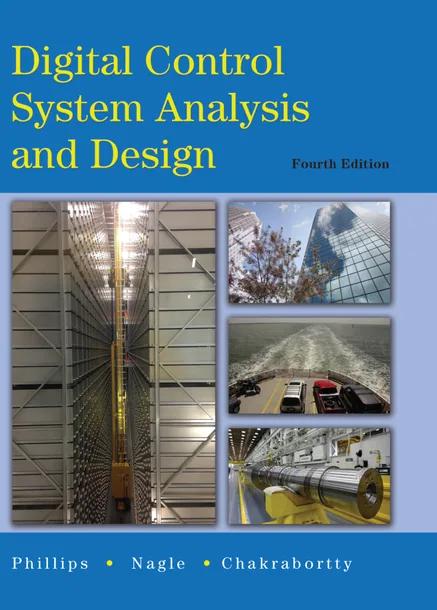
Digital Control System Analysis & Design
by Charles L. Phillips, H. Troy Nagle, Aranya Chakrabortty
4th Edition
Publisher: Pearson
Book Details
| Print ISBN | 9780132938310 |
| eText ISBN | 9780133496703 |
| Publisher | Pearson |
| Publishing Year | 2015 |
| Edition | 4th Edition |
| Language | English |
Digital Control System Analysis & Design, 4th Edition, is a Pearson textbook that emphasizes practical aspects of designing and implementing digital control systems.
The volume addresses core topics in discrete-time controls, ranging from sampling and reconstruction to system time response and closed-loop behavior. It covers foundational tools such as the z-transform alongside methods for stability analysis and digital controller design.
Designed for a one-semester or two-quarter senior-level course in digital or discrete-time controls, the text also serves as a reference for practicing engineers. Simple physical systems introduced early in the book are reused in later chapters to illuminate more advanced material.
Table of Contents
Chapter 1: Introduction
- • Overview
- • Digital Control System
- • The Control Problem
- • Satellite Model
- • Servomotor System Model
- • Antenna Pointing System
- • Robotic Control System
- • Temperature Control System
- • Single-Machine Infinite Bus Power System
- • Summary
- • References • Problems
Chapter 2: discrete-time systems and the z-transform
- • Introduction
- • Discrete-Time Systems
- • Transform Methods
- • Properties of the z-Transform
- • Addition and Subtraction
- • Multiplication by a Constant
- • Real Translation
- • Complex Translation
- • Initial Value
- • Final Value
- • Finding z-Transforms
- • Solution of Difference Equations
- • The Inverse z-Transform
- • Power Series Method
- • Partial-Fraction Expansion Method
- • Inversion-Formula Method
- • Discrete Convolution
- • Simulation Diagrams and Flow Graphs
- • State Variables
- • Other State-Variable Formulations
- • Transfer Functions
- • Solutions of the State Equations
- • Recursive Solution
- • z-Transform Method
- • Numerical Method via Digital Computer
- • Properties of the State Transition Matrix
- • Linear Time-Varying Systems
- • Summary
- • References and Further Readings • Problems
Chapter 3: sampling and reconstruction
- • Introduction
- • Sampled-Data Control Systems
- • The Ideal Sampler
- • Evaluation of E*(S)
- • Results from the Fourier Transform
- • Properties of E*(S)
- • Data Reconstruction
- • Zero-Order Hold
- • First-Order Hold
- • Fractional-Order Holds
- • Summary
- • References and Further Readings • Problems
Chapter 4: open-loop discrete-time systems
- • Introduction
- • The Relationship Between E(Z) and E*(S)
- • The Pulse Transfer Function
- • Open-Loop Systems Containing Digital Filters
- • The Modified z-Transform
- • Systems with Time Delays
- • Nonsynchronous Sampling
- • State-Variable Models
- • Review of Continuous-Time State Variables
- • Discrete State Equations
- • Practical Calculations
- • Summary
- • References and Further Readings • Problems
Chapter 5: closed-loop systems
- • Introduction
- • Preliminary Concepts
- • Derivation Procedure
- • State-Variable Models
- • Summary
- • References and Further Readings • Problems
Chapter 6: system time-response characteristics
- • Introduction
- • System Time Response
- • System Characteristic Equation
- • Mapping the s-Plane into the z-Plane
- • Steady-State Accuracy
- • Simulation
- • Control Software
- • Summary
- • References and Further Readings • Problems
Chapter 7: stability analysis techniques
- • Introduction
- • Stability
- • Bilinear Transformation
- • The Routh-Hurwitz Criterion
- • Jury’s Stability Test
- • Root Locus
- • The Nyquist Criterion
- • Bode Diagram
- • Interpretation of the Frequency Response
- • Closed-Loop Frequency Response
- • Summary
- • References and Further Readings • Problems
Chapter 8: digital controller design
- • Introduction
- • Control System Specifications
- • Steady-State Accuracy
- • Transient Response
- • Relative Stability
- • Sensitivity
- • Disturbance Rejection
- • Control Effort
- • Compensation
- • Phase-Lag Compensation
- • Phase-Lead Compensation
- • Phase-Lead Design Procedure
- • Lag-Lead Compensation
- • Integration and Differentiation Filters
- • PID Controllers
- • PID Controller Design
- • Design by Root Locus
- • Summary
- • References and Further Readings • Problems
Chapter 9: pole-assignment design and state estImatIon
- • Introduction
- • Pole Assignment
- • State Estimation
- • Observer Model
- • Errors in Estimation
- • Error Dynamics
- • Controller Transfer Function
- • Closed-Loop Characteristic Equation
- • Closed-Loop State Equations
- • Reduced-Order Observers
- • Current Observers
- • Controllability and Observability
- • Systems with Inputs
- • Summary
- • References and Further Readings • Problems
Chapter 10: system identification of discrete-time systems
- • Introduction
- • Identification of Static Systems
- • Identification of Dynamic Systems
- • Black-Box Identification
- • Least-Squares System Identification
- • Estimating Transfer Functions with Partly Known Poles and Zeros
- • Recursive Least-Squares System Identification
- • Practical Factors for Identification
- • Choice of Input
- • Choice of Sampling Frequency
- • Choice of Signal Scaling
- • Summary
- • References and Further Readings • Problems
Chapter 11: linear quadratic optimal control
- • Introduction
- • The Quadratic Cost Function
- • The Principle of Optimality
- • Linear Quadratic Optimal Control
- • The Minimum Principle
- • Steady-State Optimal Control
- • Optimal State Estimation–Kalman Filters
- • Least-Squares Minimization
- • Summary
- • References and Further Readings • Problems
Chapter 12: case studies
- • Introduction
- • Servomotor System
- • System Model
- • Design
- • Environmental Chamber Control System
- • Temperature Control System
- • Aircraft Landing System
- • Plant Model
- • Neonatal Fractional Inspired Oxygen
- • Plant Transfer Function
- • Taube’s PID Controller
- • MATLAB pidtool PIDF Controllers
- • Topology Identification in Electric Power System Models
- • References
Chapter Appendix I: Design Equations
Chapter Appendix II: Mason’s Gain Formula
Chapter Appendix III: Evaluation of E*(s)
Chapter Appendix IV: Review of Matrices
Chapter Appendix V: The Laplace Transform
Chapter Appendix VI: z-Transform Tables
Customer Reviews
0.0
0 reviews
No reviews yet. Be the first to review this book!
Write a Review
Reviewed by GradeFocus Editorial Team
Related Books
Electronics Use in Harsh Environments
Rajan Ambat
Digital Design using VerilogHDL
Shilpi Birla
Artificial Intelligence Empowered Smart Energy Systems
Qiang Yang
Stability Analysis of Converter-Rich Power Grids
Jun Liang
Multiphase Power Electronic Converters
Salman Ahmad
Robust Dynamic State Estimation of Power Systems
Junbo Zhao