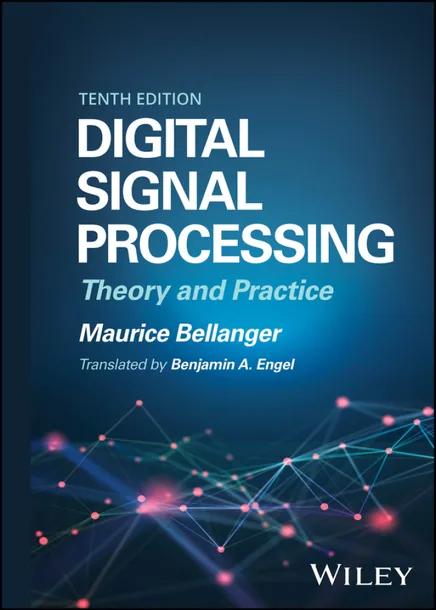
Digital Signal Processing
Theory and Practice
by Maurice Bellanger
10th Edition
Publisher: Wiley-Blackwell
Book Details
| Print ISBN | 9781394182664 |
| eText ISBN | 9781394182688 |
| Publisher | Wiley-Blackwell |
| Publishing Year | 2024 |
| Edition | 10th Edition |
| Language | English |
| Pages | 400 |
The 10th Edition of Digital Signal Processing: Theory and Practice by Maurice Bellanger presents an extensive textbook on signal conversion, spectral analysis, and computational algorithms. Designed for university students, active researchers, and industry professionals, this volume establishes the essential mathematical framework required to process, analyze, and manipulate discrete-time signals across contemporary electrical and computer engineering environments.
The coverage follows a systematic theoretical sequence across foundational signal operations. Readers examine signal digitizing, sampling, coding, and quantization before progressing to discrete functions such as convolution and the Z-transform. Subsequent chapters detail frequency-domain analysis using the Discrete Fourier Transform, Fast Fourier Transform computational algorithms, time-invariant discrete linear systems, and Finite Impulse Response filter structures.
End-of-chapter exercises allow readers to apply theoretical formulas directly and verify their understanding of core concepts. This deliberate instructional layout makes the text well suited for structured university degree courses, technical research projects, and self-directed professional development across engineering fields.
Table of Contents
Chapter 1: Signal Digitizing - Sampling and Coding
- • 1.1 Fourier Analysis
- • 1.2 Distributions
- • 1.3 Some Commonly Studied Signals
- • 1.4 The Norms of a Function
- • 1.5 Sampling
- • 1.6 Frequency Sampling
- • 1.7 The Sampling Theorem
- • 1.8 Sampling of Sinusoidal and Random Signals
- • 1.9 Quantization
- • 1.10 The Coding Dynamic Range
- • 1.11 Nonlinear Coding with the 13-segment A-law
- • 1.12 Optimal Coding
- • 1.13 Quantity of Information and Channel Capacity
- • 1.14 Binary Representations
Chapter 2: The Discrete Fourier Transform
- • 2.1 Definition and Properties of the Discrete Fourier Transform
- • 2.2 Fast Fourier Transform (FFT)
- • 2.3 Degradation Arising fromWordlength Limitation Effects
- • 2.4 Calculation of a Spectrum Using the DFT
- • 2.5 Fast Convolution
- • 2.6 Calculations of a DFT Using Convolution
- • 2.7 Implementation
Chapter 3: Other Fast Algorithms for the FFT
- • 3.1 Kronecker Product of Matrices
- • 3.2 Factorizing the Matrix of a Decimation-in-Frequency Algorithm
- • 3.3 Partial Transforms
- • 3.4 Lapped Transform
- • 3.5 Other Fast Algorithms
- • 3.6 Binary Fourier Transform - Hadamard
- • 3.7 Number-Theoretic Transforms
Chapter 4: Time-Invariant Discrete Linear Systems
- • 4.1 Definition and Properties
- • 4.2 The Z-Transform
- • 4.3 Energy and Power of Discrete Signals
- • 4.4 Filtering of Random Signals
- • 4.5 Systems Defined by Difference Equations
- • 4.6 State Variable Analysis
Chapter 5: Finite Impulse Response (FIR) Filters
- • 5.1 FIR Filters
- • 5.2 Practical Transfer Functions and Linear Phase Filters
- • 5.3 Calculation of Coefficients by Fourier Series Expansion for Frequency Specifications
- • 5.4 Calculation of Coefficients by the Least-Squares Method
- • 5.5 Calculation of Coefficient by Discrete Fourier Transform
- • 5.6 Calculation of Coefficients by Chebyshev Approximation
- • 5.7 Relationships Between the Number of Coefficients and the Filter Characteristic
- • 5.8 Raised-Cosine Transition Filter
- • 5.9 Structures for Implementing FIR Filters
- • 5.10 Limitation of the Number of Bits for Coefficients
- • 5.11 Z-Transfer Function of an FIR Filter
- • 5.12 Minimum-Phase Filters
- • 5.13 Design of Filters with a Large Number of Coefficients
- • 5.14 Two-Dimensional FIR Filters
- • 5.15 Coefficients of Two-Dimensional FIR Filters by the Least-Squares Method
Chapter 6: Infinite Impulse Response (IIR) Filter Sections
- • 6.1 First-Order Section
- • 6.2 Purely Recursive Second-Order Section
- • 6.3 General Second-Order Section
- • 6.4 Structures for Implementation
- • 6.5 CoefficientWordlength Limitation
- • 6.6 Internal DataWordlength Limitation
- • 6.7 Stability and Limit Cycles
Chapter 7: Infinite Impulse Response Filters
- • 7.1 General Expressions for the Properties of IIR Filters
- • 7.2 Direct Calculations of the Coefficients Using Model Functions
Chapter 8: Digital Ladder Filters
- • 8.1 Properties of Two-Port Circuits
- • 8.2 Simulated Ladder Filters
- • 8.3 Switched-Capacitor Filters
- • 8.4 Lattice Filters
- • 8.5 Comparison Elements
Chapter 9: Complex Signals - Quadrature Filters - Interpolators
- • 9.1 The Fourier Transform of a Real and Causal Set
- • 9.2 Analytic Signals
- • 9.3 Calculating the Coefficients of an FIR Quadrature Filter
- • 9.4 Recursive 90° Phase Shifters
- • 9.5 Single Side-Band Modulation
- • 9.6 Minimum-Phase Filters
- • 9.7 Differentiator
- • 9.8 Interpolation Using FIR Filters
- • 9.9 Lagrange Interpolation
- • 9.10 Interpolation by Blocks - Splines
- • 9.11 Interpolations and Signal Restoration
- • 9.12 Conclusion
Chapter 10: Multirate Filtering
- • 10.1 Decimation and Z-Transform
- • 10.2 Decomposition of a Low-Pass FIR Filter
- • 10.3 Half-Band FIR Filters
- • 10.4 Decomposition with Half-Band Filters
- • 10.5 Digital Filtering by Polyphase Network
- • 10.6 Multirate Filtering with IIR Elements
- • 10.7 Filter Banks Using Polyphase Networks and DFT
- • 10.8 Conclusion
Chapter 11: QMF Filters and Wavelets
- • 11.1 Decomposition into Two Sub-Bands and Reconstruction
- • 11.2 QMF Filters
- • 11.3 Perfect Decomposition and Reconstruction
- • 11.4 Wavelets
- • 11.5 Lattice Structures
Chapter 12: Filter Banks
- • 12.1 Decomposition and Reconstruction
- • 12.2 Analyzing the Elements of the Polyphase Network
- • 12.3 Determining the Inverse Functions
- • 12.4 Banks of Pseudo-QMF Filters
- • 12.5 Determining the Coefficients of the Prototype Filter
- • 12.6 Realizing a Bank of Real Filters
Chapter 13: Signal Analysis and Modeling
- • 13.1 Autocorrelation and Intercorrelation
- • 13.2 Correlogram Spectral Analysis
- • 13.3 Single-Frequency Estimation
- • 13.4 Correlation Matrix
- • 13.5 Modeling
- • 13.6 Linear Prediction
- • 13.7 Predictor Structures
- • 13.8 Multiple Sources - MIMO
- • 13.9 Conclusion
Chapter 14: Adaptive Filtering
- • 14.1 Principle of Adaptive Filtering
- • 14.2 Convergence Conditions
- • 14.3 Time Constant
- • 14.4 Residual Error
- • 14.5 Complexity Parameters
- • 14.6 Normalized Algorithms and Sign Algorithms
- • 14.7 Adaptive FIR Filtering in Cascade Form
- • 14.8 Adaptive IIR Filtering
- • 14.9 Conclusion
Chapter 15: Neural Networks
- • 15.1 Classification
- • 15.2 Multilayer Perceptron
- • 15.3 The Backpropagation Algorithm
- • 15.4 Examples of Application
- • 15.5 Convolution Neural Networks
- • 15.6 Recurrent/Recursive Neural Networks
- • 15.7 Neural Network and Signal Processing
- • 15.8 On Activation Functions
- • 15.9 Conclusion
Chapter 16: Error-Correcting Codes
- • 16.1 Reed-Solomon Codes
- • 16.2 Convolutional Codes
- • 16.3 Conclusion
Chapter 17: Applications
- • 17.1 Frequency Detection
- • 17.2 Phase-locked Loop
- • 17.3 Differential Coding of Speech
- • 17.4 Coding of Sound
- • 17.5 Echo Cancelation
- • 17.6 Television Image Processing
- • 17.7 Multicarrier Transmission - OFDM
- • 17.8 Mobile Radiocommunications
Customer Reviews
0.0
0 reviews
No reviews yet. Be the first to review this book!
Write a Review
Reviewed by GradeFocus Editorial Team
▶Research Sources (14)
- Digital Signal Processing, eBook by Maurice Bellanger - Booktopia
- https://lernerbooks.com/products/search_results?se...
- Untitled
- Sourcebooks, LLC.
- Signal Processing: Books & eBooks - LibGuides at Research Commons
- Please verify you are human - Captcha
- Nonfiction - Book Brigade
- Books - SPENCER & CO
- Digital Signal Processing: Theory and Practice - BooksRun
- Digital Signal Processing, 10th Edition [Book] - O'Reilly
- Suggest some entry-level Digital Signal Processing books ... - Reddit
- Digital Signals and Processing Group - Books - MIT
- Digital Signal Processing: Theory and Practice - Google Books
- Preface — Digital Signals Theory - Brian McFee
Related Books
Electronics Use in Harsh Environments
Rajan Ambat
Digital Design using VerilogHDL
Shilpi Birla
Artificial Intelligence Empowered Smart Energy Systems
Qiang Yang

Stability Analysis of Converter-Rich Power Grids
Jun Liang
Multiphase Power Electronic Converters
Salman Ahmad
Robust Dynamic State Estimation of Power Systems
Junbo Zhao