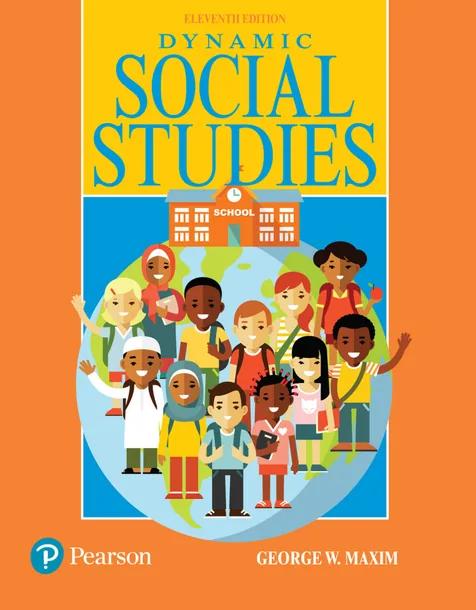
Dynamic Social Studies
by George W. Maxim
11th Edition
Publisher: Pearson
Book Details
| Print ISBN | 9780134286716 |
| eText ISBN | 9780134286709 |
| Publisher | Pearson |
| Publishing Year | 2018 |
| Edition | 11th Edition |
| Language | English |
Dynamic Social Studies, 11th Edition, is an elementary social studies textbook by George W. Maxim, published by Pearson with a 2018 copyright. It introduces the subject's origin, erosion, and rebirth alongside instructional practices that support democratic classroom communities.
Coverage outlines curriculum design, constructivist teaching methods, diverse learning resources, and pedagogy across six core social sciences. In its examination of cognitive constructivism, for instance, the text spotlights project-based learning alongside inquiry-based learning and creative problem solving.
The volume details how educators construct unit plans and lesson plans while addressing differentiated instruction. It links foundational instructional planning directly to disciplinary teaching in history, geography, civics, economics, sociology, and anthropology.
Table of Contents
Chapter 1: Social Studies: The Subject You Will Teach
- • Memories of Elementary School Social Studies
- • Attribute 1: Social Studies as a School Subject
- • Attribute 2: The Origin, Erosion, and Rebirth of Social Studies
- • Attribute 3: Instructional Practices That Promote and Support Learning
- • Attribute 4: Democratic Classroom Communities
- • A Final Thought
- • References
Chapter 2: Effective Instructional Planning
- • What Is Instructional Planning?
- • How Are Unit Plans Constructed?
- • How Are Lesson Plans Constructed?
- • What Is Differentiated Instruction?
- • A Final Thought
- • References
Chapter 3: Social Constructivism: Constructing Meaning via Collaborative Encounters
- • Constructivism as a Way of Thinking and Learning
- • Task 1: A Meaningful and Purposeful Learning Context
- • Task 2: Engaging Students with Quality Instructional Resources
- • Task 3: Using Language Processes to Scaffold Learning
- • Task 4: Organizing and Communicating Ideas with Graphic Organizers
- • Task 5: Breaking Down Concepts for Explicit, Focused Group Instruction
- • Task 6: Modeling as a Scaffolding Technique
- • Task 7: Collaborating and Cooperating with Peers as MKOs
- • Task 8: Scaffolding Learning with Computers as MKOs
- • A Final Thought
- • References
Chapter 4: Cognitive Constructivism: A Spotlight on Project-Based Learning
- • Cognitive Constructivism
- • Project-Based Learning (PBL)
- • Inquiry-Based Learning
- • Creative Problem Solving (CPS)
- • A Final Thought
- • References
Chapter 5: Beyond the Ordinary: Teaching and Learning with Concrete Instructional Resources
- • Authentic Learning
- • Field Trips
- • Classroom Visitors
- • Realia
- • The Arts
- • Games
- • A Final Thought
- • References
Chapter 6: Beyond the Ordinary: Teaching and Learning with Representational Instructional Resources
- • Educational Technology in the Classroom
- • Pictures and Study Prints
- • Simulations
- • A Final Thought
- • References
Chapter 7: Beyond the Ordinary: Teaching and Learning with Informational and Persuasive Text
- • What Is Informational Text?
- • Social Studies Textbooks
- • Informational Books
- • Biographies
- • Newspapers
- • Strategies for Reading Informational Text
- • What Is Persuasive Text?
- • A Final Thought
- • References
Chapter 8: Beyond the Ordinary: Teaching and Learning with Narrative Text
- • Personal Narratives
- • Historical Fiction
- • Folktales
- • Poetry
- • A Final Thought
- • References
Chapter 9: Young Historians: Learning to Unlock the Past
- • History in Focus
- • Chronological Thinking
- • Historical Comprehension
- • Historical Analysis and Interpretation
- • Historical Research Capabilities
- • Historical Issues Analysis and Decision Making
- • An Integration of Knowledge and Ideas
- • A Final Thought
- • References
Chapter 10: Geography: Exploring the People—Place Connection
- • Geography in Focus
- • Essential Element 1: The World in Spatial Terms
- • Essential Element 2: Places and Regions
- • Essential Element 3: Physical Systems
- • Essential Element 4: Human Systems
- • Essential Element 5: Environment and Society
- • Essential Element 6: The Uses of Geography
- • A Final Thought
- • References
Chapter 11: Civics: Young Citizens in Action
- • Civics In Focus
- • What Is Government and What Should It Do?
- • What Are the Basic Values and Principles of American Democracy?
- • How Does the Government Established by the Constitution Embody the Purposes, Values, and Principles of American Democracy?
- • What Is the Relationship of the United States to Other Nations and to World Affairs?
- • What Are the Roles of the Citizen in American Democracy?
- • A Final Thought
- • References
Chapter 12: Economics: Thinking and Choosing Responsibly
- • Economics Literacy
- • Six Core Economic Principles
- • A Final Thought
- • References
Chapter 13: Sociology and Anthropology: Social Structures and Culture
- • What Is Anthropology?
- • Teaching Anthropology in the Elementary School
- • Multicultural Education
- • What Is Sociology?
- • Teaching Sociology in the Elementary School
- • A Final Thought
- • References
Customer Reviews
0.0
0 reviews
No reviews yet. Be the first to review this book!
Write a Review
Reviewed by GradeFocus Editorial Team