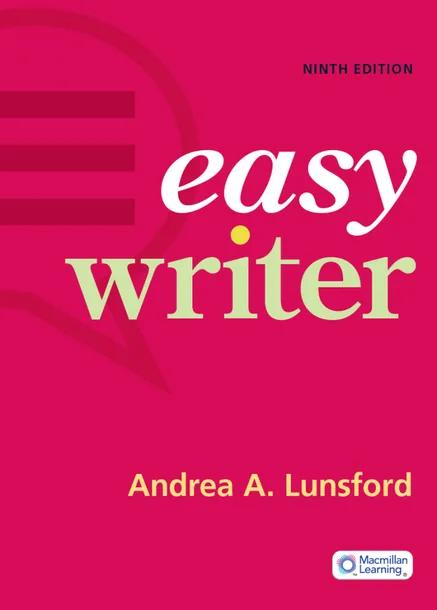
EasyWriter
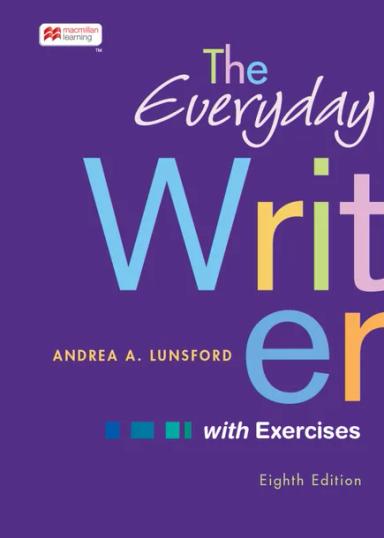
by Andrea A. Lunsford
9th Edition
Publisher: Bedford/St. Martin's
Book Details
| Print ISBN | 9781319476755 |
| eText ISBN | 9781319601270 |
| Publisher | Bedford/St. Martin's |
| Publishing Year | 2026 |
| Edition | 9th Edition |
| Language | English |
| Pages | 448 |
EasyWriter 9th Edition by Andrea A. Lunsford is an English composition textbook published by Bedford/St. Martin's. Designed specifically for college students and higher education instructors, this text establishes practical principles for clear academic writing across introductory college courses.
The volume structures its instruction around essential writing processes, presenting clear phases for exploring ideas, planning outlines, drafting prose, revising content, editing mechanics, and reflecting on finished papers. To support active comprehension, the handbook introduces critical reading strategies that emphasize annotating source materials, preparing summaries, and conducting formal rhetorical analysis. Additional sections explain techniques for building ethical and persuasive argumentation in student essays.
Beyond traditional drafting, the reference addresses overall document presentation by detailing specific design choices, visual media selection, ethical visual use, and document accessibility considerations. These combined instruction areas establish a supportive framework for postsecondary writers engaging in varied classroom writing projects.
Table of Contents
Chapter 1: Why Write?
- • a Write to connect
- • b Write to survive
- • c Write to define and discover
- • d Write to succeed
Chapter 2: A Writer’s Opportunities
- • a Recognize opportunities
- • b Be open to difference
- • c Use social media wisely
- • d Use AI tools wisely
- • e Position yourself as an academic writer
- • f Collaborate with others
- • g Take advantage of low-stakes writing assignments
Chapter 3: A Writer’s Choices
- • a Take responsibility
- • b Consider assignment and purpose
- • c Choose a topic
- • d Identify your audience
- • e Consider stance and tone
- • f Consider language
- • g Consider time, genre, medium, and format
Chapter 4: Exploring, Planning, and Drafting
- • a Explore a topic
- • b Develop a working thesis
- • c Do research and gather credible evidence
- • d Plan and draft
- • e Develop paragraphs
- • f Draft strong introductions and conclusions
Chapter 5: Making Design Decisions
- • a Lay out text
- • b Consider accessibility
- • c Choose visuals and media
- • d Use visuals and media ethically
Chapter 6: Reviewing, Revising, Editing, and Reflecting
- • a Review your writing
- • b Revise your writing
- • c Edit and proofread your writing
- • d Reflect on your writing
Chapter 7: Building Confidence for College Reading
- • a Identify your purpose for reading
- • b Use tools and technologies to your advantage
- • c Preview the text
- • d Annotate the text
Chapter 8: Reading Critically and Analytically
- • a Ask critical questions as you preview a text
- • b Annotate to begin an analysis
- • c Read collaboratively
- • d Summarize the text
- • e Analyze the text
- • f Student writing: Rhetorical analysis
Chapter 9: Arguing Ethically and Persuasively
- • a Read and listen openly
- • b Identify basic appeals in an argument
- • c Analyze the elements of an argument
- • d Argue purposefully
- • e Make an argument
- • f Organize your argument
- • g Student writing: Argument essay
Chapter 10: Writing in a Variety of Disciplines and Genres
- • a Recognize expectations of academic disciplines
- • b Understand genres
- • c Adapt genre structures
- • d Choose genres for public writing
- • e Student writing: Samples in a variety of disciplines and genres
Chapter 11: Creating Presentations
- • a Consider task, purpose, and audience
- • b Write a memorable introduction and conclusion
- • c Use explicit structure and signpost language
- • d Plan visuals
- • e Practice
- • f Deliver the presentation
- • g Student writing: Excerpts from a presentation
Chapter 12: Conducting Research
- • a Understand the challenges to research today
- • b Begin the research process
- • c Choose among types of sources
- • d Use web and library research
- • e Use generative AI for research
- • f Do field research
Chapter 13: Evaluating Sources and Taking Notes
- • a Check facts
- • b Read vertically
- • c Read laterally
- • d Read and analyze sources
- • e Synthesize sources
- • f Keep track of sources
- • g Work with quotations, paraphrases, and summaries
- • h Create an annotated bibliography
- • i Student writing: Annotated bibliography
Chapter 14: Integrating Sources and Avoiding Plagiarism
- • a Use sources ethically
- • b Integrate quotations, paraphrases, and summaries
- • c Integrate visuals and media
- • d Know which sources to acknowledge
- • e Avoid plagiarism
Chapter 15: Writing a Research Project
- • a Draft your text, including illustrations
- • b Review and revise a research project
- • c Prepare a list of sources
- • d Edit and proofread
- • e Student writing: Outline for a research project
Chapter 16: MLA Style
- • a Understand MLA citation style
- • b Consider the context of your sources
- • c Follow MLA format
- • d Create MLA in-text citations
- • e Create an MLA list of works cited
- • f Student writing: Research essay, MLA style
Chapter 17: APA Style
- • a Understand APA citation style
- • b Follow APA format
- • c Create APA in-text citations
- • d Create an APA list of references
- • e Student writing: Research essay, APA style
Chapter 18: Chicago Style
- • a Understand Chicago citation style
- • b Follow Chicago format
- • c Create Chicago notes and bibliographic entries
- • d Student writing: Research essay (excerpt), Chicago style
Chapter 19: Language and Identity
- • a Recognize how the language of others can shape identity
- • b Use language to shape your own identity
Chapter 20: Writing across Cultures, Communities, and Identities
- • a Communicate respectfully and inclusively
- • b Clarify meaning
- • c Meet audience expectations
Chapter 21: Language That Builds Connections
- • a Examine assumptions and avoid stereotypes
- • b Examine assumptions about gender
- • c Examine assumptions about race and ethnicity
- • d Consider abilities and disabilities
Chapter 22: Language Varieties
- • a Practice language awareness
- • b Experiment with language varieties
- • c Bring in other languages
Chapter 23: Word Choice
- • a Choose among levels of formality
- • b Consider denotation and connotation
- • c Use general and specific language effectively
- • d Use figurative language effectively
Chapter 24: Varying Sentences
- • a Vary sentence length
- • b Vary sentence openings
Chapter 25: Consistency and Completeness
- • a Revise confusing sentence structure
- • b Match subjects and predicates
- • c Make complete comparisons
Chapter 26: Coordination and Subordination
- • a Relate equal ideas
- • b Distinguish main ideas
Chapter 27: Conciseness
- • a Eliminate redundant words
- • b Eliminate empty words
- • c Replace wordy phrases
- • d Simplify sentence structure
Chapter 28: Parallelism
- • a Make items in a series or list parallel
- • b Make paired ideas parallel
- • c Use words necessary for clarity
Chapter 29: Shifts
- • a Revise shifts in tense
- • b Revise shifts in voice
- • c Revise shifts in point of view
- • d Revise shifts between direct and indirect discourse
Chapter 30: What Is “Standardized” English?
- • a Understand how languages are shaped—and reshaped
- • b Ask: What does standardized language have to do with me?
Chapter 31: Top Twenty Tips for Editing Your Writing
Chapter 32: Verbs and Verb Phrases
- • a Understand regular and irregular verb forms
- • b Build verb phrases
- • c Choose between infinitives and gerunds
- • d Understand lie and lay, sit and set, rise and raise
- • e Choose verb tenses to fit your meaning
- • f Choose active or passive voice
- • g Use mood appropriately
Chapter 33: Nouns and Noun Phrases
- • a Understand count and noncount nouns
- • b Choose determiners
- • c Choose the best article
Chapter 34: Subject-Verb Agreement
- • a Check for words between subject and verb
- • b Check agreement with compound subjects
- • c Make verbs agree with collective nouns
- • d Make verbs agree with indefinite pronouns
- • e Make verbs agree with who, which, and that
- • f Make linking verbs agree with subjects
- • g Make verbs agree with subjects that end in -s
- • h Check for subjects that follow the verb
- • i Make verbs agree with titles and words used as words
- • j Consider forms of be in varieties of English
Chapter 35: Adjectives and Adverbs
- • a Use adjectives after linking verbs
- • b Understand comparatives and superlatives
Chapter 36: Modifier Placement
- • a Revise misplaced modifiers
- • b Revise disruptive modifiers
- • c Revise dangling modifiers
Chapter 37: Pronouns
- • a Consider a pronoun’s role in the sentence
- • b Make pronouns agree with antecedents
- • c Make pronouns refer to clear antecedents
Chapter 38: Prepositions and Prepositional Phrases
- • a Choose the right preposition
- • b Use two-word verbs idiomatically
Chapter 39: Comma Splices and Fused Sentences
- • a Separate the clauses into two sentences
- • b Link the clauses with a comma and a coordinating conjunction
- • c Link the clauses with a semicolon
- • d Rewrite the two clauses as one independent clause
- • e Rewrite one independent clause as a dependent clause
- • f Link the two clauses with a dash
Chapter 40: Sentence Fragments
- • a Identify sentence fragments
- • b Revise phrase fragments
- • c Revise compound-predicate fragments
- • d Revise clause fragments
Chapter 41: Commas
- • a Set off introductory elements
- • b Separate clauses in compound sentences
- • c Set off nonrestrictive elements
- • d Separate items in a series
- • e Set off parenthetical and transitional expressions
- • f Set off contrasting elements, interjections, direct address, and tag questions
- • g Set off parts of dates and addresses
- • h Set off quotations
- • i Avoid unnecessary commas
Chapter 42: Semicolons
- • a Link independent clauses
- • b Separate items in a series containing other punctuation
- • c Avoid misusing semicolons
Chapter 43: End Punctuation
- • a Periods
- • b Question marks
- • c Exclamation points
- • d Understand end punctuation in informal writing
Chapter 44: Apostrophes
- • a Signal possessive case
- • b Signal contractions
- • c Understand apostrophes and plural forms
Chapter 45: Quotation Marks
- • a Signal a direct quotation
- • b Identify titles of short works
- • c Use quotation marks with other punctuation
- • d Avoid misusing quotation marks
Chapter 46: Other Punctuation
- • a Parentheses
- • b Brackets
- • c Dashes
- • d Colons
- • e Slashes
- • f Ellipses
- • g Emoticons, emojis, and tone indicators
Chapter 47: Capital Letters
- • a Capitalize the first word of a sentence
- • b Capitalize proper nouns and proper adjectives
- • c Capitalize titles before proper names
- • d Capitalize titles of works
- • e Revise unnecessary capitalization
Chapter 48: Abbreviations and Numbers
- • a Use abbreviations
- • b Use numbers
Chapter 49: Italics and Hyphens
- • a Italicize titles
- • b Italicize words, letters, and numbers used as terms
- • c Italicize non-English words
- • d Use italics for emphasis—occasionally
- • e Use hyphens with compound words
- • f Avoid unnecessary hyphens
Customer Reviews
0.0
0 reviews
No reviews yet. Be the first to review this book!
Write a Review
Reviewed by GradeFocus Editorial Team
▶Research Sources (14)
- EasyWriter
- eBook Details | Bulldog Depot
- Untitled
- EasyWriter 9th Edition | Andrea A. Lunsford
- EasyWriter (Spiral-bound) by Andrea Lunsford - Buy, Rent or Sell
- Thompson Learn.
- This item is unavailable
- EasyWriter
- EasyWriter, 9th Edition | Macmillan Learning US
- Easywriter | Rent | 9781319476755
- Easywriter : Andrea A. Lunsford (author), : 9781319476755
- EasyWriter 8th Edition Overview | PDF | English Language | Dialect
- Easy writer : a pocket reference : Lunsford, Andrea A., 1942
- EasyWriter Ninth Edition - Andrea Lunsford - 9781319476755 - Knygos