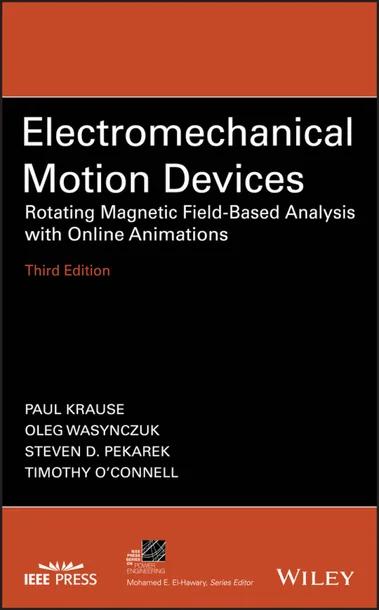
Electromechanical Motion Devices
Rotating Magnetic Field-Based Analysis with Online Animations
by Paul Krause, Oleg Wasynczuk, Steven D. Pekarek
3rd Edition
Publisher: Wiley-IEEE Press
Book Details
| Print ISBN | 9781119489825 |
| eText ISBN | 9781119489832 |
| Publisher | Wiley-IEEE Press |
| Publishing Year | 2020 |
| Edition | 3rd Edition |
| Language | English |
| Pages | 448 |
Electromechanical Motion Devices, 3rd Edition, provides an introduction to electric machines and their operational theory. The volume examines modern electromechanical devices alongside applications in hybrid and electric vehicles.
The textbook presents Nikola Tesla's rotating magnetic field as the foundation for reference frame theory. The authors review direct-current machines, induction machines, synchronous machines, and permanent-magnet alternating-current devices.
Prepared for electrical engineering students and practicing engineers in automotive and utility engineering, the text includes illustrative examples, practice problems, and online animations to support study.
Table of Contents
Chapter 1: Magnetic and Magnetically Coupled Circuits
- • 1.1 Introduction
- • 1.2 Phasor Analysis
- • 1.3 Magnetic Circuits
- • 1.4 Properties of Magnetic Materials
- • 1.5 Stationary Magnetically Coupled Circuits
- • 1.6 Open- and Short-Circuit Characteristics of Stationary Magnetically Coupled Circuits
- • 1.7 Magnetic Systems with Mechanical Motion
- • 1.8 Recapping
Chapter 2: Electromechanical Energy Conversion
- • 2.1 Introduction
- • 2.2 Energy Balance Relationships
- • 2.3 Energy in Coupling Field
- • 2.4 Graphical Interpretation of Energy Conversion
- • 2.5 Electromagnetic and Electrostatic Forces
- • 2.6 Operating Characteristics of an Elementary Electromagnet
- • 2.7 Single-Phase Reluctance Machine
- • 2.8 Windings in Relative Motion
- • 2.9 Recapping
Chapter 3: Direct-Current Machines and the Dc Drive
- • 3.1 Introduction
- • 3.2 Elementary Direct-Current Machine
- • 3.3 Voltage and Torque Equations
- • 3.4 Permanent-Magnet DC Machine
- • 3.5 Time-Domain Block Diagram and State Equations for the Permanent-Magnet DC Machine
- • 3.6 Dynamic Characteristics of Permanent-Magnet DC Motors
- • 3.7 DC Drive
- • 3.8 Recapping
Chapter 4: Winding Distribution and Tesla’s Rotating Magnetic Field
- • 4.1 Introduction
- • 4.2 Winding Distribution
- • 4.3 Air-Gap MMF
- • 4.4 Tesla’s Rotating Magnetic Field – Symmetrical Stator Circuits
- • 4.5 Tesla’s Rotating Fields and Torque with Unsymmetrical and Symmetrical Rotor Circuits
- • 4.6 P-Pole Machines
- • 4.7 Recapping
Chapter 5: Introduction to Reference Frame Theory
- • 5.1 Introduction
- • 5.2 Background
- • 5.3 Change of Variables for Symmetrical Stator Circuits
- • 5.4 Transformation of Two-Phase Stator Variables to the Arbitrary Reference Frame
- • 5.5 Balanced Steady-State Stator Variables Viewed from any Reference Frame
- • 5.6 Stator Variables Observed from Different Reference Frames
- • 5.7 Instantaneous Phasor
- • 5.8 Transformation of Three-Phase Stator Variables to the Arbitrary Reference Frame
- • 5.9 Substitute Variables for Symmetrical Rotating Circuits
- • 5.10 Recapping
Chapter 6: Permanent-Magnet AC Machine and Field Orientation of a Brushless DC Drive
- • 6.1 Introduction
- • 6.2 Two-Phase Permanent-Magnet AC Machine
- • 6.3 Voltage Equations and Winding Inductances
- • 6.4 Torque
- • 6.5 Machine Equations in the Rotor Reference Frame
- • 6.6 Instantaneous and Steady-State Phasors
- • 6.7 Three-Phase Permanent-Magnet AC Machine
- • 6.8 Unequal Direct- and Quadrature-Axis Inductances
- • 6.9 Field Orientation of a Brushless DC Drive
- • 6.10 Inverter-Supplied Brushless DC Drive
- • 6.11 Recapping
Chapter 7: Synchronous Machines
- • 7.1 Introduction
- • 7.2 Windings of the Synchronous Machine
- • 7.3 Two-Phase Round-Rotor Synchronous Machine
- • 7.4 Analysis of Steady-State Operation
- • 7.5 Analysis of Steady-State Operation in Power Systems
- • 7.6 Two-Phase Reluctance Machine
- • 7.7 Dynamic and Steady-State Performance
- • 7.8 Three-Phase Round-Rotor Synchronous Machine
- • 7.9 Recapping
Chapter 8: Symmetrical Induction Machines and Field Orientation
- • 8.1 Introduction
- • 8.2 Two-Phase Induction Machine
- • 8.3 Voltage Equations and Winding Inductances
- • 8.4 Torque
- • 8.5 Voltage Equations in the Arbitrary Reference Frame
- • 8.6 Magnetically Linear Flux-Linkage Equations and Equivalent Circuits
- • 8.7 Torque Equations in Arbitrary Reference Frame Variables
- • 8.8 Phasors and Steady-State Operating Modes
- • 8.9 Dynamic and Steady-State Performance – Machine Variables
- • 8.10 Free Acceleration Viewed from Stationary, Rotor, and Synchronously Rotating Reference Frames
- • 8.11 Three-Phase Induction Machine
- • 8.12 Principles of Field Orientation
- • 8.13 Recapping
Chapter 9: Stepper Motors
- • 9.1 Introduction
- • 9.2 Basic Configurations of Multistack Variable-Reluctance Stepper Motors
- • 9.3 Equations for Multistack Variable-Reluctance Stepper Motors
- • 9.4 Operating Characteristics of Multistack Variable-Reluctance Stepper Motors
- • 9.5 Single-Stack Variable-Reluctance Stepper Motors
- • 9.6 Basic Configuration of Permanent-Magnet Stepper Motors
- • 9.7 Equations for Permanent-Magnet Stepper Motors
- • 9.8 Equations of Permanent-Magnet Stepper Motors in Rotor Reference Frame – Reluctance Torques Neglected
- • 9.9 Recapping
Chapter 10: Power Electronics
- • 10.1 Introduction
- • 10.2 Switching-Circuit Fundamentals
- • 10.3 DC–DC Conversion
- • 10.4 AC–DC Conversion
- • 10.5 DC–AC Conversion
- • 10.6 Recapping
Chapter Appendix A: Appendix A
Chapter Appendix B: Appendix B
Customer Reviews
0.0
0 reviews
No reviews yet. Be the first to review this book!
Write a Review
Reviewed by GradeFocus Editorial Team
Related Books

Electronics Use in Harsh Environments
Rajan Ambat

Digital Design using VerilogHDL
Shilpi Birla
Artificial Intelligence Empowered Smart Energy Systems
Qiang Yang

Stability Analysis of Converter-Rich Power Grids
Jun Liang
Multiphase Power Electronic Converters
Salman Ahmad
Robust Dynamic State Estimation of Power Systems
Junbo Zhao