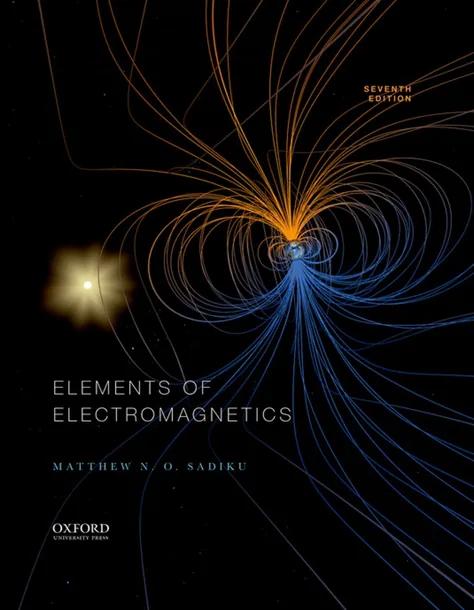
Elements of Electromagnetics
by Matthew N. O. Sadiku
7th Edition
Publisher: Oxford University Press
Book Details
| Print ISBN | 9780190698614 |
| eText ISBN | 9780190698669 |
| Publisher | Oxford University Press |
| Publishing Year | 2018 |
| Edition | 7th Edition |
| Language | English |
| Pages | 920 |
Elements of Electromagnetics, 7th Edition, is an engineering textbook by Matthew N. O. Sadiku that presents electromagnetic field theory and its practical applications.
Using a vectors-first approach, the volume provides a balanced treatment of static and time-varying fields. The text addresses vector analysis, coordinate systems, electrostatic fields, magnetostatics, and Maxwell's equations. It also examines wave propagation alongside key engineering applications, such as transmission lines, waveguides, and antennas.
Designed to help prepare students for employment in industrial and manufacturing sectors, the book includes worked examples in every chapter to demonstrate how theoretical concepts apply to different types of problems.
Table of Contents
Chapter 1: VECTOR ALGEBRA
- • 1.1 Introduction
- • 1.2 A Preview of the Book
- • 1.3 Scalars and Vectors
- • 1.4 Unit Vector
- • 1.5 Vector Addition and Subtraction
- • 1.6 Position and Distance Vectors
- • 1.7 Vector Multiplication
- • 1.8 Components of a Vector
- • Summary
- • Review Questions
- • Problems
Chapter 2: COORDINATE SYSTEMS AND TRANSFORMATION
- • 2.1 Introductio
- • 2.2 Cartesian Coordinates (x, y, z)
- • 2.3 Circular Cylindrical Coordinates (r, f, z)
- • 2.4 Spherical Coordinates (r, u, f)
- • 2.5 Constant-Coordinate Surfaces
- • Summary
- • Review Questions
- • Problems
Chapter 3: VECTOR CALCULUS
- • 3.1 Introduction
- • 3.2 Differential Length, Area, and Volume
- • 3.3 Line, Surface, and Volume Integrals
- • 3.4 Del Operator
- • 3.5 Gradient of a Scalar
- • 3.6 Divergence of a Vector and Divergence Theorem
- • 3.7 Curl of a Vector and Stokes's Theorem
- • 3.8 Laplacian of a Scalar
- • 3.9 Classification of Vector Fields
- • Summary
- • Review Questions
- • Problems
Chapter 4: ELECTROSTATIC FIELDS
- • 4.1 Introduction
- • 4.2 Coulomb's Law and Field Intensity
- • 4.3 Electric Fields Due to Continuous Charge Distributions
- • 4.4 Electric Flux Density
- • 4.5 Gauss's Law-Maxwell's Equation
- • 4.6 Applications of Gauss's Law
- • 4.7 Electric Potential
- • 4.8 Relationship between E and V-Maxwell's Equation
- • 4.9 An Electric Dipole and Flux Lines
- • 4.10 Energy Density in Electrostatic Fields
- • 4.11 Application Note-Electrostatic Discharge
- • Summary
- • Review Questions
- • Problems
Chapter 5: ELECTRIC FIELDS IN MATERIAL SPACE
- • 5.1 Introduction
- • 5.2 Properties of Materials
- • 5.3 Convection and Conduction Currents
- • 5.4 Conductors
- • 5.5 Polarization in Dielectrics
- • 5.6 Dielectric Constant and Strength
- • 5.7 Linear, Isotropic, and Homogeneous Dielectrics
- • 5.8 Continuity Equation and Relaxation Time
- • 5.9 Boundary Conditions
- • 5.10 Application Note-High Dielectric Constant Materials
- • 5.11 Application Note-Graphene
- • 5.12 Application Note - Piezoelectrics
- • Summary
- • Review Questions
- • Problems
Chapter 6: ELECTROSTATIC BOUNDARY-VALUE PROBLEMS
- • 6.1 Introduction
- • 6.2 Poisson's and Laplace's Equations
- • 6.3 Uniqueness Theorem
- • 6.4 General Procedures for Solving Poisson's or Laplace's Equation
- • 6.5 Resistance and Capacitance
- • 6.6 Method of Images
- • 6.7 Application Note-Capacitance of Microstrip Lines
- • 6.8 Application Note-RF MEMS
- • 6.9 Application NOte-Supercapacitors
- • Summary
- • Review Questions
- • Problems
Chapter 7: MAGNETOSTATIC FIELDS
- • 7.1 Introduction
- • 7.2 Biot-Savart's Law
- • 7.3 Ampère's Circuit Law-Maxwell's Equation
- • 7.4 Applications of Ampère's Law
- • 7.5 Magnetic Flux Density-Maxwell's Equation
- • 7.6 Maxwell's Equations for Static Fields
- • 7.7 Magnetic Scalar and Vector Potentials
- • 7.8 Derivation of Biot-Savart's Law and Ampère's Law
- • 7.9 Application Note-Lightning
- • 7.10 Application Note-Polywell
- • Summary
- • Review Questions
- • Problems
Chapter 8: MAGNETIC FORCES, MATERIALS, AND DEVICES
- • 8.1 Introduction
- • 8.2 Forces Due to Magnetic Fields
- • 8.3 Magnetic Torque and Moment
- • 8.4 A Magnetic Dipole
- • 8.5 Magnetization in Materials
- • 8.6 Classification of Materials
- • 8.7 Magnetic Boundary Conditions
- • 8.8 Inductors and Inductances
- • 8.9 Magnetic Energy
- • 8.10 Magnetic Circuits
- • 8.11 Force on Magnetic Materials
- • 8.12 Application Note-Magnetic Levitation
- • 8.13 Application Note-SQUIDs
- • Summary
- • Review Questions
- • Problems
Chapter 9: MAXWELL'S EQUATIONS
- • 9.1 Introduction
- • 9.2 Faraday's Law
- • 9.3 Transformer and Motional Electromotive Forces
- • 9.4 Displacement Current
- • 9.5 Maxwell's Equations in Final Forms
- • 9.6 Time-Varying Potentials
- • 9.7 Time-Harmonic Fields
- • 9.8 Application Note-Memristor
- • 9.9 Application Note-Optical Nanocircuits
- • 9.10 Application Note-Wireless Power Transfer and Qi Standard
- • Summary
- • Review Questions
- • Problems
Chapter 10: ELECTROMAGNETIC WAVE PROPAGATION
- • 10.1 Introduction
- • 10.2 Waves in General
- • 10.3 Wave Propagation in Lossy Dielectrics
- • 10.4 Plane Waves in Lossless Dielectrics
- • 10.5 Plane Waves in Free Space
- • 10.6 Plane Waves in Good Conductors
- • 10.7 Wave Polarization
- • 10.8 Power and the Poynting Vector
- • 10.9 Reflection of a Plane Wave at Normal Incidence
- • 10.10 Reflection of a Plane Wave at Oblique Incidence
- • 10.11 Application Note-Microwaves
- • 10.12 Application Note-60 GHz Technology
- • Summary
- • Review Questions
- • Problems
Chapter 11: TRANSMISSION LINES
- • 11.1 Introduction
- • 11.2 Transmission Line Parameters
- • 11.3 Transmission Line Equations
- • 11.4 Input Impedance, Standing Wave Ratio, and Power
- • 11.5 The Smith Chart
- • 11.6 Some Applications of Transmission Lines
- • 11.7 Transients on Transmission Lines 574
- • 11.8 Application Notes-Microstrip Lines and Characterization of Data Cables
- • 11.9 Application Note-Metamaterials
- • 11.10 Application Note-Microwave Imaging
- • Summary
- • Review Questions
- • Problems
Chapter 12: WAVEGUIDES
- • 12.1 Introduction
- • 12.2 Rectangular Waveguides
- • 12.3 Transverse Magnetic (TM) Modes
- • 12.4 Transverse Electric (TE) Modes
- • 12.5 Wave Propagation in the Guide
- • 12.6 Power Transmission and Attenuation
- • 12.7 Waveguide Current and Mode Excitation
- • 12.8 Waveguide Resonators
- • 12.9 Application Note-Optical Fiber
- • 12.10 Application Note-Cloaking and Invisibility
- • Summary
- • Review Questions
- • Problems
Chapter 13: ANTENNAS
- • 13.1 Introduction
- • 13.2 Hertzian Dipole
- • 13.3 Half-Wave Dipole Antenna
- • 13.4 Quarter-Wave Monopole Antenna
- • 13.5 Small-Loop Antenna
- • 13.6 Antenna Characteristics
- • 13.7 Antenna Arrays
- • 13.8 Effective Area and the Friis Equation
- • 13.9 The Radar Equation
- • 13.10 Application Note-Electromagnetic Interference and Compatibility
- • 13.11 Application Note-Textile Antennas and Sensors
- • 13.12 Application Note-Fractal Antennas
- • Summary
- • Review Questions
- • Problems
Chapter 14: NUMERICAL METHODS
- • 14.1 Introduction
- • 14.2 Field Plotting
- • 14.3 The Finite Difference Method
- • 14.4 The Moment Method
- • 14.5 The Finite Element Method
- • 14.6 Application Note-Microstrip Lines
- • Summary
- • Review Questions
- • Problems
Chapter APPENDIX A: Mathematical Formulas
Chapter APPENDIX B: Material Constants
Chapter APPENDIX C: MATLAB
Chapter APPENDIX D: The Complete Smith Chart
Chapter APPENDIX E: Answers to Odd-Numbered Problems
Customer Reviews
0.0
0 reviews
No reviews yet. Be the first to review this book!
Write a Review
Reviewed by GradeFocus Editorial Team
▶Research Sources (1)
Related Books

Electronics Use in Harsh Environments
Rajan Ambat

Digital Design using VerilogHDL
Shilpi Birla

Artificial Intelligence Empowered Smart Energy Systems
Qiang Yang

Stability Analysis of Converter-Rich Power Grids
Jun Liang

Multiphase Power Electronic Converters
Salman Ahmad

Robust Dynamic State Estimation of Power Systems
Junbo Zhao