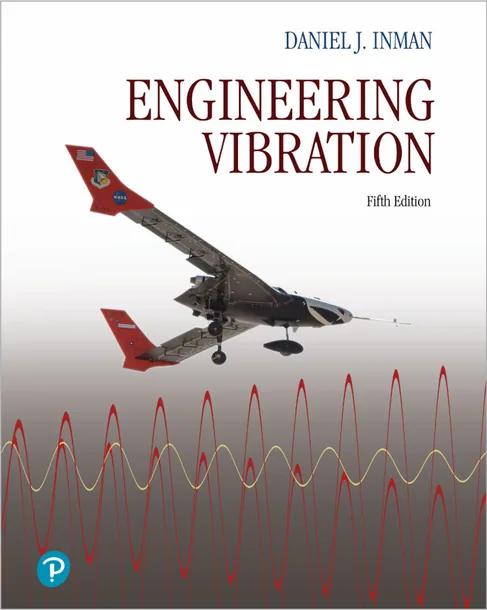
Engineering Vibration
by Daniel J. Inman
5th Edition
Publisher: Pearson
Book Details
| Print ISBN | 9780136809852 |
| eText ISBN | 9780136809616 |
| Publisher | Pearson |
| Publishing Year | 2021 |
| Edition | 5th Edition |
| Language | English |
Engineering Vibration, 5th Edition, provides an introduction to vibration analysis, design, measurement, and computation. The textbook connects traditional design-oriented topics and modal analysis with computational routines implemented in MATLAB.
Core chapters address free and forced responses to harmonic and general excitations, multiple-degree-of-freedom systems, and vibration suppression design. The text also investigates distributed-parameter media, experimental modal analysis, and introductory finite element modeling.
Special-interest windows summarize essential background information and pertinent formulas without interrupting practical study. For the 2021 edition, the volume incorporates new examples, figures, equations, enhanced problem statements, a units and conversion appendix, and MATLAB code updated to 2020 standards.
Table of Contents
Chapter 1: INTRODUCTION TO VIBRATION AND THE FREE RESPONSE
- • 1.1 Introduction to Free Vibration
- • 1.2 Harmonic Motion
- • 1.3 Viscous Damping
- • 1.4 Modeling and Energy Methods
- • 1.5 Stiffness
- • 1.6 Measurement
- • 1.7 Design Considerations
- • 1.8 Stability
- • 1.9 Numerical Integration of the Time Response
- • 1.10 Coulomb Friction and the Pendulum
- • Problems
Chapter 2: RESPONSE TO HARMONIC EXCITATION
- • 2.1 Harmonic Excitation of Undamped Systems
- • 2.2 Harmonic Excitation of Damped Systems
- • 2.3 Alternative Representations
- • 2.4 Base Excitation
- • 2.5 Rotating Unbalance
- • 2.6 Measurement Devices
- • 2.7 Other Forms of Damping
- • 2.8 Numerical Integration and Design
- • 2.9 Nonlinear Response Properties
- • Problems
Chapter 3: GENERAL FORCED RESPONSE
- • 3.1 Impulse Response Function
- • 3.2 Response to an Arbitrary Input
- • 3.3 Response to an Arbitrary Periodic Input
- • 3.4 Transform Methods
- • 3.5 Response to Random Inputs
- • 3.6 Shock Spectrum
- • 3.7 Measurement via Transfer Functions
- • 3.8 Stability
- • 3.9 Numerical Integration of the Response
- • 3.10 Nonlinear Response Properties
- • Problems
Chapter 4: MULTIPLE-DEGREE-OF-FREEDOM SYSTEMS
- • 4.1 Two-Degree-of-Freedom Model (Undamped)
- • 4.2 Eigenvalues and Natural Frequencies
- • 4.3 Modal Analysis
- • 4.4 More Than Two Degrees of Freedom
- • 4.5 Systems with Viscous Damping
- • 4.6 Modal Analysis of the Forced Response
- • 4.7 Lagrange’s Equations
- • 4.8 Examples
- • 4.9 Computational Eigenvalue Problems for Vibration
- • 4.10 Numerical Integration of the Time Response
- • Problems
Chapter 5: DESIGN FOR VIBRATION SUPPRESSION
- • 5.1 Acceptable Levels of Vibration
- • 5.2 Vibration Isolation
- • 5.3 Vibration Absorbers
- • 5.4 Damping in Vibration Absorption
- • 5.5 Optimization
- • 5.6 Viscoelastic Damping Treatments
- • 5.7 Critical Speeds of Rotating Disks
- • 5.8 Approximation and Scaling
- • Problems
Chapter 6: DISTRIBUTED-PARAMETER SYSTEMS
- • 6.1 Vibration of a String or Cable
- • 6.2 Modes and Natural Frequencies
- • 6.3 Vibration of Rods and Bars
- • 6.4 Torsional Vibration
- • 6.5 Bending Vibration of a Beam
- • 6.6 Vibration of Membranes and Plates
- • 6.7 Models of Damping
- • 6.8 Modal Analysis of the Forced Response
- • Problems
Chapter 7: VIBRATION TESTING AND EXPERIMENTAL MODAL ANALYSIS
- • 7.1 Measurement Hardware
- • 7.2 Digital Signal Processing
- • 7.3 Random Signal Analysis in Testing
- • 7.4 Modal Data Extraction
- • 7.5 Modal Parameters by Circle Fitting
- • 7.6 Mode Shape Measurement
- • 7.7 Vibration Testing for Endurance and Diagnostics
- • 7.8 Operational Deflection Shape Measurement
- • Problems
Chapter 8: FINITE ELEMENT METHOD
- • 8.1 Example: The Bar
- • 8.2 Three-Element Bar
- • 8.3 Beam Elements
- • 8.4 Lumped-Mass Matrices
- • 8.5 Trusses
- • 8.6 Model Reduction
- • Problems
Chapter APPENDICES: APPENDICES
- • A. COMPLEX NUMBERS AND FUNCTIONS
- • B. LAPLACE TRANSFORMS
- • C. MATRIX BASICS
- • D. THE VIBRATION LITERATURE
- • E. LIST OF SYMBOLS
- • F. CODES AND WEB SITES
- • G. UNITS AND CONVERSIONS
Chapter REFERENCES: REFERENCES
Chapter ANSWERS TO SELECTED PROBLEMS: ANSWERS TO SELECTED PROBLEMS
Customer Reviews
0.0
0 reviews
No reviews yet. Be the first to review this book!
Write a Review
Reviewed by GradeFocus Editorial Team
Related Books

Fundamentals of Thermal Fluid Sciences
Yunus A. Cengel
Manufacturing Processes for Engineering Materials
Serope Kalpakjian
Fundamentals of Engineering Thermodynamics
Michael J. Moran

Elementary Principles of Chemical Processes
Richard M. Felder

Precision Machining Technology
Peter J. Hoffman

Mechanical and Electrical Systems for Construction Managers
American Technical Publishers