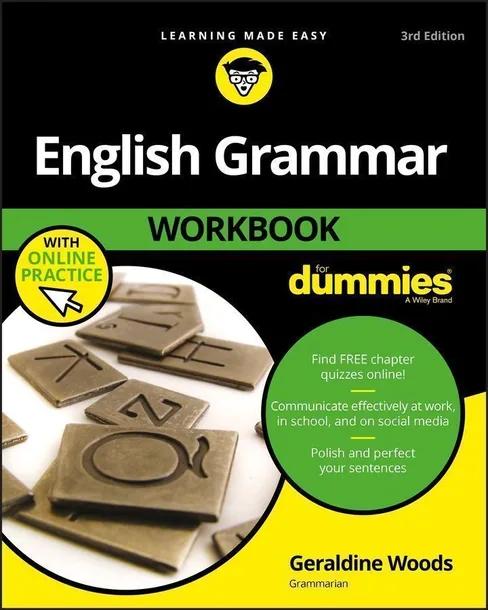
English Grammar Workbook For Dummies, with Online Practice
by Geraldine Woods
3rd Edition
Publisher: For Dummies
Book Details
| Print ISBN | 9781119455394 |
| eText ISBN | 9781119455431 |
| Publisher | For Dummies |
| Publishing Year | 2018 |
| Edition | 3rd Edition |
| Language | English |
English Grammar Workbook For Dummies, with Online Practice, 3rd Edition, by Geraldine Woods, provides lessons and practice exercises to reinforce essential grammar skills. Published by For Dummies, this workbook introduces fundamental rules governing parts of speech, sentence building, and everyday language usage.
Coverage outlines core principles of sentence construction, guiding learners through subject-verb agreement and the proper application of verb tenses. The text also explains foundational punctuation mechanics, including apostrophe and comma placement.
Designed to support clearer verbal and written communication, the text prepares readers for practical tasks ranging from drafting research papers and workplace presentations to participating in casual conversations.
Table of Contents
Chapter Introduction: Introduction
- • Foolish Assumptions
- • Icons Used in This Book
- • Beyond the Book
- • Where to Go from Here
Chapter 1: Tailoring Language to Suit Your Audience and Purpose
- • Climbing the Ladder of Language Formality
- • Matching Message to Situation
- • Answers to “Tailoring Language to Suit Your Audience and Purpose”
Chapter 2: Identifying the Major Elements of a Sentence
- • Going to the Heart of the Matter: The Verb
- • Treasure hunt: Finding the verb
- • Choosing the correct verb for negative expressions
- • Questioning with verbs
- • Aiding and abetting: Helping verbs
- • Zeroing in on the Subject
- • When one isn’t enough: Forming noun plurals
- • Adding Meaning: Objects and Complements
- • Answers to Questions about Major Elements of a Sentence
Chapter 3: Having It All: Writing Complete Sentences
- • Finding Subjects and Verbs that Match
- • Checking for Complete Thoughts
- • Improving Flow with Properly Joined Sentences
- • Setting the Tone with Endmarks
- • Proper Sentence or Not? That Is the Question
- • Calling All Overachievers: Extra Practice with Complete Sentences
- • Answers to Complete Sentence Problems
Chapter 4: Finding the Right Verb at the Right Time
- • Using Past, Present, and Future Tense at the Right Times
- • Putting Perfect Tenses in the Spotlight
- • Speaking of the Past and Things That Never Change
- • Romeo Lives! Writing about Literature and Art in Present Tense
- • Hitting Curveballs: Irregular Forms
- • Getting a Handle on Common Irregulars: Be and Have
- • Calling All Overachievers: Extra Practice with Verbs
- • Answers to Problems on Verbs and Verb Tenses
Chapter 5: Agreement: Choosing Singular or Plural Verbs and Pronouns
- • Meeting Their Match: Pairing Subjects and Verbs
- • Boning up on the basics
- • Taming the tough guys: Difficult subjects
- • Dealing with tricksters
- • Matching Pronouns and Antecedents
- • Calling All Overachievers: Extra Practice with Hitching Subjects and Verbs
- • Answers to Subject, Verb, and Pronoun Pairing Problems
Chapter 6: Solving Pronoun Case
- • Meeting the Subject at Hand and the Object of My Affection
- • To “Who” or To “Whom”? That Is the Question
- • You Talkin’ to Me, or I? Pronouns as Objects of Prepositions
- • Matching Possessive Pronouns to “-ing” Nouns
- • Missing in Action: Choosing Pronouns for Implied Comparisons
- • Calling All Overachievers: Extra Practice with Pronoun Case
- • Answers to Advanced Pronoun Problems
Chapter 7: Little Words Packing a Lot of Power: Prepositions and Interjections
- • Pinning Down Prepositions
- • Interjections Are Simple!
- • Calling All Overachievers: Extra Practice with Prepositions and Interjections
- • Answers to Questions About Prepositions and Interjections
Chapter 8: Writing Good or Well: Adjectives and Adverbs
- • Identifying Adjectives and Adverbs
- • The Right Place at the Right Time: Placing Adjectives and Adverbs
- • How’s It Going? Choosing Between Good/Well and Bad/Badly
- • Mastering the Art of Articles
- • For Better or Worse: Forming Comparisons
- • Visiting the -ER (and the -EST): One- or two-word comparisons
- • Going from bad to worse (and good to better): Irregular comparisons
- • Calling All Overachievers: Extra Practice with Descriptors
- • Answers to Adjective and Adverb Problems
Chapter 9: A Hook That Can Catch You: Apostrophes
- • Showing Who Owns What: Possessives
- • Tightening Up Text: Contractions
- • Calling All Overachievers: Extra Practice with Apostrophes
- • Answers to Apostrophe Problems
Chapter 10: “Can I Quote You on That?” Quotation Marks
- • Quoting and Paraphrasing: What’s the Difference?
- • Giving Voice to Direct Quotations
- • Punctuating Titles
- • Calling All Overachievers: Extra Practice with Quotation Marks
- • Answers to Quotation Problems
Chapter 11: Pausing to Consider the Comma
- • Keeping Lists in Order with Commas and Semicolons
- • Directly Addressing the Listener or Reader
- • Punctuating Dates and Addresses
- • Placing Commas in Combined Sentences
- • Inserting Extras with Commas: Introductions and Interruptions
- • Setting Descriptions Apart
- • Calling All Overachievers: Extra Practice with Commas
- • Answers to Comma Problems
Chapter 12: Handling Dashes, Hyphens, and Colons
- • Dashing Off
- • Helping Yourself to Hyphens
- • Coming to a Stop: Colons
- • Calling All Overachievers: Extra Practice with Dashes, Hyphens, and Colons
- • Answers to Problems on Dashes, Hyphens, and Colons
Chapter 13: Hitting the Big Time: Capital Letters
- • Paying Respect to People’s Names and Titles
- • Capitalizing the Right Time and Place
- • Working with Business and School Terms
- • Capitalizing Titles of Literary and Media Works
- • Managing Capital Letters in Abbreviations
- • Calling All Overachievers: Extra Practice with Capital Letters
- • Answers to Capitalization Problems
Chapter 14: Writing for Electronic Media
- • Knowing Your Audience: The Right Writing for the Right Situation
- • Shortening Your Message
- • Powering Up Your Presentation Slides
- • Calling All Overachievers: Extra Practice with Electronic Media
- • Answers to Electronic Media Problems
Chapter 15: Going for the Gold: The Finer Points of Verb Usage
- • Voicing an Opinion: Active and Passive Verbs
- • In the Mood: Selecting the Right Verb for All Sorts of Sentences
- • Indicating facts: Indicative mood
- • Issuing commands: Imperative mood
- • Telling lies: Subjunctive mood
- • Spicing Up Sentences by Adding Interesting Verbs
- • Calling All Overachievers: Extra Practice with Voice and Mood
- • Answers to Voice and Mood Problems
Chapter 16: Identifying Clauses and Their Effects
- • Locating Clauses
- • Sorting Independent and Subordinate Clauses
- • Making Clauses Work Together
- • Answers to Clause Problems
Chapter 17: Adding Style to Sentences
- • Speaking Verbally
- • Identifying verbals
- • Telling time with verbals
- • Playing with Sentence Patterns
- • Introductory elements
- • Combining ideas and changing word order
- • Calling All Overachievers: Extra Practice Honing Your Sentences
- • Answers to Sentence Improvement Problems
Chapter 18: Staying on Track: Parallel Writing
- • Geometry Meets English: Making Sentences Parallel
- • Staying in Gear: Avoiding Unnecessary Shifts
- • Following Special Rules for VIPs: Very Important Pairs
- • Drawing Parallel Comparisons
- • Calling All Overachievers: Extra Practice with Parallels
- • Answers to Parallelism Problems
Chapter 19: Steering Clear of Confusion: Clarity
- • Putting Descriptive Words in Their Proper Place
- • Inserting single-word descriptions
- • Relocating longer descriptions
- • Dangling descriptions
- • Getting caught in the middle: Vague descriptions
- • Avoiding Illogical Comparisons
- • Completing half-finished comparisons
- • Being smarter than yourself: Illogical comparisons
- • Making Sure Your Pronouns Are Meaningful
- • Calling All Overachievers: Extra Practice in Writing Clear Sentences
- • Answers to Clarity Problems
Chapter 20: Dealing with Grammar Demons
- • Dropping Double Negatives
- • Telling Word-Twins Apart
- • Distinguishing Between Commonly Confused Words
- • Counting and Measuring Grammatically
- • Taming Tricky Verbs
- • Banishing Bogus Expressions
- • Calling All Overachievers: Extra Practice with Tricky Words
- • Answers to Grammar Demon Problems
Chapter Appendix: Grabbing Grammar Goofs
Customer Reviews
0.0
0 reviews
No reviews yet. Be the first to review this book!
Write a Review
Reviewed by GradeFocus Editorial Team
▶Research Sources (4)
Related Books
From Inquiry to Academic Writing: A Practical Guide
Stuart Greene
Spoken English: The Basics
Michael McCarthy
A Cognitive Approach to English Grammar
N. P. Sudharshana
Introducing English Grammar
Kersti Börjars
ACT English Practice Questions
Vibrant Publishers
Practice Makes Perfect: English Conversation, Premium
Jean Yates