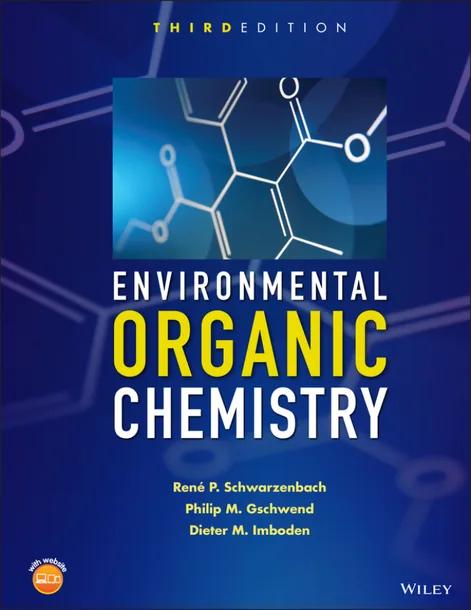
Environmental Organic Chemistry
by René P. Schwarzenbach, Philip M. Gschwend, Dieter M. Imboden
3rd Edition
Publisher: John Wiley & Sons P&T
Book Details
| Print ISBN | 9781118767238 |
| eText ISBN | 9781118767047 |
| Publisher | John Wiley & Sons P&T |
| Publishing Year | 2017 |
| Edition | 3rd Edition |
| Language | English |
| Pages | 1024 |
Environmental Organic Chemistry, 3rd Edition, is a textbook examining the molecular and macroscopic processes that govern the distribution and fate of organic chemicals in the environment. It introduces modeling tools to quantitatively describe these processes and their interplay within environmental systems.
The volume links core concepts in chemistry, physics, and mathematical modeling to environmentally relevant problems. It guides readers in relating chemical structure to physical-chemical properties and intrinsic reactivities, addressing phase partitioning, bulk phase equilibria, and transformation pathways across major environmental compartments.
Designed for course instruction and independent study, the text includes questions and problems that help teachers evaluate student comprehension and allow self-study readers to check their progress.
Table of Contents
Chapter 1: General Topic and Overview
- • 1.1 Introduction
- • 1.2 Assessing Organic Chemicals in the Environment
- • 1.3 What is This Book All About?
- • 1.4 Bibliography
Chapter 2: Background Knowledge on Organic Chemicals
- • 2.1 The Makeup of Organic Compounds
- • 2.2 Intermolecular Forces Between Uncharged Molecules
- • 2.3 Questions and Problems
- • 2.4 Bibliography
Chapter 3: The Amazing World of Anthropogenic Organic Chemicals
- • 3.1 Introduction
- • 3.2 A Lasting Global Problem: Persistent Organic Pollutants (POPs)
- • 3.3 Natural but Nevertheless Problematic: Petroleum Hydrocarbons
- • 3.4 Notorious Air and Groundwater Pollutants: Organic Solvents
- • 3.5 Safety First: Flame Retardants All Around Us
- • 3.6 How to Make Materials “Repellent”: Polyfluorinated Chemicals (PFCs)
- • 3.7 From Washing Machines to Surface Waters: Complexing Agents, Surfactants, Whitening Agents, and Corrosion Inhibitors
- • 3.8 Health, Well-Being, and Water Pollution: Pharmaceuticals and Personal Care Products
- • 3.9 Fighting Pests: Herbicides, Insecticides, and Fungicides
- • 3.10 Our Companion Compounds: Representative Model Chemicals
- • 3.11 Questions
- • 3.12 Bibliography
Chapter 4: Background Thermodynamics, Equilibrium Partitioning and Acidity Constants
- • 4.1 Important Thermodynamic Functions
- • 4.2 Using Thermodynamic Functions to Quantify Equilibrium Partitioning
- • 4.3 Organic Acids and Bases I: Acidity Constant and Speciation in Natural Waters
- • 4.4 Organic Acids and Bases II: Chemical Structure and Acidity Constant
- • 4.5 Questions and Problems
- • 4.6 Bibliography
Chapter 5: Earth Systems and ComPartments
- • 5.1 Introduction
- • 5.2 The Atmosphere
- • 5.3 Surface Waters and Sediments
- • 5.4 Soil and Groundwater
- • 5.5 Biota
- • 5.6 Questions
- • 5.7 Bibliography
Chapter 6: Environmental Systems: Physical Processes and Mathematical Modeling
- • 6.1 Systems and Models
- • 6.2 Box Models: A Concept for a Simple World
- • 6.3 When Space Matters: Transport Processes
- • 6.4 Models in Space and Time
- • 6.5 Questions and Problems
- • 6.6 Bibliography
Chapter 7: Partitioning Between Bulk Phases: General Aspects and Modeling Approaches
- • 7.1 Introduction
- • 7.2 Molecular Interactions Governing Bulk Phase Partitioning of Organic Chemicals
- • 7.3 Quantitative Approaches to Estimate Bulk Phase Partition Constants/Coefficients: Linear Free Energy Relationships (LFERs)
- • 7.4 Questions
- • 7.5 Bibliography
Chapter 8: Vapor Pressure (_pi_∗)
- • 8.1 Introduction and Theoretical Background
- • 8.2 Molecular Interactions Governing Vapor Pressure and Vapor Pressure Estimation Methods
- • 8.3 Questions and Problems
- • 8.4 Bibliography
Chapter 9: Solubility (_C_sat_i_w ) and Activity Coefficient (__sat_i_w) in Water; Air–Water Partition Constant (_Ki_aw)
- • 9.1 Introduction and Thermodynamic Considerations
- • 9.2 Molecular Interactions Governing the Aqueous Activity Coefficient and the Air–Water Partition Constant
- • 9.3 LFERs for Estimating Air–Water Partition Constants and Aqueous Activity Coefficients/Aqueous Solubilities
- • 9.4 Effect of Temperature, Dissolved Salts, and pH on the Aqueous Activity Coefficient/Aqueous Solubility and on the Air–Water Partition Constant
- • 9.5 Questions and Problems
- • 9.6 Bibliography
Chapter 10: Organic Liquid–Air and Organic Liquid–Water Partitioning
- • 10.1 Introduction
- • 10.2 Thermodynamic Considerations and Comparisons of Different Organic Solvents
- • 10.3 The Octanol–Water System: The Atom/Fragment Contribution Method for Estimation of the Octanol–Water Partition Constant
- • 10.4 Partitioning Involving Organic Solvent–Water Mixtures
- • 10.5 Evaporation and Dissolution of Organic Compounds from Organic Liquid Mixtures–Equilibrium Considerations
- • 10.6 Questions and Problems
- • 10.7 Bibliography
Chapter 11: Partitioning of Nonionic Organic Compounds Between Well-Defined Surfaces and Air or Water
- • 11.1 Introduction
- • 11.2 Adsorption from Air to Well-Defined Surfaces
- • 11.3 Adsorption from Water to Inorganic Surfaces
- • 11.4 Questions and Problems
- • 11.5 Bibliography
Chapter 12: General Introduction to Sorption Processes
- • 12.1 Introduction
- • 12.2 Sorption Isotherms and the Solid–Water Equilibrium Distribution Coefficient (_Ki_d)
- • 12.3 Speciation (Sorbed versus Dissolved or Gaseous), Retardation, and Sedimentation
- • 12.4 Questions and Problems
- • 12.5 Bibliography
Chapter 13: Sorption from Water to Natural Organic Matter (NOM)
- • 13.1 The Structural Diversity of Natural Organic Matter Present in Aquatic and Terrestrial Environments
- • 13.2 Quantifying Natural Organic Matter–Water Partitioning of Neutral Organic Compounds
- • 13.3 Sorption of Organic Acids and Bases to Natural Organic Matter
- • 13.4 Questions and Problems
- • 13.5 Bibliography
Chapter 14: Sorption of Ionic Organic Compounds to Charged Surfaces
- • 14.1 Introduction
- • 14.2 Cation and Anion Exchange Capacities of Solids in Water
- • 14.3 Ion Exchange: Nonspecific Adsorption of Ionized Organic Chemicals from Aqueous Solutions to Charged Surfaces
- • 14.4 Surface Complexation: Specific Bonding of Organic Compounds with Solid Phases in Water
- • 14.5 Questions and Problems
- • 14.6 Bibliography
Chapter 15: Aerosol–Air Partitioning: Dry andWet Deposition of Organic Pollutants
- • 15.1 Origins and Properties of Atmospheric Aerosols
- • 15.2 Assessing Aerosol–Air Partition Coefficients (_Ki_PMa)
- • 15.3 Dry and Wet Deposition
- • 15.4 Questions and Problems
- • 15.5 Bibliography
Chapter 16: Equilibrium Partitioning From Water and Air to Biota
- • 16.1 Introduction
- • 16.2 Predicting Biota–Water and Biota–Air Equilibrium Partitioning
- • 16.3 Bioaccumulation and Biomagnification in Aquatic Systems
- • 16.4 Bioaccumulation and Biomagnification in Terrestrial Systems
- • 16.5 Baseline Toxicity (Narcosis)
- • 16.6 Questions and Problems
- • 16.7 Bibliography
Chapter 17: Random Motion, Molecular and Turbulent Diffusivity
- • 17.1 Random Motion
- • 17.2 Molecular Diffusion
- • 17.3 Other Random Transport Processes in the Environment
- • 17.4 Questions and Problems
- • 17.5 Bibliography
Chapter 18: Transport at Boundaries
- • 18.1 The Role of Boundaries in the Environment
- • 18.2 Bottleneck Boundaries
- • 18.3 Wall Boundaries
- • 18.4 Hybrid Boundaries
- • 18.5 Questions and Problems
- • 18.6 Bibliography
Chapter 19: Air–Water Exchange
- • 19.1 The Air–Water Interface
- • 19.2 Air–Water Exchange Models
- • 19.3 Measurement of Air–Water Exchange Velocities
- • 19.4 Air–Water Exchange in Flowing Waters
- • 19.5 Questions and Problems
- • 19.6 Bibliography
Chapter 20: Interfaces Involving Solids
- • 20.1 The Sediment–Water Interface
- • 20.2 Transport in Unsaturated Soil
- • 20.3 Questions and Problems
- • 20.4 Bibliography
Chapter 21: Background Knowledge on Transformation Reactions of Organic Pollutants
- • 21.1 Identifying Reactive Sites Within Organic Molecules
- • 21.2 Thermodynamics of Transformation Reactions
- • 21.3 Kinetics of Transformation Reactions
- • 21.4 Questions and Problems
- • 21.5 Bibliography
Chapter 22: Hydrolysis And ReactionsWith Other Nucleophiles
- • 22.1 Nucleophilic Substitution and Elimination Reactions Involving Primarily Saturated Carbon Atoms
- • 22.2 Hydrolytic Reactions of Carboxylic and Carbonic Acid Derivatives
- • 22.3 Enzyme-Catalyzed Hydrolysis Reactions: Hydrolases
- • 22.4 Questions and Problems
- • 22.5 Bibliography
Chapter 23: Redox Reactions
- • 23.1 Introduction
- • 23.2 Evaluating the Thermodynamics of Redox Reactions
- • 23.3 Examples of Chemical Redox Reactions in Natural Systems
- • 23.4 Examples of Enzyme-Catalyzed Redox Reactions
- • 23.5 Questions and Problems
- • 23.6 Bibliography
Chapter 24: Direct Photolysis in Aquatic Systems
- • 24.1 Introduction
- • 24.2 Some Basic Principles of Photochemistry
- • 24.3 Light Absorption by Organic Compounds in Natural Waters
- • 24.4 Quantum Yield and Rate of Direct Photolysis
- • 24.5 Effects of Solid Sorbents (Particles, Soil Surfaces, Ice) on Direct Photolysis
- • 24.6 Questions and Problems
- • 24.7 Bibliography
Chapter 25: Indirect Photolysis: Reactions with Photooxidants in Natural Waters and in the Atmosphere
- • 25.1 Introduction
- • 25.2 Indirect Photolysis in Surface Waters
- • 25.3 Indirect Photolysis in the Atmosphere (Troposphere): Reaction with Hydroxyl Radical (HO∙)
- • 25.4 Questions and Problems
- • 25.5 Bibliography
Chapter 26: Biotransformations
- • 26.1 Introduction
- • 26.2 Some Important Concepts about Microorganisms Relevant to Biotransformations
- • 26.3 Initial Biotransformation Strategies
- • 26.4 Rates of Biotransformations
- • 26.5 Questions and Problems
- • 26.6 Bibliography
Chapter 27: Assessing Transformation Processes Using Compound-Specific Isotope Analysis (CSIA)
- • 27.1 Introduction, Methodology, and Theoretical Background
- • 27.2 Using CSIA for Assessing Organic Compound Transformations in Laboratory and Field Systems
- • 27.3 Questions and Problems
- • 27.4 Bibliography
Chapter 28: Exposure Assessment of Organic Pollutants Using Simple Modeling Approaches
- • 28.1 One-Box Model: The Universal Tool for Process Integration
- • 28.2 Assessing Equilibrium Partitioning in Simple Multimedia Systems
- • 28.3 Simple Dynamic Systems
- • 28.4 Systems Driven by Advection
- • 28.5 Bibliography
Customer Reviews
0.0
0 reviews
No reviews yet. Be the first to review this book!
Write a Review
Reviewed by GradeFocus Editorial Team