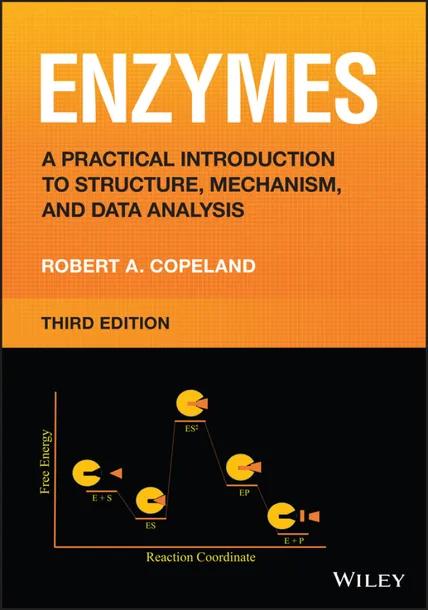
Enzymes
A Practical Introduction to Structure, Mechanism, and Data Analysis
by Robert A. Copeland
3rd Edition
Publisher: Wiley-Blackwell
Book Details
| Print ISBN | 9781119793250 |
| eText ISBN | 9781119793298 |
| Publisher | Wiley-Blackwell |
| Publishing Year | 2023 |
| Edition | 3rd Edition |
| Language | English |
| Pages | 576 |
Written by Robert A. Copeland, the 3rd Edition of *Enzymes: A Practical Introduction to Structure, Mechanism, and Data Analysis* is a 576-page biochemistry textbook designed for undergraduate students, graduate scholars, instructors, and laboratory practitioners. The volume establishes a clear framework linking physical enzyme structure directly to empirical data analysis in enzymology.
The thematic material synthesizes essential analytical methods across several fundamental biochemical topics. Readers explore quantitative approaches to protein-ligand binding equilibria, chemical catalytic mechanisms, and fundamental enzyme functions. These core topics prepare learners to process and interpret complex experimental measurements gathered during physical laboratory investigations.
A defining feature of this updated publication is the inclusion of expanded chapters dedicated to steady-state enzyme kinetics, transient-state enzyme kinetics, and structural components of enzymes. These expanded sections directly support upper-level coursework and offer ongoing analytical utility for practitioners working in academic laboratories or industrial research facilities.
Table of Contents
Chapter 1: A Brief History of Enzymology
- • Key Learning Points
- • 1.1 Enzymes in Antiquity
- • 1.2 Early Enzymology
- • 1.3 The Development of Mechanistic Enzymology
- • 1.4 Studies of Enzyme Structure
- • 1.5 Enzymology Today
- • 1.6 Summary
- • References and Further Reading
Chapter 2: Chemical Bonds and Reactions in Biochemistry
- • Key Learning Points
- • 2.1 Atomic and Molecular Orbitals
- • 2.2 Thermodynamics of Chemical Reactions
- • 2.3 Acid–base Chemistry
- • 2.4 Noncovalent Interactions in Reversible Binding
- • 2.5 Rates of Chemical Reactions
- • 2.6 Summary
- • References and Further Reading
Chapter 3: Structural Components of Enzymes
- • Key Learning Points
- • 3.1 The Amino Acids
- • 3.2 The Peptide Bond
- • 3.3 Amino Acid Sequence or Primary Structure
- • 3.4 Secondary Structure
- • 3.5 Tertiary Structure
- • 3.6 Subunits and Quaternary Structure
- • 3.7 Cofactors in Enzymes
- • 3.8 Conformational Dynamics and Enzyme Function
- • 3.9 Methods of Protein Structure Determination
- • 3.10 Summary
- • References and Further Reading
Chapter 4: Protein–Ligand Binding Equilibria
- • Key Learnings Points
- • 4.1 The Equilibrium Dissociation Constant, K d
- • 4.2 The Kinetic Approach to Equilibrium
- • 4.3 Binding Measurements at Equilibrium
- • 4.4 Graphic Analysis of Equilibrium Ligand-Binding Data
- • 4.5 Equilibrium Binding with Ligand Depletion (Tight Binding Interactions)
- • 4.6 Competition Among Ligands for a Common Binding Site
- • 4.7 Protein Dynamics in Receptor–Ligand Binding
- • 4.8 Orthosteric and Allosteric Ligand Binding Sites
- • 4.9 Experimental Methods for Measuring Ligand Binding
- • 4.10 Summary
- • References and Further Reading
Chapter 5: Steady-State Kinetics of Single-Substrate Enzyme Reactions
- • Key Learning Points
- • 5.1 The Time Course of Enzymatic Reactions
- • 5.2 Effects of Substrate Concentration on Velocity
- • 5.3 The Rapid Equilibrium Model of Enzyme Kinetics
- • 5.4 The Steady-State Model of Enzyme Kinetics
- • 5.5 The Significance of k cat and K m
- • 5.6 Experimental Measurement of k cat and K m
- • 5.7 Other Linear Transformations of Enzyme Kinetic Data
- • 5.8 Measurements at Low Substrate Concentrations
- • 5.9 Deviations From Hyperbolic Kinetics
- • 5.10 Summary
- • References and Further Reading
Chapter 6: Chemical Mechanisms in Enzyme Catalysis
- • Key Learning Points
- • 6.1 Substrate–Active Site Complementarity
- • 6.2 Rate Enhancement Through Transition State Stabilization
- • 6.3 Chemical Mechanisms for Transition State Stabilization
- • 6.4 The Serine Proteases: An Illustrative Example
- • 6.5 Enzymatic Reaction Nomenclature
- • 6.6 Summary
- • References and Further Reading
Chapter 7: Experimental Measures of Steady-State Enzyme Activity
- • Key Learning Points
- • 7.1 Initial Velocity Measurements
- • 7.2 Detection Methods
- • 7.3 Separation Methods in Enzyme Assays
- • 7.4 Factors Affecting the Velocity of Enzymatic Reactions
- • 7.5 Reporting Enzyme Activity Data
- • 7.6 Enzyme Stability
- • 7.7 Summary
- • References and Further Reading
Chapter 8: Transient-State Kinetics
- • Key Learning Points
- • 8.1 Timescale of Pre-Steady-State Turnover
- • 8.2 Instrumentation for Transient Kinetic Measurements
- • 8.3 Estimating Initial Conditions for Transient Kinetic Measurements
- • 8.4 Examples of Some Common Transient Kinetic Reaction Mechanisms
- • 8.5 Examples of Transient Kinetic Studies from the Literature
- • Deformylase
- • 8.6 Summary
- • References and Further Reading
Chapter 9: Enzyme Regulation
- • Key Learning Points
- • 9.1 Active and Inactive Conformational States
- • 9.2 Post-Translational Modifications
- • 9.3 Enzyme Regulation Through Protein–Protein Interactions
- • 9.4 Small-Molecule Allosteric Ligands
- • 9.5 Quantitative Measurements of Enzyme Activation and Inhibition
- • 9.6 Regulation of Protein Kinases
- • 9.7 Summary
- • References and Further Reading
Chapter 10: Reversible Inhibitors
- • Key Learning Points
- • 10.1 Equilibrium Treatment of Reversible Inhibition
- • 10.2 Thermodynamic Modes of Reversible Inhibition
- • 10.3 Effects of Inhibitors on Steady-State Parameters
- • 10.4 Concentration-Response Plots of Enzyme Inhibition
- • 10.5 Effects of Substrate Concentration on Inhibitor Concentration–Response Curves
- • 10.6 Mutually Exclusive Binding of Two Inhibitors
- • 10.7 Structure–Activity Relationships and Inhibitor Design
- • 10.8 Summary
- • References and Further Reading
Chapter 11: Tight-Binding Inhibitors
- • Key Learning Points
- • 11.1 Identifying Tight-Binding Inhibition
- • 11.2 Distinguishing Inhibitor Type for Tight-Binding Inhibitors
- • 11.3 Determining K I for Tight-binding Inhibitors
- • 11.4 Use of Tight-Binding Inhibitors to Determine Active Enzyme Concentration
- • 11.5 Summary
- • References and Further Reading
Chapter 12: Time-Dependent Inhibition
- • Key Learning Points
- • 12.1 Progress Curves for Slow-Binding Inhibitors
- • 12.2 Distinguishing Between Slow-Binding Schemes
- • 12.3 Distinguishing Between Modes of Inhibitor Interaction with Enzyme
- • 12.4 Determining Reversibility
- • 12.5 Examples of Slow-Binding Enzyme Inhibitors
- • 12.6 Summary
- • References and Further Reading
Chapter 13: Enzyme Reactions with Multiple Substrates
- • Key Learning Points
- • 13.1 Reaction Nomenclature
- • 13.2 Bi–Bi Reaction Mechanisms
- • 13.3 Distinguishing Between Random and Compulsory-Ordered Mechanisms by Inhibition Pattern
- • 13.4 Isotope Exchange Studies for Distinguishing Reaction Mechanisms
- • 13.5 Using the King–Altman Method to Determine Velocity Equations
- • 13.6 Cleland’s Net Rate Constant method for Determining v max and v max @k m
- • 13.7 Summary
- • References and Further Reading
Chapter 14: Enzyme–Macromolecule Interactions
- • Key Learning Points
- • 14.1 Mutlitprotein Enzyme Complexes
- • 14.2 Enzyme Reactions on Macromolecular Substrates
- • 14.3 Summary
- • References and Further Reading
Chapter 15: Cooperativity in Enzyme Catalysis
- • Key Learning Points
- • 15.1 Historic Examples of Cooperativity and Allostery in Proteins
- • 15.2 Models of Allosteric Behavior
- • 15.3 Effects of Cooperativity on Velocity Curves
- • 15.4 Sigmoidal Kinetics for Nonallosteric Enzymes
- • 15.5 Summary
- • References and Further Reading
Chapter 16: Evolution of Enzymes
- • Key Learning Points
- • 16.1 Early Earth Conditions
- • 16.2 Natural Selection
- • 16.3 Genetic Alterations
- • 16.4 Enzyme Families and Superfamilies
- • 16.5 Enzyme Promiscuity as a Springboard of Evolution
- • 16.6 Protein Dynamics and Conformational Selection in Evolution of Neofunctionality
- • 16.7 Ancestral Enzyme Reconstruction
- • 16.8 Contemporary Enzyme Evolution
- • 16.9 Summary
- • References and Further Reading
Chapter 17: Enzymes in Human Health
- • Key Learning Points
- • 17.1 Enzymes as Therapeutic Agents
- • 17.2 Enzyme Inhibitors as Therapeutic Agents
- • 17.3 Enzyme Essentiality in Disease
- • 17.4 Enzyme-Mediated Target Protein Degradation
- • 17.5 The Role of Enzymology in Drug Discovery and Development
- • 17.6 Summary
- • References and Further Reading
Customer Reviews
0.0
0 reviews
No reviews yet. Be the first to review this book!
Write a Review
Reviewed by GradeFocus Editorial Team
▶Research Sources (12)
- Enzymes: A Practical Introduction to Structure, Mechanism, and Data ...
- Enzymes by Copeland, Robert A. (9781119793298) | Akademika ...
- Enzymes A Practical Introduction... | Buy | 9781119793250
- Sourcebooks, LLC.
- Start reading Enzymes for free
- [PDF] Enzymes by Robert A. Copeland, 3rd edition - Perlego
- Textbook Catalogues - Routledge
- Thompson Learn.
- Enzymes - Hardcover [9781119793250] - BookPal
- 9781119793250 (1119793254) : Enzymes: A Practical Introduction to ...
- Books - ProductDetail - Mehul
- Enzymes, 3rd Edition by Robert A. Copeland - The Nile