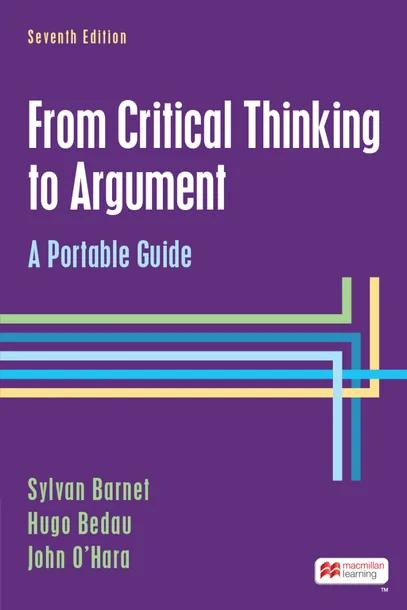
From Critical Thinking to Argument
A Portable Guide
by Sylvan Barnet, Hugo Bedau, John O'Hara
7th Edition
Publisher: Bedford/St. Martin's
Book Details
| Print ISBN | 9781319332129 |
| eText ISBN | 9781319485863 |
| Publisher | Bedford/St. Martin's |
| Publishing Year | 2023 |
| Edition | 7th Edition |
| Language | English |
From Critical Thinking to Argument, 7th Edition, is an introductory textbook authored by Sylvan Barnet, Hugo Bedau, and John O'Hara. Published by Bedford/St. Martin's, this volume provides core strategies for critical thinking, reading, and academic writing.
The text organizes essential composition practices into systematic thematic arcs. Instructions cover active reading techniques together with specific approaches for summarizing and paraphrasing source material. Additional sections guide learners through clustering and idea generation, evaluating proposals, and anticipating counterarguments to build reasoned academic positions.
Interactive tools integrated with the Achieve platform complement this 2023 release to support coursework. Intended primarily for students and instructors in introductory courses on critical thinking and argumentation, the textbook offers foundational guidance for academic readers and professionals refining their composition skills.
Table of Contents
Chapter 1: Critical Thinking
- • Thinking about Thinking
- • Thinking as a Citizen
- • Obstacles to Critical Thinking
- • An Essay on Types of Thinking (and Rethinking)
- • *Adam Grant, A Preacher, a Prosecutor, a Politician, and a Scientist
- • Thinking through an Issue
- • Evaluating a Proposal
- • Survey, Analyze, and Evaluate the Issue
- • VISUAL GUIDE: EVALUATING A PROPOSAL
- • Anticipating Counterarguments
- • Critical Thinking at Work: From a Cluster to a Short Essay
- • Alexa Cabrera, Stirred and Strained: Pastafarians Should Be Allowed to Practice in Prison (student essay)
- • Generating Ideas: Writing as a Way of Thinking
- • Confronting Unfamiliar Issues
- • Using Clustering to Discover Ideas
- • Approaching an Issue (or an Assignment)
- • Prompting Yourself: Classical Topics and Invention
- • An Essay for Generating Ideas
- • *Asao B. Inoue, Do Grades Help Students Learn in Classrooms?
- • THINKING CRITICALLY: Generating Ideas
- • Generating Ideas from Multiple Perspectives
- • A Checklist for Critical Thinking
- • A Short Essay Calling for Critical Thinking
- • *Anand Jayprakash Vaidya, The Inclusion Problem in Critical Thinking: The Case of Indian Philosophy
Chapter 2: Critical Reading: Getting Started
- • Framing Arguments
- • Active Reading
- • Previewing
- • A Checklist for Previewing and Skimming
- • A Short Essay for Previewing Practice
- • Thinking Critically: Previewing
- • Charles R. Lawrence III, On Racist Speech
- • Reading With a Careful Eye:Underlining, Highlighting, Annotating
- • Reading Fast and Slow
- • Summarizing and Paraphrasing
- • A Checklist for a Paraphrase
- • Patchwriting and Plagiarism
- • Strategies for Summarizing
- • Critical Summary
- • A Short Essay for Summarizing Practice
- • VISUAL GUIDE: WRITING A CRITICAL SUMMARY
- • Susan Jacoby, A First Amendment Junkie
- • A Checklist for a Summary
- • Essays for Analysis
- • Gwen Wilde, Why the Pledge of Allegiance Should Be Revised (student essay)
- • *Sohrab Ahmari, Porn Isn’t Free Speech — on the Web or Anywhere
Chapter 3: Understanding Rhetorical Appeals
- • Argument and Persuasion
- • Persuasive Appeals
- • THINKING CRITICALLY: Identifying Ethos
- • VISUAL GUIDE: EVALUATING PERSUASIVE APPEALS
- • Seeing the Appeals in Real-World Events
- • Unethical Uses of Rhetorical Appeals
- • Are Such Appeals Always Unethical?
- • Nonrational Appeals: Satire, Irony, Sarcasm
- • Does All Communication Contain Arguments?
- • Arguments for Analysis
- • Afrika Afeni Mills, A Letter to White Teachers of My Children
- • Dodai Stewart, The Case for a National One-Week Vacation
Chapter 4: Identifying Procedures of Argument
- • The Power and Perils of Reason
- • Rationalization
- • Confirmation Bias
- • Types of Reasoning
- • Induction
- • Deduction
- • Premises and Syllogisms
- • Testing Truth and Validity
- • A Checklist for Evaluating a Syllogism
- • Thinking Critically: Inductive and Deductive Reasoning
- • Some Procedures in Argument
- • Definitions
- • Thinking Critically: Analyzing Definitions
- • Evidence
- • THINKING CRITICALLY: Authoritative Testimony
- • A Checklist For Evaluating Statistical Evidence
- • Assumptions
- • A Checklist for Examining Assumptions
- • An Essay for Examining Assumptions
- • A Checklist For Examining Assumptions
- • An Example Argument and a Look at the Writer’s Strategies
- • John Tierney, The Reign of Recycling
Chapter 5: Visual Rhetoric: Thinking about Images as Arguments
- • Uses of Visual Images
- • Seeing versus Looking
- • Reading Advertisements
- • A Checklist for Analyzing Images
- • Detecting Emotional Appeals in Visual Culture
- • Reading Photographs
- • Do Photographs Always Tell the Truth?
- • A Checklist for Inspecting Digital Photographs
- • Are Some Images Not Fit to Be Shown?
- • A Checklist for Publishing Controversial Images
- • Accommodating, Resisting, and Negotiating the Meaning of Images
- • Writing about Political Cartoons and Memes
- • THINKING CRITICALLY: Analyzing Memes and Political Cartoons
- • An Example: A Student’s Essay Analyzing Images
- • Ryan Kwon, The American Pipe Dream? (student essay)
- • Visuals as Aids to Clarity: Maps, Graphs, and Pie Charts
- • A Checklist for Charts And Graphs
- • Using Visuals in Your Own Paper
Chapter 6: Writing an Analysis of an Argument
- • Analyzing an Argument
- • Examining the Author’s Thesis
- • Examining the Author’s Purpose
- • Examining the Author’s Methods
- • Examining the Author’s Persona
- • Examining the Author’s Audience
- • A Checklist for Analyzing an Author’s Intended Audience
- • Organizing Your Analysis
- • VISUAL GUIDE: ORGANIZING YOUR ANALYSIS
- • Summary versus Analysis
- • A Checklist for Analyzing a Text
- • An Argument, Its Elements, and a Student’s Analysis of the Argument
- • Nicholas D. Kristof, For Environmental Balance, Pick Up a Rifle
- • THINKING CRITICALLY: Examining Language to Analyze an Author’s Argument
- • The Essay Analyzed
- • Theresa Carcaldi, For Sound Argument, Drop the Jokes: How Kristof Falls Short in Convincing His Audience (student essay)
- • An Analysis of the Student’s Analysis
- • A Checklist for Writing an Analysis of an Argument
Chapter 7: Developing an Argument of Your Own
- • Planning an Argument
- • Getting Ideas: Argument as an Instrument of Inquiry
- • Brainstorming Strategies
- • Revision as Invention
- • The Thesis or Main Point
- • Raising the Stakes of Your Thesis
- • A Checklist For A Thesis Statement
- • THINKING CRITICALLY: “Walking the Tightrope”
- • Imagining an Audience
- • Addressing Opposition and Establishing Common Ground
- • A Checklist for Imagining an Audience
- • Drafting and Revising an Argument
- • The Title
- • The Opening Paragraphs
- • Organizing the Body of the Essay
- • VISUAL GUIDE: ORGANIZING YOUR ARGUMENT
- • Checking Transitions
- • THINKING CRITICALLY: Using Transitions in Argument
- • The Ending
- • Uses of an Outline
- • A Checklist for Organizing an Argument
- • Tone and the Writer’s Persona
- • THINKING CRITICALLY: Eliminating We, One, and I
- • A Checklist for Establishing Tone and Persona
- • Avoiding Sexist Language
- • Peer Review
- • A Checklist for Peer Review
- • A Student’s Essay, from Rough Notes to Final Version
- • Emily Andrews, Why I Don’t Spare “Spare Change” (student essay)
Chapter 8: Using Sources
- • Why Use Sources?
- • Entering a Discourse
- • Understanding Information Literacy
- • Choosing a Topic
- • A Checklist for Approaching a Topic
- • Finding Sources
- • VISUAL GUIDE: FINDING DISCOURSE ON YOUR TOPIC
- • Finding Quality Information Online
- • Finding Articles Using Library Databases
- • THINKING CRITICALLY: Using Search Terms
- • Locating Books
- • Evaluating Sources
- • Scholarly, Popular, and Trade Sources
- • Evaluating Online Sources
- • A Checklist for Identifying Reliable Websites
- • A Checklist for Identifying Fake News
- • Considering How Current Sources Are
- • A Checklist for Evaluating Sources
- • Performing Your Own Primary Research
- • Interviewing Peers and Local Authorities
- • Conducting Observations
- • Conducting Surveys
- • Research in Archives and Special Collections
- • Synthesizing Sources
- • Taking Notes
- • A Note on Plagiarizing
- • A Checklist for Avoiding Plagiarism
- • Compiling an Annotated Bibliography
- • Quoting from Sources
- • VISUAL GUIDE: INTEGRATING QUOTATIONS
- • Thinking Critically: Using Signal Phrases
- • Documentation
- • A Note on Footnotes (and Endnotes)
- • MLA Format: Citations within the Text
- • MLA Format: The List of Works Cited
- • An Annotated Student Research Paper in MLA Format
- • Lesley Timmerman, An Argument for Corporate Responsibility (student essay)
- • APA Format: Citations within the Text
- • APA Format: The List of References
- • An Annotated Student Research Paper in APA Format
- • Hannah Smith Brooks, Does Ability Determine Expertise? (student essay)
Chapter 9: A Philosopher’s View: The Toulmin Model
- • Understanding the Toulmin Model
- • VISUAL GUIDE: THE TOULMIN METHOD
- • Components of the Toulmin Model
- • The Claim
- • Grounds
- • Warrants
- • Backing
- • Modal Qualifiers
- • Rebuttals
- • THINKING CRITICALLY: Constructing a Toulmin Argument
- • Putting the Toulmin Method to Work: Responding to an Argument
- • *Jonathan Safran Foer, Saving the Planet Begins at Breakfast
- • Thinking with the Toulmin Method
- • A Checklist for Using the Toulmin Method
Chapter 10: A Logician’s View: Deduction, Induction, and Fallacies
- • Using Formal Logic for Critical Thinking
- • Deduction
- • Visual Guide: Deduction and Induction
- • Examples of Deduction
- • Induction
- • Observation and Inference
- • Probability
- • Mill’s Methods
- • Fallacies
- • VISUAL GUIDE: COMMON FALLACIES
- • Fallacies of Ambiguity
- • Fallacies of Presumption
- • Fallacies of Irrelevance
- • A Checklist for Evaluating an Argument with Logic
- • Additional Fallacies
- • THINKING CRITICALLy: Identifying Fallacies
- • Max Shulman, Love Is a Fallacy
Chapter 11: A Psychologist’s View: Rogerian Argument
- • Rogerian Argument: An Introduction
- • VISUAL GUIDE: ROGERIAN ARGUMENT
- • A Checklist for Analyzing Rogerian Argument
- • Carl R. Rogers, Communication: Its Blocking and Its Facilitation
- • *Lewis Oakley, Is It Time to Retire the Word “Privileged”?
Customer Reviews
0.0
0 reviews
No reviews yet. Be the first to review this book!
Write a Review
Reviewed by GradeFocus Editorial Team
▶Research Sources (12)
- From Critical Thinking to Argument, 7th Edition
- From Critical Thinking to Argument - ISBN 9781319485863
- From Critical Thinking to Argument 7th Edition | Sylvan Barnet
- From Critical Thinking to Argument A Portable Guide 7th
- From Critical Thinking to Argument: A Portable Guide [7 ed.] 1319332129
- Critical Reasoning: Books - LibGuides - West Coast University
- https://caccl-smccd.primo.exlibrisgroup.com/permal...
- From Critical Thinking to Argument A Portable Guide
- Critical Thinking to Argument Guide | PDF | Books | Thought
- From Critical Thinking to Argument A Portable Guide
- From critical thinking to argument : a portable guide : Barnet, Sylvan, author
- From Critical Thinking to Argument | Rent | 9781319332129