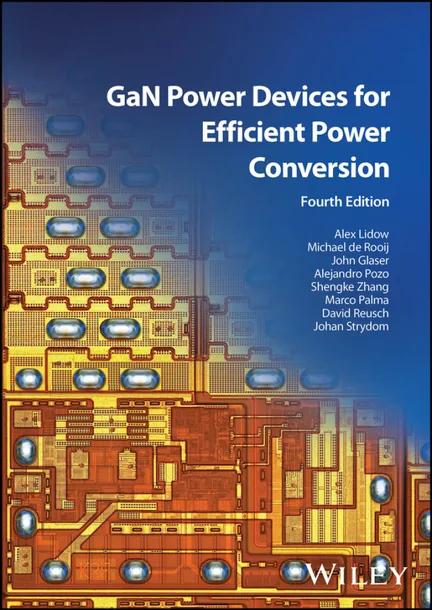
GaN Power Devices for Efficient Power Conversion
by Alex Lidow, Michael de Rooij, John Glaser
4th Edition
Publisher: Wiley
Book Details
| Print ISBN | 9781394286959 |
| eText ISBN | 9781394286973 |
| Publisher | Wiley |
| Publishing Year | 2024 |
| Edition | 4th Edition |
| Language | English |
| Pages | 496 |
GaN Power Devices for Efficient Power Conversion, 4th Edition presents an updated review of gallium nitride transistor design, technological advancements, and power electronics applications. The publication establishes a technical foundation intended for practicing power conversion engineers, electrical engineering students, and device scientists working within the field of power electronics.
The material organizes core concepts by examining fundamental power switching architectures alongside practical system designs. The text explicitly covers hard-switching topologies, resonant and soft-switching converters, and multilevel converters. It demonstrates how these circuit concepts operate in specific application contexts, including solar inverters, motor drive controllers, satellite electronics, and high-performance LiDAR devices.
Reflecting recent technological evolution in wide-bandgap semiconductors, this fourth edition incorporates key updates for space applications, vertical GaN, and methods for driving transistors and integrated circuits. This targeted technical coverage provides academic and professional readers with structured reference material for practical implementation.
Table of Contents
Chapter 1: GaN Technology Overview
- • 1.1 Silicon Power MOSFETs: 1976–2010
- • 1.2 The GaN Journey Begins
- • 1.3 GaN and SiC Compared with Silicon
- • 1.4 The Basic GaN Transistor Structure
- • 1.5 Building a GaN HEMT Transistor
- • 1.6 GaN Integrated Circuits
- • 1.7 Summary
Chapter 2: GaN Transistor Electrical Characteristics
- • 2.1 Introduction
- • 2.2 Device Ratings
- • 2.3 Gate Voltage
- • 2.4 On-Resistance (R DS(on))
- • 2.5 Threshold Voltage
- • 2.6 Capacitance and Charge
- • 2.7 Reverse Conduction
- • 2.8 Thermal Characteristics
- • 2.9 Summary
Chapter 3: Driving GaN Transistors
- • 3.1 Introduction
- • 3.2 Gate Drive Voltage
- • 3.3 Gate Drive Resistance
- • 3.4 dv/dt Considerations
- • 3.5 di/dt Considerations
- • 3.6 Bootstrapping and Floating Supplies
- • 3.7 Transient Immunity
- • 3.8 Gate Drivers and Controllers for Enhancement-Mode GaN Transistors
- • 3.9 Cascode, Direct Drive, and Higher-Voltage Configurations
- • 3.10 Using GaN Transistors with Drivers or Controllers Designed for Si MOSFETs
- • 3.11 Driving GaN ICs
- • 3.12 Summary
Chapter 4: Layout Considerations for GaN Transistor Circuits
- • 4.1 Introduction
- • 4.2 Origin of Parasitic Inductance
- • 4.3 Minimizing Common-Source Inductance
- • 4.4 Minimizing Power-Loop Inductance in a Half-Bridge Configuration
- • 4.5 Paralleling GaN Transistors
- • 4.6 Summary
Chapter 5: GaN Reliability
- • 5.1 Introduction
- • 5.2 Getting Started with GaN Reliability
- • 5.3 Determining Wear-Out Mechanisms Using Test-to-Fail Methodology
- • 5.4 Using Test-to-Fail Results to Predict Device Lifetime in a System
- • 5.5 Wear-Out Mechanisms
- • 5.6 Mission-Specific Reliability Predictions
- • 5.7 Summary
Chapter 6: Thermal Management of GaN Devices
- • 6.1 Introduction
- • 6.2 Thermal Equivalent Circuits
- • 6.3 Cooling Methods
- • 6.4 System-Level Thermal Overview: Single FET
- • 6.5 System-Level Thermal Analysis: Multiple FETs
- • 6.6 Experimental Thermal Examples
- • 6.7 Summary
Chapter 7: Hard-Switching Topologies
- • 7.1 Introduction
- • 7.2 Hard-Switching Loss Analysis
- • 7.3 External Factors Impacting Hard-Switching Losses
- • 7.4 Frequency Impact on Magnetics
- • 7.5 Buck Converter Example
- • 7.6 Summary
Chapter 8: Resonant and Soft-Switching Converters
- • 8.1 Introduction
- • 8.2 Resonant and Soft-Switching Techniques
- • 8.3 Key Device Parameters for Resonant and Soft-Switching Applications
- • 8.4 High-Frequency Resonant Bus Converter Example
- • 8.5 Summary
Chapter 9: RF Performance
- • 9.1 Introduction
- • 9.2 Differences Between RF and Switching Transistors
- • 9.3 RF Basics
- • 9.4 RF Transistor Metrics
- • 9.5 Amplifier Design Using Small-Signal s-Parameters
- • 9.6 Amplifier Design Example
- • 9.7 Summary
Chapter 10: DC–DC Power Conversion
- • 10.1 Introduction
- • 10.2 DC–DC Converter Examples
- • 10.3 Summary
Chapter 11: Multilevel Converters
- • 11.1 Introduction
- • 11.2 Benefits of Multilevel Converters
- • 11.3 Experimental Examples
- • 11.4 Summary
Chapter 12: Class D Audio Amplifiers
- • 12.1 Introduction
- • 12.2 GaN Transistor Class D Audio Amplifier Example
- • 12.3 Summary
Chapter 13: High Current Nanosecond Laser Drivers for Lidar
- • 13.1 Introduction to Light Detection and Ranging (Lidar)
- • 13.2 Pulsed Laser Driver Overview
- • 13.3 Basic Design Process
- • 13.4 Hardware Driver Design
- • 13.5 Experimental Results
- • 13.6 Additional Considerations for Laser Transmitter Design
- • 13.7 Summary
Chapter 14: Motor Drives
- • 14.1 Introduction
- • 14.2 Motor Types
- • 14.3 Inverter
- • 14.4 Typical Applications
- • 14.5 Voltage Source Inverters and Motor Control Basics
- • 14.6 Field-Oriented Control Basics
- • 14.7 Current Measurement Techniques
- • 14.8 Power Dissipation in Motor and Inverter
- • 14.9 Silicon Inverter Limitations
- • 14.10 LC Filter Dissipation
- • 14.11 Torque Sixth Harmonic Dissipation
- • 14.12 GaN Advantage
- • 14.13 GaN Switching Behavior
- • 14.14 Dead Time Elimination Effect
- • 14.15 PWM Frequency Increase Effect
- • 14.16 Layout Considerations for Motor Drives
- • 14.17 GaN Devices for Motor Applications
- • 14.18 Application Examples
- • 14.19 Summary
Chapter 15: GaN Transistors and Integrated Circuits for Space Applications
- • 15.1 Introduction
- • 15.2 Failure Mechanisms in Electronic Components Used in Space Applications
- • 15.3 Standards for Radiation Exposure and Tolerance
- • 15.4 Gamma Radiation
- • 15.5 Neutron Radiation (Displacement Damage)
- • 15.6 Single-Event Effects (SEE) Testing
- • 15.7 Performance Comparison Between GaN Transistors and Rad-Hard Si MOSFETs
- • 15.8 GaN Integrated Circuits
- • 15.9 Summary
Chapter 16: Replacing Silicon Power MOSFETs
- • 16.1 Introduction: GaN, Rapid Growth/Great Future
- • 16.2 New Capabilities Enabled by GaN Devices
- • 16.3 GaN Devices Are Easy to Use
- • 16.4 GaN Cost Reduction over Time
- • 16.5 GaN Devices Are Reliable
- • 16.6 Future Direction of GaN Devices
- • 16.7 Summary
Chapter Appendix: Glossary of Terms
Customer Reviews
0.0
0 reviews
No reviews yet. Be the first to review this book!
Write a Review
Reviewed by GradeFocus Editorial Team
▶Research Sources (13)
- 9781394286973: GaN Power Devices for Efficient Power ...
- GaN Power Devices for Efficient Power Conversion - ritograk.fo
- GaN Power Devices for Efficient Power Conversion - Alex Lidow
- GaN Power Devices for Efficient Power Conversion
- GaN Power Devices for Efficient Power Conversion (ebook), Alex ...
- Untitled
- GaN Power Devices for Efficient Power Conversion - Kobo
- Georgia Law Review - Mixam
- GaN Power Devices for Efficient Power Conversion - EPC Co
- GaN Power Devices for Efficient Power Conversion - IEEE Xplore
- EPC Announces 4th Edition of 'GaN Power Devices for Efficient Power ...
- EPC Releases 4th Edition of 'GaN Power Devices for High-Efficiency ...
- EPC Announced 4th Edition of 'GaN Power Devices for Efficient Power ...
Related Books

Electronics Use in Harsh Environments
Rajan Ambat

Digital Design using VerilogHDL
Shilpi Birla
Artificial Intelligence Empowered Smart Energy Systems
Qiang Yang
Stability Analysis of Converter-Rich Power Grids
Jun Liang
Multiphase Power Electronic Converters
Salman Ahmad

Robust Dynamic State Estimation of Power Systems
Junbo Zhao