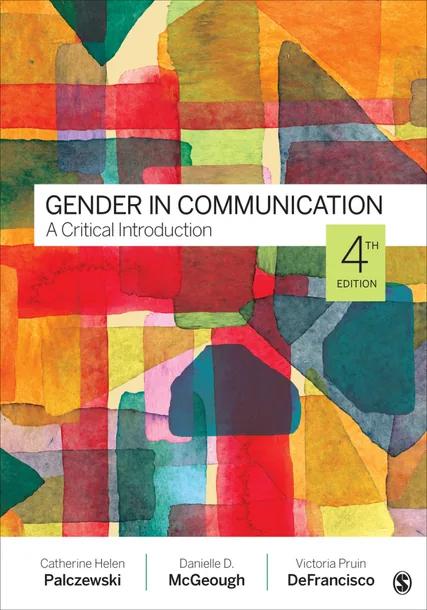
Gender in Communication
A Critical Introduction
by Catherine Helen Palczewski, Danielle D. McGeough, Victoria Pruin DeFrancisco
4th Edition
Publisher: SAGE Publications, Inc.
Book Details
| Print ISBN | 9781071852927 |
| eText ISBN | 9781071852941 |
| Publisher | SAGE Publications, Inc. |
| Publishing Year | 2023 |
| Edition | 4th Edition |
| Language | English |
| Pages | 306 |
*Gender in Communication: A Critical Introduction, 4th Edition* is an academic textbook that explores how gender influences human interaction and how communicative acts construct cultural concepts of gender. Authors Catherine Helen Palczewski, Danielle D. McGeough, and Victoria Pruin DeFrancisco provide structured analytical frameworks for students examining these intersecting dynamics.
The text equips students with critical analysis tools to evaluate gender processes through an intersectional framework. Initial chapters move past simple binary sex differences by advocating a broader gender diversity perspective. The authors ground this inquiry in social construction theory while outlining biological, psychological, and critical or cultural theories of gender and sex.
Published by SAGE Publications, Inc., this textbook addresses specialized topics such as single-sex education alongside critical institutional analyses of gender. The material supports students pursuing coursework in communication studies and language arts disciplines who seek to evaluate how gender operates across public and private social spheres.
Table of Contents
Chapter 1: Developing a Critical Gender/Sex Lens
- • Gender Diversity in Communication (Instead of Sex Differences)
- • Intersectionality
- • Gender and Sex, Gender/Sex
- • Sexuality and Romantic Attraction
- • Race and Ethnicity
- • National Identity
- • Socioeconomic Class
- • Intersectionality Conclusion
- • Communication
- • Systemic Gendered Violence
- • Conclusion
- • Key Concepts
- • Discussion Questions
Chapter 2: Theories of Gender/Sex
- • Biological Theories
- • Chromosomes (Hormones and Genitalia)
- • Brains
- • Biological Mosaic Instead of Dimorphism
- • Biological Theories Conclusion
- • Psychological Theories
- • Psychoanalysis and Psychoanalytic Feminism
- • Social Learning
- • Psychological Theories Conclusion
- • Critical/Cultural Theories
- • Shared Premises
- • Critical/cultural approaches share at least four central premises
- • Social reality is communicatively constructed.
- • Categories such as sex, gender, sexuality, and race become the focus of criticism.
- • To study gender/sex you also must study power and systems of hierarchy.
- • Oppositional critical views are necessary to critique hegemonic norms.
- • Multiracial and Global Feminisms
- • Queer Theory
- • Critical/Cultural Theories Conclusion
- • Applying Gender Theory: Some Useful Criteria
- • Criterion 1: Is an intersectional approach being used?
- • Criterion 2: Is the focus on communication?
- • Criterion 3: Does the source recognize unique context-dependent influences on behaviors?
- • Criterion 4: Are there possible power implications?
- • Conclusion
- • Key Concepts
- • Discussion Questions
Chapter 3: Gendered/Sexed Voices
- • Vocal Fry
- • Code-Switching
- • Interacting Voices
- • Conversation Work
- • Politeness
- • Swearing
- • Identity Work
- • Feminine Conversational Style
- • Masculine Conversational Style
- • Gay and Lesbian Conversational Styles
- • Trans and Gender Non-Conforming Conversational Styles
- • Relationship Work
- • Consent
- • Conversational Aggression
- • Conclusion
- • Key Concepts
- • Discussion Questions
Chapter 4: Gendered/Sexed Bodies
- • Body Politics
- • Gender Performativity
- • Objectification
- • Disciplining Gendered Bodies
- • Attractiveness
- • Attractive Men
- • Attractive Women
- • Clothing
- • Embodied Space
- • Embodied Movement
- • Refusing the Command Performance
- • Agency
- • Using Norms Against Each Other
- • Making Norms Visible
- • Overtly Challenging Norms
- • Revaluing the Body
- • Conclusion
- • Key Concepts
- • Discussion Questions
Chapter 5: Gendered/Sexed Language
- • The Power of Language
- • Terministic Screens
- • Patriarchal Universe of Discourse
- • Language Can Be Used to Oppress and Subordinate
- • He/Man Language
- • Semantic Derogation
- • Semantic Polarization
- • Semantic Imbalance
- • Marked and Unmarked Terms
- • Trivialization
- • Naming
- • Lack of Vocabulary
- • The Truncated Passive
- • The Falsely Universal We
- • The Deverbing of Woman
- • Language as Violence
- • Language as Resistance
- • Talking Back
- • Developing New Language
- • Resignification
- • Strategic Essentialism and Rhetorics of Difference
- • Moving Over
- • Conclusion
- • Key Concepts
- • Discussion Questions
Chapter 6: An Introduction to Gender in Social Institutions
- • Social Institutions and Gender
- • Prejudice Versus Institutionalized Discrimination
- • Institutional Control
- • Institutionalized Gendered/Sexed Violence
- • Preview
- • Key Concepts
- • Discussion Questions
Chapter 7: Families
- • Defining Family and Gender/Sex Roles
- • The Nuclear Family
- • The State of Families
- • Doing and Undoing Motherhood
- • Communicating in Families
- • Parent–Child Communication
- • Couple Communication
- • Domestic Labor
- • Family Leave
- • (Un)Doing Family
- • Singles and Childfree People
- • Creative Undoing of Family
- • Engaged Fatherhood
- • Same-Sex Parents
- • Raising Transgender Children
- • Conclusion
- • Key Concepts
- • Discussion Questions
Chapter 8: Education
- • The Politics of Knowledge
- • The History of Education: Gendered/Sexed, Raced, and Classed
- • Hidden Curriculum: Sexist, Racist, Classist, and Heterosexist
- • Gendered Expectations and Interpersonal Communication
- • Classroom Interactions
- • Bullying, Harassment, and Sexual Assault
- • Emancipatory Education
- • Curricula
- • Laws
- • Globally
- • Conclusion
- • Key Concepts
- • Discussion Questions
Chapter 9: Work
- • Work Is Sexed/Gendered
- • Pay Equity and Job Segregation
- • Sex Discrimination in the Workplace
- • Work as Liberation and Locations of Empowerment
- • Conclusion
- • Key Concepts
- • Discussion Questions
Chapter 10: Religion
- • Why Study Religion, Gender, and Communication?
- • Religion and Gender/Sex Roles
- • Gender, Sex, and Religiosity
- • Sex and Institutional Religious Power
- • Complementarians and Egalitarians
- • Muscular Christianity
- • Religion and Sexuality
- • Religion as Liberation and Locations of Empowerment
- • African Americans and Religion
- • Veiling Practices
- • Conclusion
- • Key Concepts
- • Discussion Questions
Chapter 11: Media
- • Defining Media and How They Function
- • Media Hegemony or Polysemy
- • Media Polyvalence
- • The Gaze(s)
- • Ways of Seeing
- • The Gaze
- • An Oppositional Gaze
- • Who Is Represented in Media
- • News
- • Film
- • Television and Scripted Programming
- • Video Games
- • How People Are Represented
- • Sexualization of Women
- • “Masculinity in Crisis”
- • Digital Blackface, Shadow Banning, and Digital Whiteness
- • Conclusion
- • Key Concepts
- • Discussion Questions
Chapter 12: One Last Look Through a Critical Gendered Lens
- • Gender Diversity in Communication
- • Intersectionality
- • Gendered Institutions
- • Conclusion: Our Hopes
- • Discussion Questions
Customer Reviews
0.0
0 reviews
No reviews yet. Be the first to review this book!
Write a Review
Reviewed by GradeFocus Editorial Team
▶Research Sources (13)
- Gender in Communication - Sage College Publishing
- Gender in Communication by: Catherine Helen Palczewski
- Gender in Communication: A... | Rent | 9781071852927
- Gender in Communication - ISBN 9781071852941
- Gender in Communication: A Critical Introduction
- Gender in Communication A Critical Introduction [4 
- Gender in Communication, eBook by Catherine Helen ...
- STREAMLINED COM 307 GENDER IN COMMUNICATION
- Gender in Communication: A Critical Introduction
- Gender in Communication: A Critical Introduction
- Gender in Communication: A Critical Introduction
- Gender in Communication | Rent | 9781071852927
- A Critical Introduction, 4th edition : r/textbook