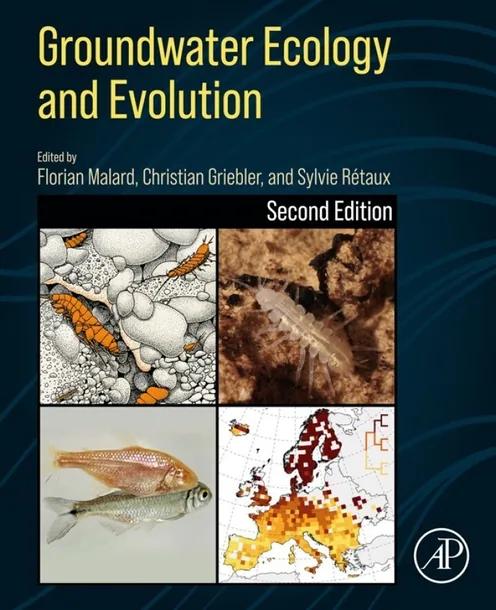
Groundwater Ecology and Evolution
by Florian Malard, Christian Griebler, Sylvie Rétaux
2nd Edition
Publisher: Academic Press
Book Details
| Print ISBN | 9780128191194 |
| eText ISBN | 9780128191200 |
| Publisher | Academic Press |
| Publishing Year | 2023 |
| Edition | 2nd Edition |
| Language | English |
Groundwater Ecology and Evolution (2nd Edition) delivers an integrated scientific framework bridging community ecology, evolutionary biology, and functional ecology to examine subterranean biological systems. The volume addresses the specialized research needs of graduate students, post-graduate students, and academic researchers working in ecology, evolution, and subsurface biology.
The material synthesizes physical drivers and environmental processes that structure underground habitats. Initial chapters examine hydrodynamics, geomorphology, ecosystem classification, and physical or biogeochemical hyporheic exchange processes in alluvial rivers. Content then advances to environmental constraints on biological distribution, community richness, species composition, and speciation dynamics within subterranean systems.
A defining structural feature is the thorough investigation of evolutionary principles using key subterranean animal models. The text evaluates adaptive trait development through case studies of Astyanax mexicanus, Proteus anguinus, Asellus aquaticus, and Gammarus minus. This empirical grounding prepares researchers to evaluate ecological dynamics and functional traits across diverse subsurface habitats.
Table of Contents
Chapter 1: Hydrodynamics and geomorphology of groundwater environments
- • Introduction
- • The aquifer concept
- • Drivers of groundwater flow
- • Aquifer hydrodynamics
- • Porosity
- • Permeability and hydraulic conductivity
- • Geologic types of aquifers
- • Links to surface hydrology
- • Aquifer function
- • Flow and transport in aquifers
- • Groundwater age
- • Modeling aquifers
- • The chemical composition of groundwater
- • Origin of chemical compounds in surface waters
- • Water–rock interactions within aquifers
- • Major water quality types
- • Reduced environments
- • Chemical and nutrient fluxes in aquifers
- • Biogeochemical reactions
- • Oxygen in groundwater
- • Nitrogen and emerging contaminants in groundwater
- • Conclusion
- • Acknowledgments
- • References
Chapter 2: Classifying groundwater ecosystems
- • Introduction
- • Classification systems
- • Global scale
- • Continental scale
- • Landscape scale
- • Habitat/local scale
- • Compact aquifers
- • Unconsolidated sediment aquifers
- • Fractured aquifers
- • Karst aquifers
- • Ecotonal groundwater habitats
- • Conclusions
- • Glossary
- • Acknowledgments
- • References
Chapter 3: Physical and biogeochemical processes of hyporheic exchange in alluvial rivers
- • Introduction
- • The hyporheic zone
- • Predicting hyporheic exchange
- • Bedform scale
- • Reach and landscape scales
- • The role of hyporheic flow on water quality
- • Conclusion
- • Acknowledgments
- • References
Chapter 4: Ecological and evolutionary jargon in subterranean biology
- • Introduction
- • Ecological classifications
- • Schiødte's classification and two possible explanations
- • Modern ecological classifications
- • Critique and alternative classifications
- • Colonization and speciation
- • Climatic Relict and Adaptive Shift hypotheses and their historical background
- • Critique of CRH and ASH
- • Alternative terminology: swinging the pendulum from geography to processes generating reproductive isolation
- • Should we retire the CRH and ASH as formal categories?
- • Morphological modification for subterranean life
- • Troglomorphy and the nature of selection
- • Case studies of troglomorphy
- • Overall recommendations
- • Glossaries
- • Aim and scope of two glossaries
- • Eco-Evo Glossary
- • Retired Speleobiological Glossary
- • Acknowledgments
- • References
Chapter 5: Groundwater biodiversity and constraints to biological distribution
- • Introduction
- • An overview of groundwater biodiversity
- • Viruses
- • Prokaryotes: Archaea and Bacteria
- • Microeukaryotes
- • Metazoans
- • Physical constraints to biological distribution
- • Size of voids and their interconnectedness
- • Hydrological connection to the surface environment
- • Temperature
- • Chemical constraints to biological distribution
- • Groundwater chemistry
- • Oxygen content and organic matter
- • Species interactions
- • Species interactions in surface water—groundwater ecotones
- • Species interactions in groundwater
- • The effect of the past: paleogeographic events and historical climates
- • Conclusion
- • Acknowledgments
- • References
Chapter 6: Patterns and determinants of richness and composition of the groundwater fauna
- • Introduction
- • Patterns of species richness
- • Defining local and regional species richness
- • Local species richness patterns
- • Regional species richness patterns
- • Europe
- • North America
- • South America
- • Global pattern of species richness
- • Patterns of species composition
- • Variation in species composition among localities within a region
- • Variation in species composition among regions
- • Toward a multifaceted approach to groundwater biodiversity patterns
- • Acknowledgments
- • References
Chapter 7: Phylogenies reveal speciation dynamics: case studies from groundwater
- • Introduction
- • Single colonization versus multiple colonizations from surface ancestors
- • Speciation from subterranean ancestors
- • Speciation from subterranean ancestors: likely mechanisms
- • Drivers of subterranean diversity: the role of paleoclimatic and paleogeological events
- • Tethys Ocean, plate tectonics and marine regression-transgression cycles
- • Climatic oscillations
- • New karst areas
- • Synthesis and future prospects
- • Acknowledgments
- • References
Chapter 8: Dispersal and geographic range size in groundwater
- • Introduction
- • Evolution of dispersal
- • Extrinsic factors
- • Environmental heterogeneity in space and time
- • Environmental cues to disperse
- • The dispersal-ecological specialization trade-off
- • Interspecific interactions
- • Intrinsic factors
- • Body size
- • Reproductive strategies
- • Inbreeding
- • Intraspecific interactions
- • Range size
- • Groundwater landscape connectivity modulates dispersal
- • Conclusion
- • Acknowledgments
- • References
Chapter 9: Microbial diversity and processes in groundwater
- • Introduction
- • Ecological processes determining microbial community diversity and composition
- • Importance of environmental conditions, dispersal, and species interactions
- • Differences between planktonic and surface-attached microbial communities
- • Implications of assembly processes for community functioning and knowledge gaps
- • Microbial communities and biogeochemical cycles
- • The role of microbial networks in the cycling of DOM, nitrogen, and other elements
- • Chemolithoautotrophy in groundwater
- • Toward predictive models of microbial communities and biogeochemical fluxes
- • Microbial attenuation of groundwater contaminants and bottlenecks
- • Petroleum hydrocarbons
- • Chlorinated organic compounds
- • Toxic metals and metalloids
- • Emerging organic contaminants and micropollutants
- • Resistance and resilience of groundwater microbial communities to perturbations
- • Outlook
- • Acknowledgments
- • References
Chapter 10: Groundwater food webs
- • Introduction
- • Basal energy dynamics in groundwater food webs
- • Detrital food webs
- • Transport
- • Transfer to higher trophic levels
- • Chemolithoautotrophic food webs
- • The role of habitat in groundwater food web dynamics
- • Network structure
- • Surface-subsurface connectivity
- • The role of food web processes in groundwater community dynamics
- • Trophic niche diversification in groundwater ecosystems
- • Future directions
- • Unpacking the microbial compartment of groundwater food webs
- • Clarifying and quantifying food web structure
- • Natural abundances of stable isotopes and mixing models
- • Radiocarbon (14C) natural abundance
- • Artificially enriched tracer compounds
- • Compound specific methods
- • Acknowledgments
- • References
Chapter 11: Role of invertebrates in groundwater ecosystem processes and services
- • Introduction
- • Trophic actions of invertebrates
- • Karst systems
- • Alluvial systems
- • Ecosystem engineering activities by invertebrates
- • Conceptual model of the role of invertebrates on ecosystem processes and consequences for ecosystem services
- • Environmental impacts on surface water–groundwater interfaces and consequences for the provision of ecosystem services by i ...
- • Suggestions for future research directions
- • Acknowledgments
- • References
Chapter 12: Voices from the underground: animal models for the study of trait evolution during groundwater colonization an ...
- • Introduction
- • Brief historical timeline
- • Groundwater model systems
- • Troglomorphic traits
- • Reductive traits
- • Constructive traits
- • Other traits
- • Timeline of troglomorphic trait evolution
- • Evolutionary developmental biology of groundwater organisms
- • Loosing eyes
- • The many ways to lose eyes during development
- • Exchanging eyes for other senses during development
- • Evolutionary genomics of groundwater organisms
- • Coding mutations
- • Regulatory changes
- • Conclusions
- • Acknowledgments
- • References
Chapter 13: The olm (Proteus anguinus), a flagship groundwater species
- • Introduction
- • The historical rise to fame
- • Systematics and evolution
- • Molecular ecology and conservation genetics
- • Morphology and sensory systems of a groundwater top predator
- • Reproductive peculiarities
- • The overlooked part of groundwater ecology: symbioses, pathogens and parasites
- • Conservation
- • Conclusive remarks on flagship species in groundwater
- • Acknowledgments
- • References
Chapter 14: The Asellus aquaticus species complex: an invertebrate model in subterranean evolution
- • Introduction
- • Phylogeography and population structure
- • A widespread surface species with local subterranean populations budding off
- • Subterranean populations
- • Phenotypic evolution of subterranean populations
- • Morphology
- • Behavior
- • Physiology
- • Life history
- • Raising and breeding in the laboratory
- • Genetic basis of subterranean-related traits
- • Evolutionary development (evo-devo)
- • Comparative transcriptomics
- • Conclusions and prospect
- • Acknowledgments
- • References
Chapter 15: Developmental and genetic basis of troglomorphic traits in the teleost fish Astyanax mexicanus
- • The history of genetic and genomic studies of troglomorphy in Astyanax
- • Classical genetic studies
- • Candidate gene studies
- • QTL mapping
- • Transcriptomics
- • Genomics
- • Developmental basis of troglomorphy in Astyanax
- • Developmental basis of eye regression
- • Developmental basis of constructive traits
- • Developmental constraints for cavefish evolution
- • Embryonic origins of cavefish evolution
- • Conclusions
- • Acknowledgments
- • References
Chapter 16: Ecological and evolutionary perspectives on groundwater colonization by the amphipod crustacean Gammarus minus
- • Introduction
- • Ecological setting and morphological variation
- • Upstream colonization of subterranean waters by Gammarus minus
- • Impetus for colonizing cave streams
- • Size-selective predation, sexual selection and cave colonization
- • Multiple independent colonization of cave streams
- • Allozyme variation
- • COI and ITS sequences
- • Evolutionary perspectives
- • Eye development gene expression
- • Opsins show No loss of functional constraints in cave populations
- • Changes in gene expression associated with adaptation to the cave habitat
- • Evidence for positive selection
- • Photolyase
- • Melanin pigment loss and innate immunity
- • Future directions
- • Acknowledgments
- • References
Chapter 17: Evolutionary genomics and transcriptomics in groundwater animals
- • Introduction
- • Evolution of genes and genome architecture
- • Cavefish genomics and gene decay
- • Isopods genomics
- • Genome size evolution
- • Molecular evolution rate in subterranean habitats
- • Life history traits
- • Environmental radiation
- • Elemental composition of genomes, transcriptomes and proteomes in subterranean habitats
- • Evolution of gene expression in groundwater
- • Cavefish transcriptomics
- • Arthropod transcriptomics
- • Conclusion
- • Acknowledgments
- • References
Chapter 18: Dissolving morphological and behavioral traits of groundwater animals into a functional phenotype
- • Introduction
- • Habitat template
- • Morphological-behavioral functional phenotype
- • Sensory input
- • Morphology
- • Behavior and its interaction with morphology
- • Beyond the darkness
- • Locomotion
- • Feeding
- • Energy-saving mechanisms
- • Differentiation with respect to type of food
- • Reproduction
- • Habitat choice and adaptation to specific habitats
- • Antipredation mechanisms
- • Synthesis and perspectives
- • Acknowledgments
- • References
Chapter 19: Life histories in groundwater organisms
- • Introduction
- • A brief overview of life history evolution, life history traits, and life table variables
- • The current conceptual model of life history evolution in groundwater species
- • Support for the current conceptual model of life history evolution in groundwater species
- • Expanding the conceptual model of life history evolution in groundwater species
- • The environment and life history plasticity
- • Trade-offs among life history, morphological, and physiological traits
- • Life history evolution and population demography
- • Linking life history traits to molecular evolution
- • Conclusions
- • Acknowledgments
- • References
Chapter 20: Physiological tolerance and ecotoxicological constraints of groundwater fauna
- • Introduction
- • Physiological tolerance of groundwater invertebrates to changing thermal conditions
- • Tolerance to cold
- • Tolerance to heat
- • Insights and future perspectives for global warming scenarios
- • Physiological tolerance of groundwater organisms to chemical stress
- • Pattern of tolerance to chemicals
- • Pattern of environmental risk
- • Insights and future perspectives
- • Physiological tolerance of groundwater organisms to light, food and oxygen variations: indications for ecotoxicological pro ...
- • Tolerance to light
- • Tolerance to oxygen depletion
- • Tolerance to starvation
- • Conclusions
- • Acknowledgments
- • References
Chapter 21: Global groundwater in the Anthropocene
- • Introduction
- • Groundwater availability and distribution
- • Global distribution
- • Interactions
- • Climate
- • Sustainable groundwater use and management
- • Frameworks for sustainable use of groundwater in the Anthropocene
- • Groundwater and its link to the United Nations Sustainable Development Goals
- • Planetary boundary of freshwater use
- • Anthropogenic threats to groundwater
- • Depletion
- • Seawater intrusion
- • Global groundwater quality
- • Outlook
- • Glossary
- • Acknowledgments
- • References
Chapter 22: Assessing groundwater ecosystem health, status, and services
- • Introduction
- • Assessing ecosystem health and condition
- • Current approaches in surface and groundwaters
- • Indicators of ecosystem health and condition
- • Organizational indicators for assessing health
- • Functional indicators for assessing health
- • Stress indicators for assessing health
- • Defining the reference condition for groundwater ecosystems
- • Combining indicators into summary indices
- • Predicting ecosystem health and condition
- • Future directions
- • Acknowledgments
- • References
Chapter 23: Recent concepts and approaches for conserving groundwater biodiversity
- • Introduction
- • Past concepts and approaches in groundwater biodiversity conservation
- • Past concepts of groundwater biodiversity
- • Past approaches to groundwater conservation
- • Initial impediments to groundwater conservation
- • Recent concepts and approaches in groundwater biodiversity conservation
- • Environmental DNA and metabarcoding
- • Vulnerability mapping
- • Conserving hotspots of groundwater biodiversity and endemism
- • Conservation biogeography of subterranean species
- • Systematic conservation planning approaches
- • Conclusion and future directions
- • Acknowledgments
- • References
Chapter 24: Legal frameworks for the conservation and sustainable management of groundwater ecosystems
- • Introduction
Customer Reviews
0.0
0 reviews
No reviews yet. Be the first to review this book!
Write a Review
Reviewed by GradeFocus Editorial Team
▶Research Sources (18)
- Groundwater Ecology and Evolution | Rent | 9780128191200
- Groundwater Ecology and Evolution 2nd Edition by Florian ...
- eBook Details
- eBook Details | GCTC Campus Store | BibliU
- Groundwater Ecology and Evolution - - e-kirja (9780128191200)
- E-raamat: Groundwater Ecology and Evolution
- Groundwater Ecology and Evolution (ebook) | 9780128191200 ... - Bol
- Recent concepts and approaches for conserving ...
- PDF Groundwater Ecology and Evolution 2nd Edition by Florian ...
- Groundwater Ecology and Evolution - 2nd Edition
- Groundwater Ecology and Evolution
- Groundwater Ecology and Evolution, 2nd Edition
- Groundwater Ecology And Evolution [2 ed.] 9780128191194
- Groundwater Ecology and Evolution (Second Edition)
- Groundwater Ecology and Evolution by Griebler
- Groundwater Ecology and Evolution
- Groundwater Ecology and Evolution
- Groundwater Ecology and Evolution